Pipetting Made Easy - Part 3: Pipette Selection
KNAUER: Pipetting Made Easy
The Ultimate Guide to Choosing the Right Pipette for Your Lab
Pipettes are among the most frequently used tools in almost every laboratory, from life sciences to analytical chemistry. Yet with so many formats and mechanisms available, choosing the most suitable pipette for a particular workflow is not always straightforward. In this article, we’ll look at what a pipette is, the major pipette types and how they function, their advantages and limitations, and help you understand when each option is the best fit.
So, what is a pipette?
A pipette is a laboratory tool used to measure and transfer relatively small quantities of liquid from one vessel to another.
Pipettes range from simple glass or plastic Pasteur and serological pipettes to highly precise micropipettes, including single-channel, multichannel, manual, and electronic models with fine volume adjustment. The right choice depends on factors such as required accuracy and precision, ease of operation, and compatibility with specific liquids and laboratory workflows.
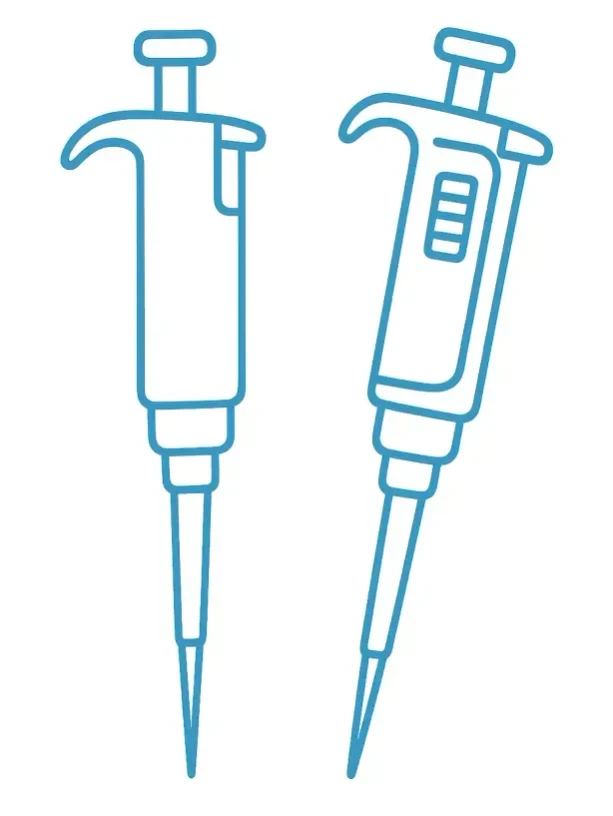
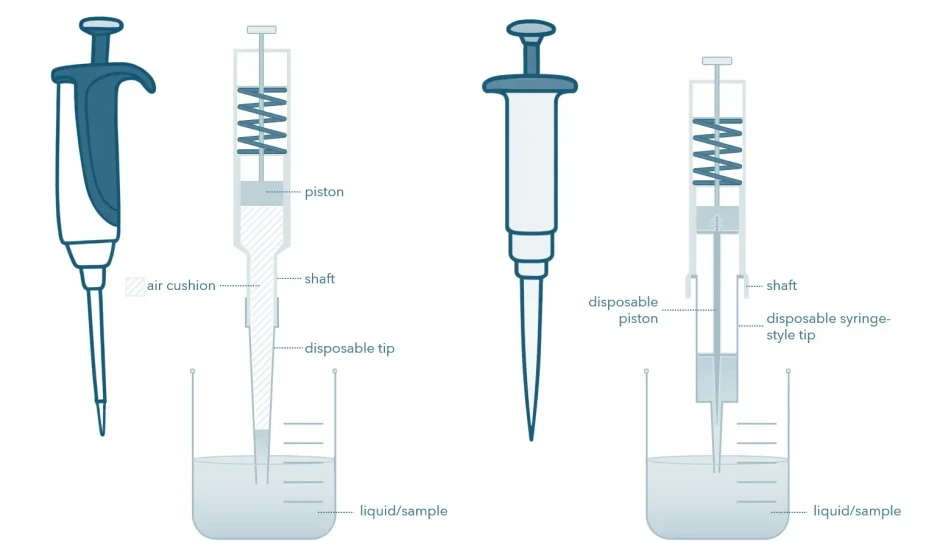 KNAUER: Figure 1 - Air displacement (left) and positive displacement (right) pipette systems.
The different types of pipettes and how they work
Air Displacement Pipettes
How they work
Air displacement pipettes are probably the most widely used type of micropipette. Their operation is based on a piston moving inside the pipette body. Between the piston and the liquid contained in the tip is a small cushion of air.
During aspiration, movement of the piston first pushes air out of the system. As the piston returns upward, a partial vacuum is created, drawing liquid into the tip. During dispensing, the piston compresses the air cushion and forces the liquid out.
Advantages
Because air displacement pipettes are so common, there is a wide selection of manufacturers, models, and compatible tips available. They are also generally a cost-effective choice for routine laboratory work.
Downsides
The air cushion is influenced by the physical properties of the liquid, including viscosity, density, temperature, and volatility, as well as by environmental conditions such as ambient temperature and atmospheric pressure.
Accuracy and precision may also decline when the pipette is operated near the lower end of its specified volume range.
When to Use
Air displacement pipettes are an excellent choice for routine laboratory applications involving standard aqueous liquids, such as buffers and similar solutions.
Positive Displacement Pipettes
How they work
In a positive displacement pipette, the piston comes into direct contact with the sample and is typically integrated into the disposable tip. This design eliminates the air cushion between the piston and the liquid.
That makes positive displacement pipettes particularly suitable for samples that would otherwise interfere with air displacement performance, including viscous, volatile, hot, cold, and foaming liquids.
Advantages
Because there is no air cushion, positive displacement systems are less sensitive to differences in viscosity, volatility, and temperature. When difficult liquids are involved, this mechanism generally provides more reliable and accurate dispensing.
Downsides
The main disadvantage is usually the higher cost of consumables, because these pipettes require specific piston-tip systems or special tips.
Most laboratories rely primarily on air displacement pipettes. However, if highly viscous or volatile samples are handled regularly, positive displacement pipettes may be the better option.
When to Use
Positive displacement pipettes are particularly useful for liquids with challenging characteristics, such as high viscosity, strong volatility, temperature differences, or a tendency to foam, and whenever maximum reliability is required.
They can also be considered as an alternative to filtered tips used with air displacement pipettes when contamination control is especially important. Because the piston is contained within the disposable tip and does not contact the pipette body, the risk of cross-contamination can be reduced. This is useful in sensitive workflows such as DNA/RNA analysis or when handling hazardous samples.
Want to learn more about working with challenging liquids? Take a look at the second article in our “Pipetting Made Easy” series.
Within both pipetting mechanisms described above, particularly air displacement pipettes, several additional classifications are commonly used.
Fixed vs Adjustable Volume Pipettes
- Fixed-volume pipettes are designed to dispense one predefined volume that cannot be changed. Although this makes them less versatile, they often deliver very high accuracy and precision at that specific volume.
- Adjustable-volume pipettes allow the user to select a volume within a defined operating range. They provide significantly more flexibility and are therefore useful for a wide variety of tasks. However, accuracy and precision may decrease when they are routinely used near the lowest end of their specified range.
 KNAUER: Fixed vs Adjustable Volume Pipettes
Manual vs Electronic Pipettes
- Manual pipettes are operated mechanically by pressing a plunger and adjusting the volume by hand. The speed of aspiration and dispensing is controlled by the user through thumb and wrist movement.
- They are usually affordable and work well in routine applications, particularly in laboratories with relatively low sample throughput.
- Electronic pipettes, by contrast, use an electric motor to control piston movement. Many models also include programmable functions, such as stored pipetting protocols.
- These features can reduce physical strain, improve consistency and reproducibility, and minimize variability between operators.
- Compared with basic manual pipettes, however, electronic models generally have a higher initial purchase price and may require more complex servicing. They are especially useful in high-throughput applications, multi-step pipetting routines, and laboratories processing large numbers of samples every day.
Single-channel vs Multichannel Pipettes
- Single-channel pipettes, as the name suggests, contain one pipetting channel and are designed to handle one sample at a time.
- They are ideal for smaller numbers of transfers, non-plate formats such as individual tubes, and isolated wells where using a multichannel pipette would not provide much benefit. A single-channel pipette is particularly useful when precision for each individual sample matters more than overall speed.
- Multichannel pipettes contain several parallel pipetting channels, for example 8, 12, 16, 24, or 96 channels. They allow several samples to be aspirated and dispensed simultaneously, such as transferring liquid from a reservoir into an entire row or column of a microplate.
- These pipettes are designed specifically for plate-based workflows and high-throughput applications. They can dramatically speed up liquid handling, reduce repetitive strain, and decrease the likelihood of errors when many identical transfers must be performed.
- Their disadvantages include higher cost and the need for compatible laboratory formats, such as matching microplates and channel spacing. Tip spacing must also be considered depending on the pipette and plate format.
 KNAUER: Single‐channel vs Multichannel Pipettes
Repeating or Stepper Pipettes
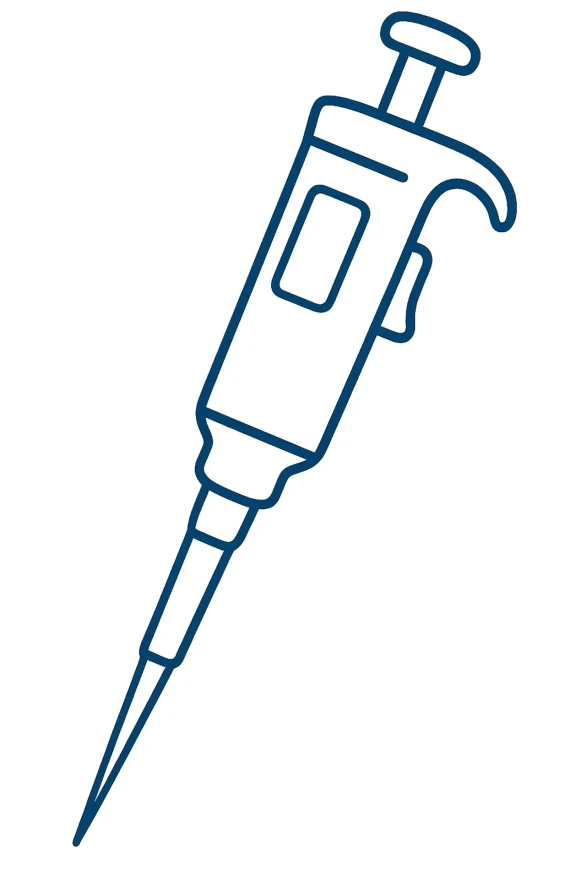
Repeating pipettes, also called stepper pipettes, are designed to dispense the same volume repeatedly after a single aspiration. They usually rely on special syringe-style tips.
Because multiple identical aliquots can be dispensed from one aspiration, they are well suited to repetitive tasks and can reduce both pipetting time and hand strain.
Typical applications include dispensing identical volumes of buffers, media, or reagents into microplates, as well as repeated steps in serial experimental workflows.
However, the specialized tips can be relatively expensive, and these pipettes are less suitable when every dispense requires a different volume.
 KNAUER: Repeating or Stepper Pipettes
Serological and Pasteur Pipettes
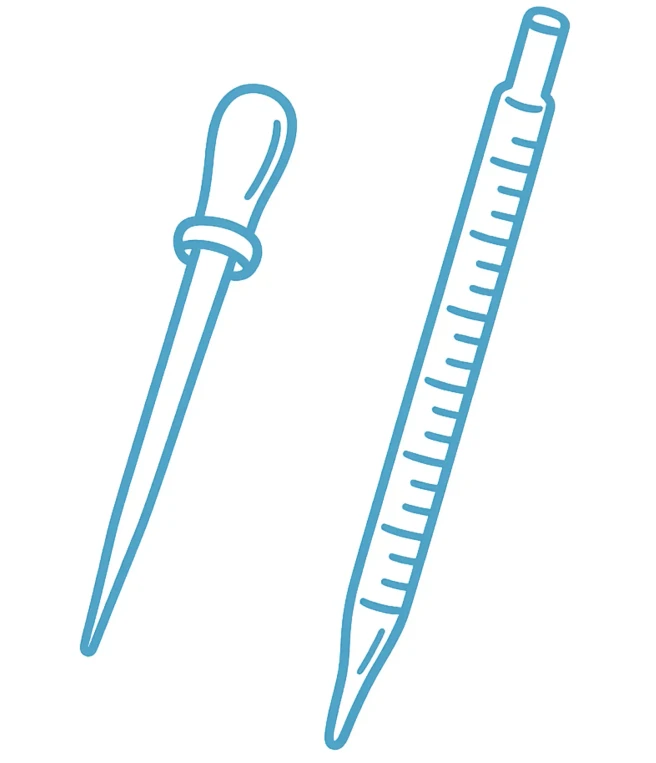
- Pasteur pipettes are simple droppers intended mainly for qualitative or approximate transfer of small liquid volumes.
- They consist of a narrow tube tapering toward the dispensing end and are fitted with a plastic or rubber bulb at the opposite end. Traditional Pasteur pipettes are made of glass, although plastic versions are also widely available.
- They are inexpensive and very useful when exact volume measurement is unnecessary.
- Typical applications include adding or transferring solvents and reagents or quickly removing supernatants.
- Similar applications can be carried out using transfer pipettes. These are usually manufactured as a single piece from low-density polyethylene and are resistant to breakage. Because the bulb is already integrated into the pipette, no separate bulb is required. They also eliminate the risk associated with broken glass and are generally resistant to biological fluids and many acids.
- Serological pipettes are designed for larger liquid volumes, typically between 1 and 100 mL. They are usually operated with pipette controllers, pipette aids, or manual bulbs.
- Typical uses include mixing and transferring chemical solutions or cell suspensions. They can also be used for tasks such as layering reagents to create gradients.
- Compared with micropipettes, serological pipettes make bulk liquid transfer faster. However, their precision is lower, and improper handling can introduce air bubbles into the sample.
 KNAUER: Serological and Pasteur Pipettes
Pipette types and their specifications
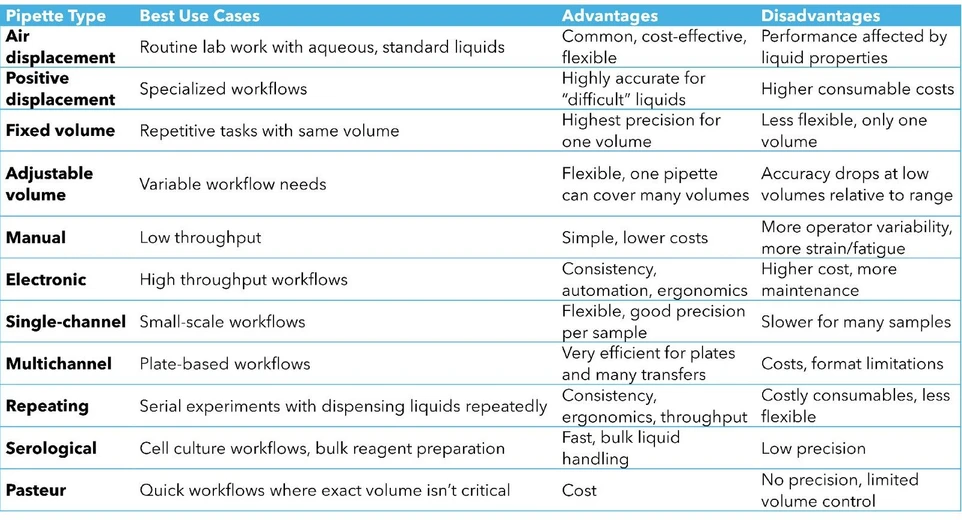 KNAUER: Table 1: Pipette types and their specifications.
How to choose the right pipette
Several practical decision points can help determine which pipette is most appropriate for your laboratory.
Required Volume & Pipette Range
It is generally best to select the smallest pipette whose working range still covers the desired volume, because adjustable pipettes typically perform most accurately toward the upper end of their range.
For example, if your routine volume is between 75 and 100 µL, a pipette with a 10–100 µL range is usually preferable to a 20–200 µL model.
Similarly, using a 5000 µL pipette to dispense only 50 µL is likely to compromise accuracy.
For very small volumes, for example below 2 µL, specialized micropipettes or alternative liquid-handling technologies may be necessary.
 KNAUER: Required Volume & Pipette Range
Liquid Properties
For a more detailed discussion of difficult liquids, see the second article in our “Pipetting Made Easy” series.
For aqueous, low-viscosity liquids at moderate temperatures, air displacement pipettes are generally sufficient. If your laboratory works mostly with standard aqueous samples, investing in positive displacement systems may not be necessary.
If you routinely handle viscous, foaming, volatile, very hot, or very cold liquids, positive displacement pipettes are usually the more appropriate choice.
With air displacement pipettes, some challenging samples may require techniques such as slower aspiration or reverse pipetting to improve performance.
Throughput & Format
If your workflow involves microplates such as 96- or 384-well formats, repeated parallel transfers, and high sample throughput, multichannel pipettes can significantly reduce processing time and operator fatigue.
For smaller sample numbers, occasional transfers, and work with individual tubes or wells, a manual single-channel pipette is often sufficient.
If your work involves many repetitive dilutions or liquid transfers, an electronic pipette can be a worthwhile investment because it improves ergonomics and reproducibility.
 KNAUER: Throughput & Format
User Ergonomics & Reproducibility
If you perform many pipetting steps every day, choose a pipette that is lightweight, well balanced, and requires low force for plunger operation, tip attachment, and tip ejection.
Good ergonomics can help reduce the risk of repetitive strain injuries.
Electronic pipettes may further decrease physical strain and reduce operator-to-operator variability. They can also improve reproducibility, particularly in applications requiring consistently high accuracy, such as diagnostics or high-throughput screening.
Budget & Consumables
Electronic and multichannel pipettes require a higher initial investment, but in high-throughput laboratories the cost can be offset by savings in time, fewer handling errors, improved ergonomics, and better data consistency.
For occasional low-volume work, a high-quality manual pipette may be entirely sufficient.
The cost of pipetting is not limited to the instrument itself. Consumables such as standard tips, low-retention tips, or specialized tips, as well as calibration and maintenance costs, should also be considered.
Tip compatibility is another important factor. In many cases, it is not essential to use only tips from the same manufacturer as the pipette, provided compatibility is assured.
Positive displacement pipettes generally involve higher consumable costs because of their specialized piston-tip systems.
Maintenance & Calibration
Ease of servicing and calibration should also be considered when purchasing a pipette.
Important questions include the availability of manufacturer or third-party service support, recommended calibration intervals, durability, and long-term maintenance requirements.
Regular servicing and calibration are essential for maintaining both performance and accuracy over the lifetime of the pipette.
 KNAUER: Table 2 - Decision factors for choosing the right pipette
Walk-through scenarios
Below are three typical laboratory workflows and the pipette types that would generally suit them best.
Scenario A
You work in a molecular biology laboratory. Most of your daily tasks involve adding 5–100 µL of aqueous buffers, enzyme mixtures, and similar standard solutions. Your throughput is moderate, with a few dozen samples processed per day.
Recommendation: Use a high-quality adjustable air displacement single-channel pipette, for example one covering 2–20 µL and another covering 20–100 µL.
If 96-well microplate work becomes a regular part of your routine, an 8-channel pipette covering approximately 20–200 µL may also be useful.
Scenario B
You work in a biochemistry laboratory and regularly handle viscous protein solutions, glycerol stocks, hot or cold reagents, and calibration or standard solutions. Accurate liquid transfer is important, and some samples are particularly valuable or difficult to replace.
Recommendation: Use a positive displacement pipette for challenging liquids. Standard liquids can still be handled effectively with a conventional air displacement pipette.
Remember, however, that positive displacement systems typically involve higher consumable costs.
Scenario C
You work in a high-throughput screening facility, filling 384-well microplates and processing large numbers of replicates. Speed, reproducibility, and reduced operator fatigue are major priorities.
Recommendation: Consider an electronic multichannel pipette or even an automated liquid-handling system.
Choose models with good ergonomic design to reduce fatigue during long pipetting sessions.
For very small volumes below approximately 5 µL, acoustic or other non-tip liquid-handling technologies may also be considered, although these systems fall outside the scope of conventional pipetting.
Final thoughts
Choosing the right pipette is not simply a matter of selecting the newest or most expensive instrument. The most suitable option is the one that matches your workflow, sample properties, required volume range, throughput, and ergonomic needs.
Understanding the key differences between pipetting technologies, including air displacement versus positive displacement, manual versus electronic operation, and single-channel versus multichannel formats, makes it easier to select the right tool for the job rather than relying only on manufacturer claims.
And regardless of which pipette you choose, correct pipetting technique remains essential.
Use the appropriate tip, pre-wet when necessary, maintain the correct pipetting angle, control immersion depth, and follow consistent aspiration and dispensing procedures.
- INTEGRA Biosciences Corp., Blog Article, Everything you need to know about the different types of pipettes, last accessed: 2025-11-27, 8:50
- INTEGRA Biosciences Corp., Product News, Are you using the right type of micropipette?, last accessed: 2025-11-27, 9:00
- INTEGRA Biosciences Corp., The complete guide to micropipettes, last accessed: 2025-11-27, 9:30
- Pipette.com, Blog, What Types Of Pipettes Are There?, last accessed: 2025-11-27, 9:15
- Eppendorf SE, Liquid Handling Selection Guide, last accessed: 2026-22-01, 12:35