In-Source Fragmentation Searches in NIST26 Chromatogram Window
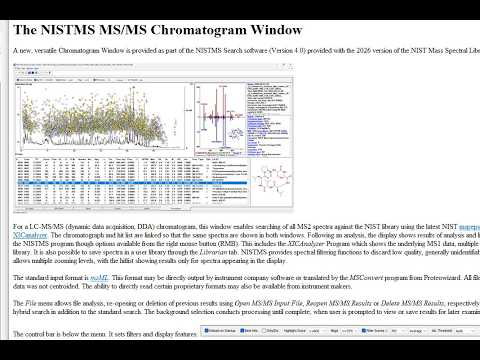
- Photo: James Little: In-Source Fragmentation Searches in NIST26 Chromatogram Window
- Video: james little: In-Source Fragmentation Searches in NIST26 Chromatogram Window
In-source fragmentation can complicate LC-MS/MS data interpretation because ions may fragment before they reach the collision cell. Instead of obtaining a clean spectrum generated from an isolated precursor ion, the analyst may encounter a mixture containing the protonated molecule, adduct ions, and fragments produced directly in the ion source.
NIST26 provides tools for recognizing these spectra and searching them against MS/MS libraries. The workflow described by James Little of Mass Spec Interpretation Services shows how chromatogram search results, filtered and unfiltered scores, and the NIST Library Search window can be combined to identify compounds even when the molecular ion is weak or absent.
What is in-source fragmentation?
In-source fragmentation occurs when analyte ions fragment within the ion source before conventional tandem mass spectrometry takes place. A typical in-source spectrum therefore contains a mixture of precursor and fragment ions.
For example, the protonated molecule [M+H]⁺ may remain visible while several fragment ions are simultaneously present. This is fundamentally different from a conventional MS/MS experiment, where a particular precursor is isolated and subsequently fragmented to produce a comparatively clean product-ion spectrum.
Terms used for these ions include:
- In-source fragment ions
- Source-induced fragments
- In-source fragmentation products
- Source fragmentation ions
- In-source CID products
The presentation recommends “in-source fragment ions” as the clearest and most explicit terminology.
Why in-source fragmentation matters for library searching
When a reference standard is infused during the generation of NIST library data, MS2 spectra can be acquired not only for molecular-ion adducts but also for fragment ions observed at high resolution.
This becomes particularly important for compounds whose intact protonated molecule is weak or essentially absent. In such cases, searching exclusively for [M+H]⁺ could prevent a useful library match even though abundant and characteristic fragment ions are available.
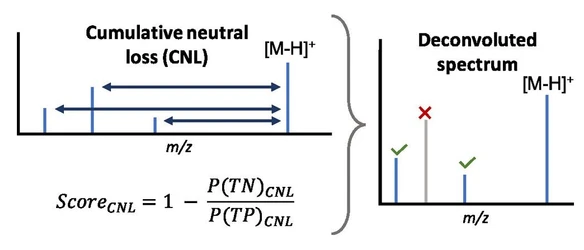
The spectrum illustrated on page 3 of the presentation demonstrates this concept: the same spectrum contains fragment ions at m/z 311 and 333 together with [M+H]⁺ at m/z 377, [M+Na]⁺ at m/z 399, and [M+K]⁺ at m/z 415.
Cholesterol: when the protonated molecule is not enough
Cholesterol provides a useful example. In positive-ion electrospray, essentially no significant intensity is observed for the [M+H]⁺ ion of cholesterol. Instead, loss of water produces an abundant dehydrated ion.
Consequently, a major cholesterol MS/MS spectrum in the NIST library is based on [M+H−H₂O]⁺ at m/z 369.3506 rather than the intact [M+H]⁺ precursor.
This illustrates an important principle: a useful MS/MS library spectrum does not necessarily have to originate from the intact protonated molecule. Stable and abundant ions generated through predictable in-source fragmentation can also provide valuable information for compound identification.
How NIST26 handles small neutral losses
For relatively small losses, NIST26 can associate the resulting ion with the correct molecular structure directly in the Chromatogram window.
This applies to losses such as:
- H₂O
- NH₃
- Other small neutral molecules
- Adduct formation such as [M+Na]⁺
For cholesterol, for example, a chromatogram search result for [M+H−H₂O]⁺ can therefore still be displayed together with the correct cholesterol structure.
The presentation provides oxosorbicillinol as another example. Its chromatogram result is associated with the precursor type [M+H−H₂O]⁺ while retaining the identity and structure of oxosorbicillinol.
What happens with larger fragment losses?
The situation becomes more complicated when fragmentation involves a larger mass loss.
For large fragment losses, the correct parent structure is not displayed directly for the corresponding entry in the Chromatogram results list. Structures are shown there primarily for conventional molecular/adduct ions such as M+H and M+Na and for the small neutral losses discussed above.
To investigate larger in-source fragments and obtain proposed structures, the spectrum therefore needs to be transferred to the NIST Library Search window.
Using Score and Score (Unfiltered) to find candidates
A useful strategy for recognizing possible in-source fragmentation spectra is to compare the standard Score with Score (Unfiltered).
The presentation recommends adding Score (Unfiltered) as a displayed property in the lower Chromatogram window and using a reasonably high value, such as >800, in the filter settings. Results can then be sorted by Score (Unfiltered), placing the highest-scoring candidates at the top.
The analyst should pay particular attention to entries where:
Score is much lower than Score (Unfiltered).
Such a large discrepancy can indicate a potentially useful in-source fragmentation spectrum that deserves further investigation.
The example shown in the presentation is particularly striking:
- Score: 22
- Score (Unfiltered): 928
Despite the extremely low conventional Score, the very high unfiltered score indicates that the spectrum contains potentially valuable information that can be explored through a dedicated library search.
Finding in-source candidates in the chromatogram
NIST26 also provides a visual way to recognize potential candidates.
Possible in-source spectra are indicated by blue dots in the Chromatogram TIC plot. Selecting one of these candidates with the mouse changes the marker from blue to green, indicating the currently active spectrum linked to the corresponding entry in the results list.
This makes it possible to move visually through the chromatogram while simultaneously inspecting candidate spectra and their associated scores. The TIC example on pages 7–8 shows how these potential in-source spectra are distributed across the chromatographic run.
How to send an in-source spectrum to Library Search
Once a promising candidate has been identified, the workflow is straightforward:
- Identify a potential in-source spectrum in the Chromatogram window.
- Check its Score and Score (Unfiltered) values.
- Select the candidate in the chromatogram.
- Right-click the corresponding entry.
- Select Library Search.
- Examine the resulting candidates in the NIST Library Search window.
Sending the spectrum to Library Search is especially important when larger fragment losses are involved because plausible structures cannot be obtained directly from the Chromatogram results list in these cases.
Interpreting the Library Search results
Once the in-source spectrum has been transferred to Library Search, several potential identities may be returned with high scores.
The example on page 9 demonstrates this clearly. Searching an in-source spectrum produces several high-scoring candidate spectra, with the leading result reaching a score of 928. Multiple library spectra for related candidate compounds may appear because different precursor types, collision energies, or fragmentation pathways can produce compatible spectral patterns.
The purpose of the search is therefore not simply to accept the first result automatically. Instead, the resulting candidate list provides structures and identities that can be evaluated in the context of the experimental data.
Check the Library Search settings
Correct search settings are important when working with in-source spectra.
The presentation illustrates several settings that should be checked before interpreting the results. The search is configured for Identity and MS/MS, with the precursor ion m/z taken from the spectrum. The illustrated high-resolution library search tolerances are 20 ppm for precursor ions and 40 ppm for product ions.
Another important point is the MS/MS Hit List Filter. In the workflow shown in the presentation, Enable Filtering (Tandem Only) is switched off.
Analysts should therefore verify the Library Search options rather than relying on default settings, as inappropriate filtering could remove potentially useful matches from consideration.
Practical workflow at a glance
For routine investigation of potential in-source fragmentation in NIST26, the presentation suggests the following approach:
- Review the Chromatogram TIC for possible in-source spectra.
- Add Score (Unfiltered) to the displayed result properties.
- Apply a relatively high Score (Unfiltered) threshold, with >800 suggested as a reasonable starting point.
- Sort results by Score (Unfiltered), highest first.
- Look for unusually large differences between Score and Score (Unfiltered).
- Select promising candidates marked in the TIC.
- Send spectra involving substantial fragment losses to NIST Library Search.
- Verify the MS/MS search and filtering settings.
- Examine the high-scoring library candidates and proposed structures.
This workflow provides a practical way to extract identification information from spectra that could otherwise appear problematic because the dominant ion is an in-source fragment rather than the expected molecular-ion adduct.
Conclusion
In-source fragmentation does not necessarily make an LC-MS spectrum unusable. In some cases, particularly for compounds such as cholesterol, a fragment generated before conventional MS/MS can actually be the dominant and analytically useful ion.
NIST26 addresses this challenge by combining chromatogram-level searching with high-resolution MS/MS library data. Small neutral losses and common adducts can be associated directly with the parent structure, while more substantial fragmentation can be investigated by transferring the spectrum to the Library Search window. Comparing Score with Score (Unfiltered) provides an additional practical way to recognize promising in-source candidates.
By understanding these relationships and using the appropriate search settings, analysts can obtain meaningful structural candidates from spectra that might otherwise be overlooked during LC-MS/MS data interpretation.