4.5-Minute Oral Fluid LC MS Method to Detect 31 Drugs of Abuse Using Stellar MS

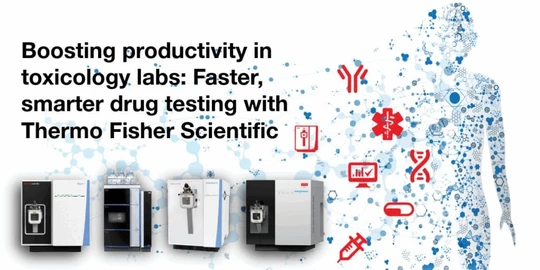
- Photo: Thermo Fisher Scientific: 4.5-Minute Oral Fluid LC MS Method to Detect 31 Drugs of Abuse Using Stellar MS
- Video: Chromatography & Mass Spectrometry Solutions: Stellar MS NPI Video with Flying Ions Animation
This workflow confirms and quantifies 31 drugs of abuse in oral fluid (including THC) in a 4.5‑minute LC run on the Thermo Scientific Stellar mass spectrometer using full scan + targeted MS2 (tMS2) with both HCD and CID fragmentation. With 1 µL injection and 0.1% formic acid in water/methanol mobile phases, the method supports ~13 samples/hour (up to ~320/day continuous operation) while maintaining confirmation performance via ion ratios.
Method at a glance
- What matrix is tested? Oral fluid
- How many drugs? 31 drugs of abuse (panel includes THC)
- Run time? 4.5 minutes
- Throughput? ~13 samples/hour → up to ~320 samples/day (24‑hour operation)
- Injection volume? 1 µL
- Mobile phases? 0.1% formic acid in water (A) and 0.1% formic acid in methanol (B)
- MS acquisition? Full scan + targeted MS2 (tMS2)
- Fragmentation? Compound‑optimized HCD and CID in the same targeted list
- Confirmation strategy? Ion ratios with ±20% tolerance (typical confirmatory approach)
Why oral fluid—and why speed matters
Oral fluid is attractive for clinical and forensic toxicology because collection is simple and the matrix aligns well with high‑volume workflows (workplace/occupational, roadside, and other settings). The challenge is building a method that’s simultaneously:
- Broad enough for today’s drug panels
- Sensitive enough to reach required cutoffs
- Fast enough to keep sample queues under control
- Confirmation‑ready (consistent product ions and ion ratios)
A 4.5‑minute method is a practical lever here: compress runtime, raise throughput, and still keep confirmation quality by optimizing MS/MS conditions per compound.
The LC method
A short, efficient separation is the foundation of the workflow:
- UHPLC system: Thermo Scientific Vanquish Horizon UHPLC
- Column: Thermo Scientific Accucore Biphenyl, 50 × 2.1 mm, 2.6 µm
- Mobile phase A: 0.1% formic acid in water
- Mobile phase B: 0.1% formic acid in methanol
- Injection volume: 1 µL
- Gradient runtime: 4.5 minutes
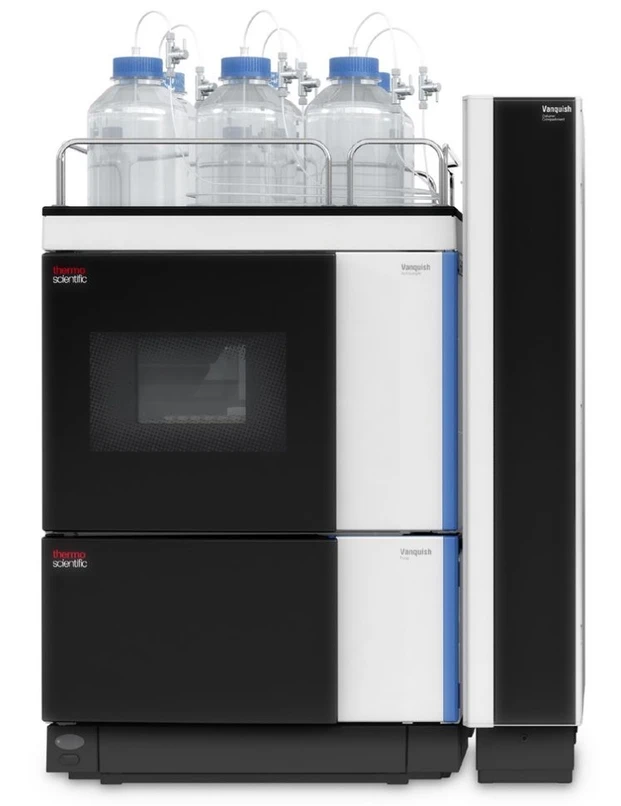 Thermo Fisher Scientific: 4.5-Minute Oral Fluid LC MS Method to Detect 31 Drugs of Abuse Using Stellar MS: Figure 1: Thermo Scientific Vanquish Horizon UHPLC system.
The MS method (Full scan + targeted MS2 with HCD + CID)
Acquisition approach
This method uses a “two‑layer” strategy for quantitation + confirmation:
- Full scan (broad coverage, context, quantitative support)
- Targeted MS2 (tMS2) (confirmation‑focused product ions, ion ratios)
The key differentiator: HCD and CID in one targeted list
Instead of forcing every analyte into a single fragmentation style, the method uses both:
- HCD (beam‑type fragmentation)
- CID (resonance‑type fragmentation)
Why that improves method development:
Drugs of abuse span multiple chemistries. A single collision approach often works “okay” for most compounds—but one or two analytes can become persistent problems (weak qualifiers, unstable ion ratios, excess noise). Having both HCD and CID available in one method lets you optimize per compound and move faster.
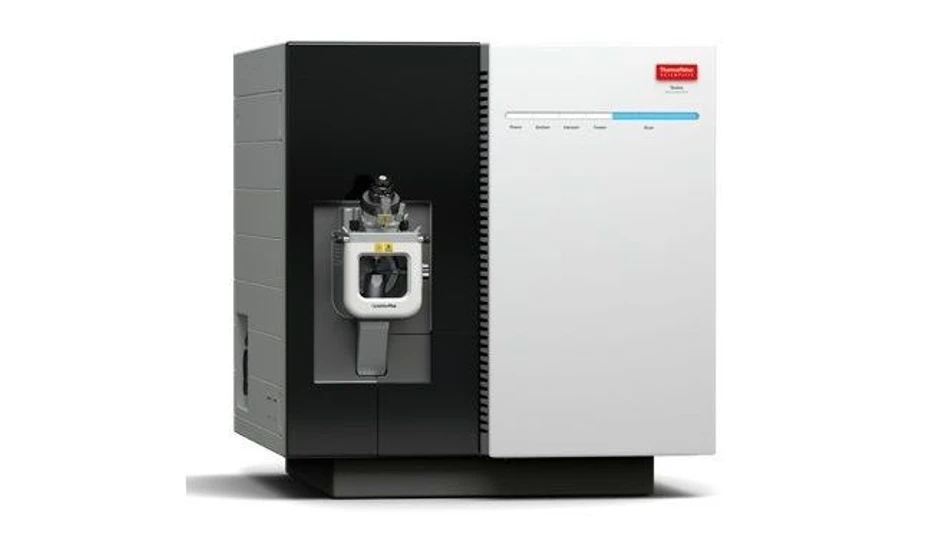 Thermo Fisher Scientific: 4.5-Minute Oral Fluid LC MS Method to Detect 31 Drugs of Abuse Using Stellar MS: Figure 2: Thermo Scientific Stellar mass spectrometer.
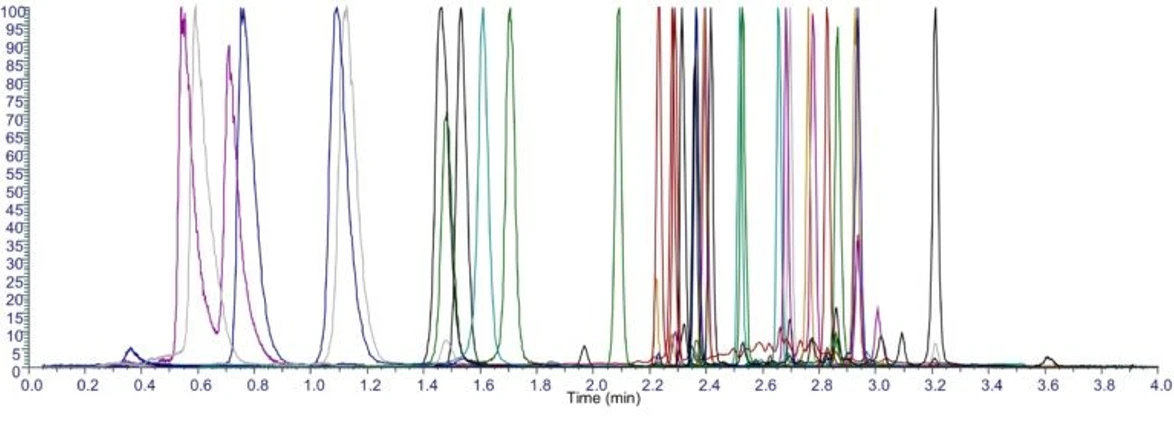 Thermo Fisher Scientific: 4.5-Minute Oral Fluid LC MS Method to Detect 31 Drugs of Abuse Using Stellar MS: Figure 3: Full scan & targeted MS2 methods, HCD and collision energies used.
Why CID + HCD flexibility improves confirmation
In this workflow, HCD performed well for most compounds. But for buprenorphine, HCD produced one dominant product ion with additional low m/z noise and noticeable residual precursor. Using CID generated two high‑intensity product ions and delivered consistent ion ratios across the calibration range.
When your confirmation hinges on stable ion ratios, the ability to switch fragmentation mode (not just collision energy) is a method‑development advantage—especially for “problem analytes.”
Controllable ionization
Oral fluid methods often deal with limited sample volume and matrix effects. This workflow pairs low injection volume with ionization control using the Thermo Scientific OptaMax Plus HESI source.
- The OptaMax Plus HESI source supports high probe temperature capability (up to 650 °C).
- In this study, a vaporizer temperature of 500 °C was used to help achieve sensitivity and improve relative peak areas across drugs of abuse.
Why this matters: If you’re injecting only 1 µL, ionization stability and efficiency can be the difference between “meets cutoff” and “misses at LOQ.”
Sample preparation
Oral fluid panels become more challenging when THC is included because most drugs of abuse are basic, while THC is largely neutral, and that can stress extraction chemistry.
In this workflow, oral fluid calibrators and samples were extracted using a mixed‑mode approach designed to recover THC alongside other drugs:
- Calibrators prepared across eight levels (broad dynamic range)
- Extraction performed using mixed‑mode chemistry tips (SCX/WAX) in a dispersive SPE‑style workflow
- Steps automated on a liquid handling platform to support high‑throughput consistency
- Samples dried and reconstituted prior to LC‑MS analysis
- Only 1 µL injected per run
Even if your lab uses different automation or consumables, the method structure (fast LC + full scan + targeted MS2 with dual fragmentation) transfers well.
Throughput math
- 4.5 minutes per injection → 60 / 4.5 = 13.3 injections/hour
- That’s ~13 samples/hour in typical phrasing
- Over 24 hours: 13.3 × 24 = ~320 samples/day (continuous operation)
If you run a single shift, just scale accordingly (e.g., ~106/day for an 8‑hour shift, excluding QC and overhead).
Performance summary
Sensitivity and linearity
- Linearity from LOQs as low as 0.25 ng/mL up to 1,000 ng/mL (panel-dependent)
- For THC specifically: LOQ at 1 ng/mL, with a dynamic range extending to 1,000 ng/mL in this evaluation
- Across the panel, LOQs were reported as lower than recommended confirmation cutoffs referenced in SAMHSA guidance and NSC Tier 1 cutoffs (study-specific outcome)
Confirmation via ion ratios
- Ion ratios evaluated using ±20% tolerance (typical confirmatory acceptance framework)
- The workflow produced consistent ion ratios across calibrator levels for the full panel in this evaluation
Case sample comparison (real-world relevance)
When compared against a validated triple quadrupole method for case study samples, the Stellar MS workflow:
- Confirmed the positive hits observed by the reference method
- Reported a few additional positives for select analytes, attributed to lower LOQs
- Highlighted an operational efficiency point: 1 µL injection in this method versus 20 µL injection in the compared method
FAQ
- How long does the LC‑MS run take for the 31‑drug oral fluid panel?
4.5 minutes per injection using a short UHPLC gradient.
- How many drugs of abuse can Stellar MS detect in this workflow?
31 drugs of abuse, including THC, using full scan + targeted MS2.
- What MS/MS approach is used?
A combined strategy: full scan plus targeted MS2 (tMS2) for confirmation.
- Why use both HCD and CID?
Because some analytes fragment better—and produce more stable confirmation ions/ion ratios—under one mode versus the other. Using both increases flexibility and speeds method optimization.
- What injection volume is used?
1 µL of extracted sample.
- What mobile phases are used?
0.1% formic acid in water (A) and 0.1% formic acid in methanol (B).
- How many samples can you run per day?
At 4.5 minutes/injection, throughput is ~13 samples/hour or up to ~320/day with continuous operation (actual throughput depends on QC and scheduling).
What makes this workflow “easy” to develop on Stellar MS
Here’s the short list of features that directly reduce method‑development friction:
- HCD or CID in one method → optimize per compound, not compromise
- Fast MS2 acquisition speeds (up to 140 Hz for MS2) → more data points across narrow peaks
- Fast polarity switching (true 5 ms) → supports mixed panels efficiently
- Adaptive RT (real‑time retention time window adjustment) → helps reduce reinjections when retention times drift (e.g., column aging) and supports method transfer from longer to shorter gradients
- OptaMax Plus HESI source control → supports sensitivity at low injection volumes
If you’re building a fast oral fluid confirmation workflow—or updating an existing DOA panel—this 4.5‑minute method shows how Stellar MS can combine speed, confirmation-ready MS2, and fragmentation flexibility (HCD + CID) in a single targeted workflow. Reach out to learn how to adapt the targeted list, collision settings, and scheduling strategy to your lab’s cutoffs and throughput goals.
Visit us on LinkedIn: #MassSpectrometry #OralFluid #DrugsOfAbuse #MethodDevelopment #HighThroughput