News from LabRulezLCMS Library - Week 09, 2026
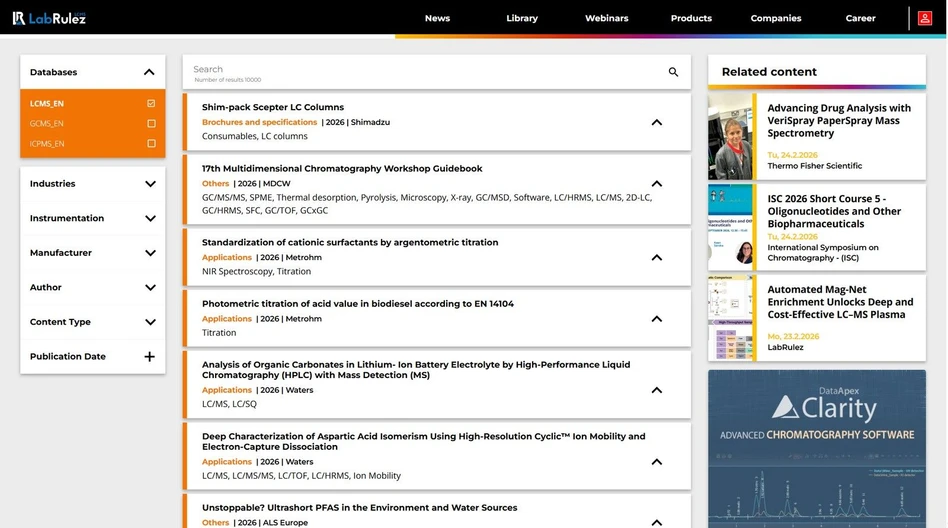
LabRulez: News from LabRulezLCMS Library - Week 09, 2026
Our Library never stops expanding. What are the most recent contributions to LabRulezLCMS Library in the week of 23rd February 2026? Check out new documents from the field of liquid phase, especially HPLC and LC/MS techniques!
👉 SEARCH THE LARGEST REPOSITORY OF DOCUMENTS ABOUT LCMS AND RELATED TECHNIQUES
👉 Need info about different analytical techniques? Peek into LabRulezGCMS or LabRulezICPMS libraries.
This week we bring you application notes by Agilent Technologies, KNAUER, Shimadzu and Waters Corporation and poster by Thermo Fisher Scientific / MSACL!
1. Agilent Technologies: Simultaneous C1–C18 PFAS Analysis in Drinking Water by Large-Volume Direct Injection Using an Altura Poroshell 120 PFAS Column
- Application note
- Full PDF for download
PFAS and ultra-short-chain PFAS
PFAS is a large family of fluorinated chemicals used in nonstick coatings, repellents, industrial fluids, and many other products. Because of their high chemical and thermal stability (for which they are known as "forever chemicals"), they persist in the environment and are now routinely detected in drinking water.
Most early regulations focused on a few long-chain PFAS, such as PFOA and PFOS. However, as manufacturing has shifted and monitoring programs expanded, ultra-short-chain PFAS (C1–C3) species such as TFA, PFPrA and small perfluorosulfonates—started to show up more frequently and, in some cases, dominate the PFAS profile in surface and drinking waters. These compounds are very polar and highly water soluble and are difficult to remove in conventional treatment. They are poorly retained on traditional reversed‑phase columns. From an LC point of view, this combination makes the C1–C3 end of the panel the hardest to measure reliably.
Experimental
Instrumentation
Analysis was performed using an Agilent 1290 Infinity II LC equipped with a high‑speed pump coupled to an Agilent 6475 triple quadrupole LC/MS. The LC was configured with a 100 μL injection loop and a multisampler. To reduce PFAS contamination and background from solvents and the LC system, a PFC-free LC conversion kit was installed. Table 1 shows the LC parameters, and Table 2 shows the MS parameters.
Performance of the new PFAS delay column
System-derived PFAS, especially TFA and PFBA, are a known issue in PFAS workflows. We compared configurations with and without delay columns. For TFA, without a delay column, a strong system background overlapped the target retention window. The new delay column removed the majority of the system TFA contaminates, leaving a clean baseline for the analyte shown in Figure 2.
For PFBA, a similar pattern was observed, with the new delay column providing the best separation between sample PFBA and system background shown in Figure 3. Overall, the new delay column provides a cleaner baseline and makes it easier to interpret low-level USC peaks, especially when combined with the new analytical column.
Conclusion
The new Agilent Altura Poroshell 120 PFAS column and PFAS delay column support a straightforward, single‑injection LC/MS/MS method for C1–C18 PFAS in drinking water, delivering improved retention and peak shape for C1–C3 USC PFAS compared with standard C18 columns, while the delay column effectively separates TFA and PFBA system peaks from the analytes to reduce background. The method supports robust large-volume direct injection—up to 100 µL with 0.1% acetic acid—without severe solvent effects or peak distortion, and provides good linearity, recovery, and precision across the panel with run times and pressures compatible with typical LC/MS setups. As regulations and customer expectations move toward broader PFAS panels and increased attention to USC PFAS, this column set offers a simple way for labs to extend capability from the traditional panel to a full C1–C18 range in a single method.
2. KNAUER: Introducing the KNAUER HTQC system solution for High Throughput Quality Control
- Application note
- Full PDF for download
What does high throughput mean? And what parameters and hardware requirements are crucial for performing high throughput analyses? The term 'high throughput’ in this context refers to the utilisation of automated technologies and processes to expeditiously execute a substantial number of tests or experiments in parallel. The primary functionality of the system is to rapidly generate substantial quantities of data.
Therefore, the key words for describing an HTQC system are speed, sample throughput, automation and miniaturization, as well as parallel processing. But how can this be achieved and what is necessary to perform fast, reliable and automated measurements? In this technical note we take a closer look at those requirements and how they are implemented in the KNAUER HTQC system.
RESULTS
Speed
High throughput HPLC applications most often require fast methods. This could refer to both the overall method runtime and the cycle time of the injection module. Fast gradient applications up to 1200 bar can easily be realized with the HTQC system due to its two included UHPLC high pressure gradient pumps (Fig.1).
Switching from classical HPLC to fast, high-resolution methods can significantly enhance your daily sample throughput. Assuming we are running an “old fashioned” HPLC method on a 250 x 4.6 mm ID column, the total runtime per sample is 75 min, including equilibration, analysis, and cleaning. This would allow for around six samples per day during an eight-hour working day.
Transferring the same method to UHPLC will be a significant productivity boost. With analysis time, equilibration time and backflushing time all reduced to less than six minutes per sample, now around 90 samples can be analyzed in a single working day. Another way of improving the speed of your analysis is to optimize your injection system. The cycle time of the injector can sometimes be very time-consuming due to washing steps and the injection procedure itself. The HTQC system is equipped with the KNAUER LH 8.1 Analytical Liquid Handler as standard (Fig.2).
The LH 8.1 features the use of overlapped injections. That means you can effectively save time because the injection for the next run will be already prepared while the measurement is still in progress, without compromising the necessary cleaning steps of the injection system (Fig. 3).
Using the overlapped injection feature results in a saving of one more minute per sample. Together with the already implemented UHPLC method we can now analyze approximately 105 samples per day.
CONCLUSION
What have we done to increase the throughput? First, a scale down from a classical HPLC to a fast UHPLC method was performed. Then, a second pump and a special column switching and backflushing valve were added to our UHPLC system. Combined with the liquid handler LH 8.1, its option for overlapped injections and its outstanding sample storing capabilities, the HTQC system is a versatile configuration for high throughput analysis. It can be coupled to almost any detector that can be used in HPLC. Due to the possibility of very fast operation, mass spectrometric methods are a perfect fit!
3. Shimadzu: Quantitative Analysis of Aflatoxin in Edible Nuts by Using High-Performance Liquid Chromatography Coupled with Florescence Detector
- Application note
- Full PDF for download
Aflatoxins are toxic metabolites produced by molds such as Aspergillus flavus and Aspergillus parasiticus. These fungi can contaminate nuts when conditions like high humidity and warm temperatures occur during cultivation, drying, storage, or transport.
Nuts including peanuts, almonds, pistachios, cashews, walnuts, and Brazil nuts are particularly susceptible. Even low levels of contamination can pose serious health risks. Early detection and control of aflatoxin contamination help prevent economic losses and safeguard consumers from long-term toxic effects. Reliable and sensitive detection of B1, B2, G1, and G2 aflatoxins in nut products is therefore critical, particularly in view of the strict limits set by the European Union (e.g., a maximum of 2 µg/kg for aflatoxin B₁ and 4 µg/kg for total aflatoxins in nuts intended for direct human consumption)1. The analysis commonly begins with immunoaffinity cartridges, which selectively capture aflatoxins while removing other matrix components. This step not only concentrates the toxins but also reduces interference, enhancing the accuracy and reproducibility of subsequent measurements.
For detection, post-column photochemical derivatisation is employed to increase the natural fluorescence of aflatoxin B1 and G1, improving sensitivity and lowering detection limits. This derivatisation method is rapid, reagent-free, and well-suited for routine monitoring of aflatoxinsin complex food samples.
2. Materials and methods
Aflatoxin standards B1, B2, G1, and G2 were procured from Biopure, Germany. A total of five commercially available edible nuts were collected from the local market. Sample clean-up was performed using AflaCLEAN immunoaffinity cartridges from LC Tech, Germany. For chromatographic analysis, an i-Series LC-2060C 3D system coupled with a fluorescence detector RF-20Axs manufactured by Shimadzu, Japan, and a photochemical derivatization chamber from LC Tech, Germany, was employed. The analytical conditions are summarized in Table 1 and the system configuration isillustrated in Fig 1.
3. Result and Discussion
The calibration curve showed excellent linearity, with a correlation coefficient (R²) of ≥ 0.998 and accuracy within the range of 80–120% indicating a high degree of accuracy and reliability in the measurements. Peanut and cashew samples were spiked with aflatoxins (0.4 µg/kg for G1 and B1, and 0.1 µg/kg for G2 and B2), yielding recoveries between 80% and 100%. The regression coefficients and slopes of the compounds obtained from the calibration curves are presented in Table 2. The visual representation of chromatograms of standards and samples is shown in Fig. 2-5. The presence of four types of aflatoxins—G2, G1, B2, and B1 was analyzed in various nut samples, including pine nuts, almonds, cashews, peanuts, and walnuts. Aflatoxins G2 and G1 were found to be below the limit of detection (LOD) in all nut samples. However, measurable levels of aflatoxin B2 and B1 were detected in certain samples. Pine nuts showed the highest contamination, with aflatoxin B2 at 0.066 µg/kg and aflatoxin B1 at 0.346 µg/kg. Peanuts also contained detectable levels of aflatoxins, with 0.015 µg/kg of B2 and 0.057 µg/kg of B1 .
4. Conclusion
The developed HPLC–fluorescence method with post-column photochemical derivatization and AflaCLEAN immunoaffinity column clean-up enabled accurate and sensitive detection of aflatoxins (B1, B2, G1, G2) in edible nuts. The method showed excellent linearity (R² ≥ 0.998), good recoveries (80–100%), and very low detection limits. All analyzed nut samples were within the permissible EU limits, confirming their safety. The use of immunoaffinity columns significantly reduced matrix interference and improved precision, making this method reliable for routine monitoring of aflatoxinsin food safety testing.
4. Thermo Fisher Scientific / MSACL: Sensitive and selective quantitation of bile acids using targeted MS2/MS3 on the Stellar mass spectrometer
- Poster
- Full PDF for download
This poster presents a targeted LC–MS/MS approach for the sensitive and selective quantification of bile acids and their conjugates in human serum using the Thermo Scientific™ Stellar™ mass spectrometer, a hybrid quadrupole–dual-pressure linear ion trap system. The Stellar MS enables simultaneous tMS2 and tMS3 acquisition within a single run, combining CID and HCD fragmentation modes to enhance selectivity, sensitivity, and confidence in compound identification. The study demonstrates how multi-stage fragmentation improves differentiation of structurally similar bile acids, particularly in complex biological matrices.
Chromatographic separation was performed using a Thermo Scientific™ Vanquish™ Horizon UHPLC system coupled to the Stellar MS, with a Waters Acquity BEH C18 column (2.1 × 100 mm, 1.7 µm) and a 9-minute LC gradient. Data acquisition was carried out using Thermo Scientific™ Xcalibur™ software (v4.7) and processed with Thermo Scientific™ TraceFinder™ software (v5.2). The optimized method included more than 200 qualitative and quantitative transitions, with retention time windows of 0.8 minutes, enabling robust high-throughput analysis.
Method optimization showed that conjugated bile acids preferentially fragmented under HCD conditions, while CID provided characteristic core fragments. For analytes affected by matrix interferences or near the limit of quantitation (LOQ), implementation of tMS3 acquisition significantly reduced baseline noise and improved signal-to-noise ratios, lowering LOQs by up to two calibration points compared to tMS2-CID alone. The assay demonstrated a dynamic range spanning four orders of magnitude (<1 nM to 1000 nM), with excellent linearity (e.g., R² = 0.9989 for deoxycholic acid).
The method was successfully applied to serum samples from children with and without autism spectrum disorder (ASD), enabling quantitative profiling of 12 bile acids across 49 samples. The results highlight the capability of the Stellar MS tMS2/tMS3 workflow to deliver highly sensitive, selective, and reproducible bile acid measurements in clinical research settings. This approach provides a powerful analytical platform for studying bile acid metabolism and its relationship to human health.
5. Waters Corporation: mAbs Testing in Inflammation Using Mass Spectrometry – Combination of mAbXmise™ Kits and XEVO™ TQ Absolute XR Mass Spectrometer
- Application note
- Full PDF for download
For 25 years, mAbs have revolutionized the management of inflammatory bowel diseases. The original anti-TNF drugs, such as infliximab and adalimumab, and more recently additional biologics, including ustekinumab and vedolizumab, have demonstrated their efficacy for the induction and maintenance of remission in Crohn’s disease and ulcerative colitis.1,2
Therapeutic drug monitoring (TDM) has also been incorporated into daily clinical practice, especially for patients losing response to therapeutics (reactive monitoring). Hence, measuring serum drug levels and anti-drug antibodies is useful for clinicians to explain drug failure and adapting the medication regimen for patients. For the 4 mAbs cited above, minimal therapeutic target trough levels in maintenance have been published by international groups of experts (ECCO, ACG, AGA) and are: infliximab >5 µg/mL, adalimumab >7,5 µg/mL, vedolizumab >15 µg/mL, and ustekinumab >1 µg/mL.3-5
The difficulties for a laboratory willing to offer TDM of mAbs reside in the limited offer of assays for the concerned mAbs and the variability and lack of robustness of these assays. The challenge is to offer a more robust approach with optimal turnaround time and cost-effectiveness.
Liquid chromatography - mass spectrometry (LC-MS/MS) is a method of choice for this application, now described and used by multiple clinical teams.6-8 LC-MS/MS enables direct, peptide-level detection and quantification and thus provides optimal specificity, with reduced susceptibility to matrix interference, enabling unambiguous identification of drug-derived peptides and immune responses even in patients receiving multiple biologics. By doing so, false-negative and false-positive rates are largely reduced, enabling users to drastically reduce errors and samples reanalysis.9-11 Due to its dynamic range, LC-MS/MS offers an extended measuring range and enables multiplex quantification, which is useful to simultaneously monitor two biologics after a switch or in the case of combination therapies. Finally, a key benefit is the addition of internal standards, which correct the variability (sample variability, variability during technical operations or analyses) and improve the standardization across laboratories.
This application note presents a streamlined workflow dedicated to inflammation mAbs testing using mass spectrometry. This workflow combines ready-to-use kits that largely facilitate the implementation of the assay in the clinical laboratory and use for routine clinical care, and the analytical sensitivity, precision, and accuracy of Waters Xevo TQ Absolute XR Tandem Quadrupole Mass Spectrometer. The analytical methods have been set up and optimized for 4 inflammation mAbs, commonly used to treat inflammatory bowel disease (IBD) patients – infliximab, adalimumab, ustekinumab, and vedolizumab – as well as two anti-drug antibodies – anti-IFX and antiADL. This global solution can be implemented rapidly in clinical labs that are willing to perform mAbs testing and looking for an alternative to immunoassays.
Experimental
Materials and Methods
Mass Spec Analysis
- ACQUITY™ Premier Peptide CSH™ C18, 130 Å, 1.7 µm Column (p/n : 186009488)
- Sample analyses were performed on a Xevo TQ Absolute XR Mass Spectrometer
- Data processing was performed using MassLynx™ Software version 4.2 SCN1050
Results and Discussion
Quantitation of Patient Samples
Seven patient samples were analyzed using the Promise Proteomics ITDM2 kit and cross-compared to values assigned by immunoassay. Patients were under treatment of adalimumab or infliximab. No ustekinumab or vedolizumab were present in these samples. The results are in good accordance with the reported values achieved by immunoassays and shown in Table 7. As expected, in some cases the absolute values differ in direct comparison of both detection techniques. These findings have been already reported in literature.12, 13 However, good correlation between mAbXmise kits and immunoassay has already been reported in the literature.8
In parallel to ITDM2 analysis, the seven patient samples were analyzed with the IADA1 kit. The presence of antidrug antibodies were observed for two patients treated with infliximab and for one patient treated with adalimumab, in good accordance with the results of the ELISA antidrug antibodies. Both methods show the presence of anti-drug antibodies. Some values were above their specific method ULOQ.
Conclusion
This application note highlights a comprehensive suite dedicated to the quantification of monoclonal antibodies and anti-drug antibodies. The solution combines a range of kits for sample preparation (mAbXmise, Promise Proteomics, France) and associated analytical methods, optimized for the Waters Xevo TQ Absolute XR Mass Spectrometer.
The results demonstrate excellent analytical performance (accuracy, precision). The key advantage of the described solution lies in its rapid implementation in clinical laboratories already familiar with mass spectrometry. The transition from small-molecule analysis to antibodies is made easier and faster, thanks both to the kits that simplify sample preparation for this application and to the analytical methods that are ready to use on the instrument.