An Analyte-Specific LC-IMS-HRMS Framework for Enhanced Identification Confidence in Target Screening of Contaminants in Complex Matrices
![<p>Anal. Chem. (2026): Figure 4. Comparison of data acquired by the analysis of a urine sample spiked at Cinstrumental = 5 μg/L using LC-QTOF MS without (TIMS OFF) (i) and with the TIMS dimension (TIMS ON) (ii). For norfentanyl (A), the Extracted Ion Chromatograms (EICs) (m/z window of ±0.005) for [M + H]+ (PI) and the bbCID MS/MS fragment ions, and the corresponding MS and/or bbCID MS/MS spectra are shown in (i), while in (ii) the respective filtered EICs (mobility window of ±0.015 V·s/cm (2)), Extracted Ion Mobilograms (EIMs) (m/z window of ±0.005 and RT range of ±0.08 min), along with the corresponding MS and/or bbCID MS/MS spectra are illustrated. In EICs and EIMs, the PI and the mandatory qualifier ion (QI) are shown in blue and orange, respectively. Fulfilled identification criteria are highlighted. </p>](https://lcms.labrulez.com/labrulez-bucket-strapi-h3hsga3/Anal_Chem_2026_Figure_4_A_3314e86557_l.webp)
Anal. Chem. (2026): Figure 4. Comparison of data acquired by the analysis of a urine sample spiked at Cinstrumental = 5 μg/L using LC-QTOF MS without (TIMS OFF) (i) and with the TIMS dimension (TIMS ON) (ii). For norfentanyl (A), the Extracted Ion Chromatograms (EICs) (m/z window of ±0.005) for [M + H]+ (PI) and the bbCID MS/MS fragment ions, and the corresponding MS and/or bbCID MS/MS spectra are shown in (i), while in (ii) the respective filtered EICs (mobility window of ±0.015 V·s/cm (2)), Extracted Ion Mobilograms (EIMs) (m/z window of ±0.005 and RT range of ±0.08 min), along with the corresponding MS and/or bbCID MS/MS spectra are illustrated. In EICs and EIMs, the PI and the mandatory qualifier ion (QI) are shown in blue and orange, respectively. Fulfilled identification criteria are highlighted.
This study introduces an analyte-specific LC-TIMS-HRMS framework for more confident target screening of contaminants in complex matrices. An enriched database covering 1,948 compounds incorporates MS/MS qualifier ions, collision cross section (CCS) values, and mobility filtering windows, while predefined mandatory qualifiers further strengthen identification criteria.
Approximately 2,500 CCS values showed high repeatability and interinstrument reproducibility. Mobility-filtered spectra improved selectivity and low-level detection in raptor eggs, human urine, and wastewater, while CCS-based differentiation and mandatory qualifiers reduced both false positives and false negatives. The workflow provides a robust approach for high-throughput environmental monitoring and human exposure assessment.
The original article
An Analyte-Specific LC-IMS-HRMS Framework for Enhanced Identification Confidence in Target Screening of Contaminants in Complex Matrices
Konstantina S. Diamanti; Dimitrios E. Damalas; Georgios O. Gkotsis; Eleni I. Panagopoulou; Maria-Christina Nika; Carsten Baessmann; Karin Wendt; Birgit Schneider; Bob Galvin; Nikolaos S. Thomaidis *
Anal. Chem. (2026)
licensed under CC-BY 4.0
Selected sections from the article follow. Formats and hyperlinks were adapted from the original.
Although mass spectrometric analyses and data processing have progressed, several analytical challenges continue to limit confident identification of contaminants in complex matrices, which could be possibly decreased through improvements in instrumental configurations. High matrix effects resulting from sample complexity and subsequent ion suppression often hamper the detection of compounds at low concentration levels. Moreover, complex MS/MS data with lots of coeluting and interfering fragment ions acquired by DIA modes also prevent reliable identifications. Finally, sometimes the two dimensions of separation (chromatography and mass spectrometry) are not enough for identification, since isomeric/isobaric analytes coelute from the chromatographic column and have identical fragmentation profiles. (20, 21) Challenges in separation can be addressed by using complementary LC techniques, such as hydrophilic interaction liquid chromatography (HILIC) or ion exchange chromatography (IEX), which require though additional analyses. (22) Moreover, two-dimensional LC approaches that combine different separation mechanisms in one analysis can be utilized but are primarily limited by significant dilution of analytes. (23) To improve DIA MS/MS data interpretation, alternative DIA approaches, such as the Sequential Window Acquisition of all Theoretical Mass Spectra (SWATH) and other methods that follow the same principle, have emerged, which enable fragmentation of all precursor ions through predefined wide overlapping m/z windows (typically m/z 20–50) across the entire mass range. (20, 24) Lately, ion mobility spectrometry (IMS) incorporated into HRMS instruments has come as a promising tool to enhance instrumental performance. IMS provides an additional dimension of separation based on differences in size- and shape-to-charge ratios and improves spectral quality through mobility alignment. (25) Among the various IMS technologies, trapped ion mobility spectrometry (TIMS) is an alternative to the first commercially available traveling wave IMS (TWIMS) (26) and drift tube IMS (DTIMS) (27) HRMS instruments. TIMS coupled to HRMS is characterized by its high mobility resolution despite its small size and low voltage requirements, its high ion transmission resulting in improved sensitivity, and its high efficacy in ion utilization. Moreover, TIMS-HRMS allows control of parameters such as the mobility range, the scan speed, and the duty cycle, thus enabling the tuning of the ion mobility resolving power. (28−30)
Therefore, the present study aimed to integrate multidimensional information from LC-TIMS-QTOF MS analyses of 1948 contaminant standards into an in-house database and to leverage this resource in an analyte-specific framework designed to enhance confidence in the identification of contaminants in complex environmental and biological matrices. For each analyte, retention time was assigned, the principal ion was set, mobility-filtered MS and MS/MS ions were designated as qualifiers, and TIMS-derived CCS values were calculated. Among these, the qualifier ions having an intensity equal to or higher than 50% of the principal ion’s intensity were further distinguished from the rest as the most informative, since they were observed to be detected along with the principal ion even at lower concentration levels against the others, thereby refining identification criteria. With respect to TIMS data, CCS values were systematically assessed for accuracy and precision, providing reliable, freely accessible CCS values that extend ongoing research efforts focused on establishing CCS libraries for chemical contaminants. Finally, the applicability of the proposed framework was demonstrated in environmental, wildlife, and human biological samples spiked with contaminants, investigating its reliability under real conditions. Specifically, the study investigated methodological aspects, such as the impact of incorporating mobility information on selectivity, detectability, separation, and identification, and the influence of assigning mandatory qualifier ions on identification.
Experimental Section
Instrumentation
LC-TIMS-QTOF MS analyses were performed using an Elute UHPLC system (Bruker Daltonics, Bremen, Germany) coupled to a timsTOF Pro 2 (Bruker Daltonics, Bremen, Germany). Detailed information on the chromatographic conditions, the ion source operation, the MS parameters, the applied acquisition modes, and the calibration procedure is presented in Section S3 and Figure S1 in the Supporting Information A.
Results and Discussion
General Overview of the Database Development Framework
The fungicide metalaxyl was selected as an example to describe the procedure followed for the extraction of chromatographic and mobility information for the database development (Figure 2). Metalaxyl eluted at tR = 7.72 min, as depicted in the EIC (Figure 2A). The pseudomolecular ion (m/z 280.154) along with two adduct ions (with Na and K) and one MS1 fragment with m/z 220.133 (C13H18NO2+) was observed in the MS spectrum in the positive ionization mode (Figure 2C). The fragment was confirmed as originating from metalaxyl after its detection in the corresponding DDA MS/MS spectra (Figure 2G and 2H). As observed from the EIM of each MS ion (Figure 2B), the ion mobilities of both adduct ions differed from the one of the pseudomolecular ion. Even if the site of protonation and adduction is the same, the three-dimensional conformation of different adducts and [M + H]+ may vary and thus affect ion mobility. (60) In contrast, the MS1 fragment ion C13H18NO2+ shared the same ion mobility as [M + H]+, supporting its formation after the pseudomolecular ion traversed the TIMS cell. Incorporating the distinct CCS values for all MS ions along with RT into the database is expected to increase analyte specificity and improve identification confidence in complex samples.
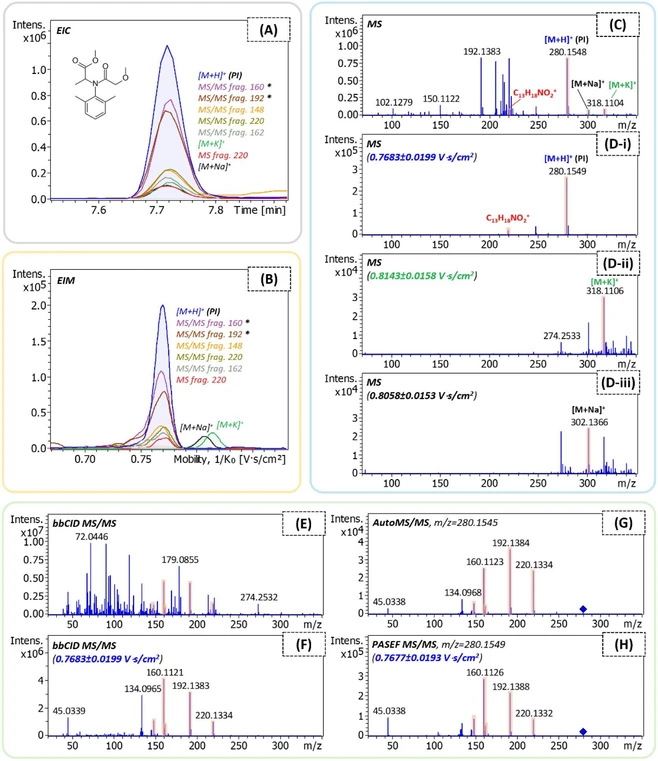 Anal. Chem. (2026): Figure 2. Illustration of the main LC-TIMS-QTOF MS information retrieved for metalaxyl in the positive ionization mode. Gray panel (LC dimension): Extracted Ion Chromatograms (EICs) (A) for the pseudomolecular ion, the adduct ions, and the MS and bbCID MS/MS fragment ions with m/z window of ±0.005. Yellow panel (TIMS dimension): Respective Extracted Ion Mobilograms (EIMs) (B) with a retention time (RT) range of ±0.07 min. In A and B, the principal ion is indicated as PI, while the mandatory qualifier ions are marked with an asterisk. Blue panel (MS dimension): MS scans corresponding to the RT range of the chromatographic peak without mobility filtering (C), and with filtering based on the mobility range of different ions’ mobility peaks (D-i, D-ii, D-iii). Green panel (MS/MS dimension): Left: bbCID MS/MS scans corresponding to the RT range of the chromatographic peak without (E) and with mobility filtering based on the mobility range of the PI’s mobility peak (F). Right: MS/MS spectra for the PI in the AutoMS/MS (G) and the PASEF MS/MS (H) injections. In E–H, the common fragments are highlighted.
The role of mobility filtering in refining MS spectra was also investigated. When the MS spectrum corresponding to the RT range of metalaxyl was filtered with the mobility window of [M + H]+ and C13H18NO2+, all ions with different mobilities were resolved. These included both coeluting analytes and matrix components, and other metalaxyl-derived ions such as [M + Na]+ and [M + K]+ (Figure 2D-i). The same was observed when the MS spectrum was filtered with the 1/K0 range of [M + K]+ (Figure 2D-ii) or [M + Na]+ (Figure 2D-iii), isolating only the adduct ions. It was observed that in these deconvoluted MS spectra, the mobility filtering windows differed based on the mobility peak width of each ion. In the database, the windows were set at ±0.020 V·s/cm2 for [M + H]+ and C13H18NO2+, and at ±0.015 V·s/cm2 for [M + Na]+ and [M + K]+, underscoring the importance of selecting optimal ranges for each ion. After comparing the MS ions’ intensities, the most abundant ion was designated as the principal one, which was the pseudomolecular ion, while the others were assigned as qualifier ions, listed in descending order of intensity. However, none of these MS1 qualifier ions was characterized as mandatory for identification due to their <50% relative abundance compared to the principal ion. Consequently, the filtering procedure demonstrates how ion-specific mobility windows yield “cleaner” MS spectra, facilitating reliable detection of principal and (mandatory) qualifier ions, and reducing the likelihood of false-positive or false-negative results during identification in samples.
The same example was used to demonstrate the assignment of (mandatory) qualifier ions in MS/MS spectra. The fragment ions of metalaxyl were recorded in bbCID MS/MS scans (Figure 2E) and confirmed against the AutoMS/MS mode. Here, the AutoMS/MS spectrum of the pseudomolecular ion was available (Figure 2G). Comparison with the corresponding injection in PASEF mode could also be performed; also here, one PASEF MS/MS spectrum corresponding to the pseudomolecular ion was acquired (Figure 2H). The observed differentiation in the intensity profiles of fragment ions among different acquisition modes was attributed to the different collision energies and did not affect the produced fragment ions. When creating the EIMs for all bbCID MS/MS fragments detected in the nonmobility-filtered bbCID MS/MS scan (Figure 2B), it was obvious that all of them had the same CCS values as [M + H]+, which indicated their formation from the fragmentation of [M + H]+ and/or the MS1 fragment C13H18NO2+. To construct the database, the bbCID MS/MS spectrum filtered with the mobility range of [M + H]+ was used to rank fragments by decreasing abundance and assign the mandatory ones (Figure 2F). C11H14N+ (m/z = 160.112) and C12H18NO+ (m/z= 192.138) were designated as mandatory due to their relative abundance exceeding 50% of the principal ion’s abundance. Designating bbCID MS/MS fragments as qualifier ions and further distinguishing the most intense ones as mandatory is considered to enhance the identification procedure in samples.
Evaluating the Impact of the TIMS Dimension and Mobility Filtering in Sample Characterization
To assess the impact of incorporating CCS values and mobility filtering in the LC-HRMS target screening framework both qualitatively and quantitatively, a human urine sample spiked with contaminants at 25 μg/L (5 μg/L instrumental concentration, 5 times dilution) was analyzed without (TIMS OFF) and with the TIMS dimension (TIMS ON). As illustrated in Table S8, 144 compounds were successfully identified in both TIMS OFF and ON. The CCS error criterion available in TIMS ON increased the confidence of these findings by +1.5 IPs. Notably, mobility filtering in TIMS ON enabled the detection of qualifier ions, which were not detectable in TIMS OFF, resulting in the reporting of 21 additional compounds with higher IP scores. Since mandatory qualifier ions had to be detected alongside the principal ion within the proposed approach, 15 of these cases were rejected in TIMS OFF instead of being reported with lower IPs. This approach may negatively influence detection limits in TIMS OFF, but is proposed as a compromise in order to achieve higher reliability in the results of the LC-HRMS wide-scope target screening. For the other 6 compounds, nonmandatory ions were solely reported in the database, which could not be detected in TIMS OFF, indicating the need for further evaluation by reanalysis under different instrumental parameters to produce qualifier ions rather than rejecting the finding. On the other hand, the nature of the TIMS dimension, where interfering ions are separated, may result infrequently in a decreased signal-to-noise ratio at low concentrations. This was the case for 8 compounds in TIMS ON, for which no qualifier ions were detected, in contrast to TIMS OFF. Seven of them were rejected, while 1 should be further evaluated, according to the previous suggestion. Similarly, 9 compounds were rejected in both modes due to the nondetection of mandatory qualifier ions, while 14 compounds needed further evaluation due to the absence of qualifier ions from the database.
To better demonstrate how mobility filtering improved the interpretability of qualifier ion data, two representative examples are illustrated in Figure 4. In TIMS OFF mode, norfentanyl was rejected due to poor isotopic pattern fitting and the absence of its mandatory qualifier ion (false-negative result) (Figure 4A-i). However, with TIMS ON, norfentanyl was confidently identified. Despite the poor isotopic pattern fitting, the identification was achieved through the provision of an acceptable CCS value and the detection of the mandatory bbCID MS/MS fragment (m/z = 84.081), enabled by the TIMS dimension and mobility filtering. Mobility filtering removed the background signal caused by the presence of coeluting isobaric ions, allowing the detection of the mandatory qualifier ion (Figure 4A-ii). Similarly, mefexamide, which lacked qualifier ions in TIMS OFF (Figure 4B-i), was successfully identified in TIMS ON. This was attributed to the acceptable CCS error and the detection of three qualifier ions in the ion mobility-filtered bbCID MS/MS spectrum; not only was the mandatory bbCID MS/MS fragment ion (m/z = 208.097) detected, but also two additional nonmandatory fragment ions (m/z = 137.056 and 85.052) for confirmation (Figure 4B-ii). Also, in this case it is obvious that mobility filtering allowed qualifier ions to be distinguished from the background signal, while in TIMS OFF the chromatographic peak of the mandatory qualifier ion was barely distinguished from the background (S/N < 3). The mandatory qualifier ions of both norfentanyl and mefexamide were detected at instrumental concentration levels higher than 20 μg/L in TIMS OFF, in which identification was considered confident, while both compounds were detected at lower concentration levels than 5 μg/L in TIMS ON. Although higher-intensity qualifier ions could in some cases be obtained by applying collision energies optimized for individual analytes, this is not readily feasible in LC-HRMS wide-scope target screening, where thousands of compounds are covered using a single generic method. Under such conditions, collision energy settings necessarily represent a compromise across structurally diverse analytes, and therefore may not be optimal for all compounds. Consequently, it is evident that the incorporation of the TIMS dimension in LC-HRMS facilitates the identification of a larger number of compounds during data treatment with the correct postacquisition strategy, via both providing the additional criterion of CCS error and enhancing the MS dimension through mobility filtering, which enables the detection of low-intensity qualifier ions after deconvolution from irrelevant background ions. As a result, the LC-TIMS-QTOF MS methodologies have the potential to achieve lower LODs and LOQs.
![Anal. Chem. (2026): Figure 4. Comparison of data acquired by the analysis of a urine sample spiked at Cinstrumental = 5 μg/L using LC-QTOF MS without (TIMS OFF) (i) and with the TIMS dimension (TIMS ON) (ii). For norfentanyl (A) and mefexamide (B), the Extracted Ion Chromatograms (EICs) (m/z window of ±0.005) for [M + H]+ (PI) and the bbCID MS/MS fragment ions, and the corresponding MS and/or bbCID MS/MS spectra are shown in (i), while in (ii) the respective filtered EICs (mobility window of ±0.015 V·s/cm (2)), Extracted Ion Mobilograms (EIMs) (m/z window of ±0.005 and RT range of ±0.08 min), along with the corresponding MS and/or bbCID MS/MS spectra are illustrated. In EICs and EIMs, the PI and the mandatory qualifier ion (QI) are shown in blue and orange, respectively. Fulfilled identification criteria are highlighted. The mandatory QI (m/z = 84.081) for norfentanyl (A) and the mandatory QI (m/z = 208.097) along with two additional QIs (m/z = 137.060 and 85.052) for mefexamide (B) were detected only in TIMS ON due to the improved spectral quality through mobility filtering. In TIMS OFF, there was high background signal that impacted the detection of the qualifier ions.](https://lcms.labrulez.com/labrulez-bucket-strapi-h3hsga3/Anal_Chem_2026_Figure_4_Comparison_of_data_acquired_by_the_analysis_of_a_urine_sample_3983e6fe91_l.webp) Anal. Chem. (2026): Figure 4. Comparison of data acquired by the analysis of a urine sample spiked at Cinstrumental = 5 μg/L using LC-QTOF MS without (TIMS OFF) (i) and with the TIMS dimension (TIMS ON) (ii). For norfentanyl (A) and mefexamide (B), the Extracted Ion Chromatograms (EICs) (m/z window of ±0.005) for [M + H]+ (PI) and the bbCID MS/MS fragment ions, and the corresponding MS and/or bbCID MS/MS spectra are shown in (i), while in (ii) the respective filtered EICs (mobility window of ±0.015 V·s/cm (2)), Extracted Ion Mobilograms (EIMs) (m/z window of ±0.005 and RT range of ±0.08 min), along with the corresponding MS and/or bbCID MS/MS spectra are illustrated. In EICs and EIMs, the PI and the mandatory qualifier ion (QI) are shown in blue and orange, respectively. Fulfilled identification criteria are highlighted. The mandatory QI (m/z = 84.081) for norfentanyl (A) and the mandatory QI (m/z = 208.097) along with two additional QIs (m/z = 137.060 and 85.052) for mefexamide (B) were detected only in TIMS ON due to the improved spectral quality through mobility filtering. In TIMS OFF, there was high background signal that impacted the detection of the qualifier ions.
Anal. Chem. (2026): Figure 4. Comparison of data acquired by the analysis of a urine sample spiked at Cinstrumental = 5 μg/L using LC-QTOF MS without (TIMS OFF) (i) and with the TIMS dimension (TIMS ON) (ii). For norfentanyl (A) and mefexamide (B), the Extracted Ion Chromatograms (EICs) (m/z window of ±0.005) for [M + H]+ (PI) and the bbCID MS/MS fragment ions, and the corresponding MS and/or bbCID MS/MS spectra are shown in (i), while in (ii) the respective filtered EICs (mobility window of ±0.015 V·s/cm (2)), Extracted Ion Mobilograms (EIMs) (m/z window of ±0.005 and RT range of ±0.08 min), along with the corresponding MS and/or bbCID MS/MS spectra are illustrated. In EICs and EIMs, the PI and the mandatory qualifier ion (QI) are shown in blue and orange, respectively. Fulfilled identification criteria are highlighted. The mandatory QI (m/z = 84.081) for norfentanyl (A) and the mandatory QI (m/z = 208.097) along with two additional QIs (m/z = 137.060 and 85.052) for mefexamide (B) were detected only in TIMS ON due to the improved spectral quality through mobility filtering. In TIMS OFF, there was high background signal that impacted the detection of the qualifier ions.
Conclusions
LC-HRMS wide-scope target screening is a powerful approach for environmental monitoring and human biomonitoring. However, it still faces challenges in achieving confident identifications, separating coeluting compounds, and ensuring accurate quantification. In this study, it was demonstrated how the integration of the TIMS dimension in LC-HRMS and the development of an enriched analyte-specific database can address these limitations and substantially improve target screening frameworks.
First, a comprehensive database containing ∼2500 TIMS-derived CCS values for (pseudo)molecular ions and adducts of 1948 contaminants was introduced. These values were validated for precision and accuracy showing high consistency with CCS data reported across different IMS-HRMS platforms. By linking CCS values to each MS and bbCID MS/MS ion species, the database enabled the application of the orthogonal %ΔCCS criterion during identification, reinforcing confidence in target screening results. Second, ion-specific mobility filtering was applied to MS and bbCID MS/MS spectra, producing “cleaner” data by removing background from coeluting analytes and matrix components. This approach improved the detection of qualifier ions, lowered detection limits, increased the number of reliably identified compounds, and reduced false positives and false negatives. Finally, the concept of mandatory qualifier ions was introduced, which is defined by high-abundance adducts and/or fragments. Thus, qualifier ions with intensity ≥50% compared to the principal ion’s intensity must accompany the principal ion for positive identification. This analyte-specific approach overcomes a key limitation of current guidelines and practices, which typically consider only the number of qualifiers without accounting for ionization or fragmentation behavior.
Although the development of an enriched database and the resulting framework including such extensive LC, TIMS, MS, and MS/MS information were time-consuming and demanded thorough data evaluation, their implementation in wide-scope target screening studies significantly eliminates laborious and often unreliable data processing, thus achieving fast and highly confident results during the identification procedure in complex environmental and biological samples. These advances pave the way for more robust LC-IMS-HRMS target screening studies and provide a framework for the future integration of IMS-derived information into regulatory and routine monitoring applications.