Marketplace products from category Mass detectors focused on LC/QQQ from Agilent Technologies - page 1

Agilent Ion Injector G1964-80112 for the 6495D LC/TQ, 1.2 mm × 90 mm, designed for stable and sensitive LC-MS/MS analysis.
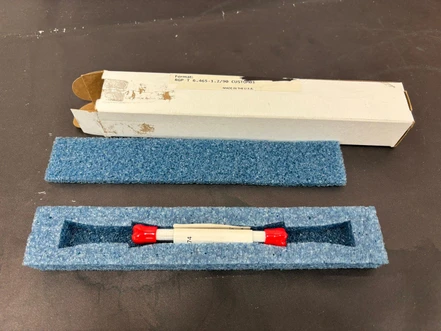
Agilent G1964-80112 Ion Injector for 6495D LC/TQ ensures stable ion transfer with 1.2 mm ID × 90 mm design for high sensitivity and durability.
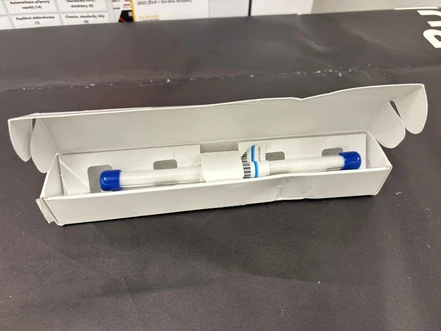
Agilent FS ion injector (0.6 mm ID, 180 mm) for Agilent mass spectrometers, designed for stable and reproducible ion transfer from the ion source to the analyzer.

Agilent G1964-80112 Ion Injector for 6495D LC/TQ ensures stable ion transfer with 1.2 mm ID × 90 mm design for high sensitivity and durability.


The Agilent 6430 Triple Quadrupole LC/MS System is designed for high-performance, quantitative analysis in connection with UHPLC, providing unmatched speed, sensitivity, and flexibility for complex assays.
The Agilent 6410 Triple Quadrupole LC/MS System is a high-performance mass spectrometer designed for sensitive and precise quantitative analysis. It supports multiple ionization modes, including ESI and APCI, and features fast polarity switching, a wide dynamic range, and automated tuning. Ideal for applications in pharmaceuticals, environmental testing, and food safety, the 6410 ensures reliable and efficient high-throughput analysis.
The Agilent 6460 Triple Quadrupole LC/MS System is a high-performance mass spectrometer designed for sensitive, fast, and reliable quantitative analysis. Featuring Agilent Jet Stream Technology for enhanced ion generation and desolvation, the 6460 delivers attogram-level sensitivity, making it ideal for detecting trace-level compounds in complex matrices.
The Agilent 6400 Series Triple Quadrupole LC/MS System is a high-performance liquid chromatography-mass spectrometry (LC/MS) system designed for advanced analytical applications. It offers exceptional sensitivity, speed, and accuracy, making it ideal for complex sample analysis.
The Agilent 6490 Triple Quadrupole LC/MS System sets new standards for sensitivity and detection limits. With innovative iFunnel technology, it delivers zeptomole-level sensitivity at conventional flow rates, making it the ideal choice for complex matrices and trace-level quantification.
Related content