Premier MALS
The DAWN instrument is the premier Multi-Angle static Light Scattering (MALS) detector for absolute characterization of the molar mass and size of macromolecules and nanoparticles in solution. It offers the highest sensitivity, the widest range of molecular weight, size, and concentration, and the largest selection of configurations and optional modules for enhanced capabilities.
Separation First
MALS is most often used in conjunction with a separation system such as Gel Permeation Chromatography (GPC-MALS), Size Exclusion Chromatography (SEC-MALS), or Field-Flow Fractionation (FFF-MALS) to determine distributions of mass, size, and composition, independent of column calibration by reference standards.
Supported by ASTRA ™ Software
ASTRA Software and its built-in analysis modules support the DAWN MALS instrument, providing the most versatile analysis available for online multi-angle and dynamic light scattering measurements.
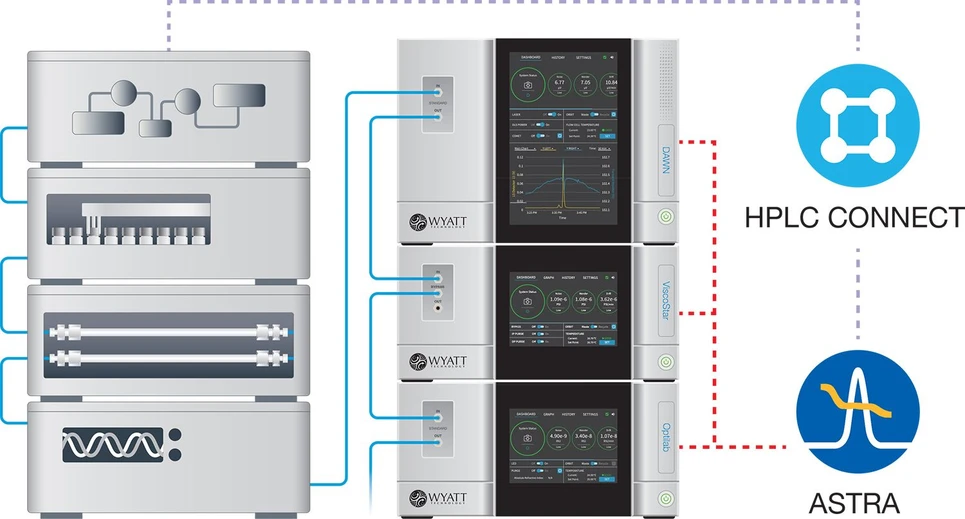 Waters DAWN™ Multi Angle Light Scattering (MALS) Instrument: ASTRA Software
Product description
The DAWN and its companion Optilab ™ dRI detector are the established benchmarks for MALS analysis, cited in thousands of peer-reviewed publications. Multi-angle light scattering detection is indispensable for use with GPC and HPLC-SEC in order to obtain reliable molecular mass distributions and information on molecular conformation, branching ratio, fragments and aggregates.
SEC-MALS with a DAWN and Optilab characterizes conformation and branching of synthetic and natural polymers larger than 10 nm in rms radius R g . The addition of a ViscoStar ™ differential viscometer creates a GPC triple-detection system that can analyze molecular conformation and size below the R g limit of 10 nm and determine Mark-Houwink Sakurada coefficients.
The combination of a UV/Vis absorbance detector with a DAWN instrument and Optilab refractive index detector creates a UV-MALS-RI triple-detection system, for analysis of copolymers and protein conjugates (glycoproteins, PEGylated proteins, surfactant-bound membrane proteins, etc.). With the addition of a WyattQELS ™ DLS module for size determination, protein conformation may be analyzed.
- Mw from 200 Da to 1000 MDa
- Sensitivity: 10 ng/mL 100 kDa polystyrene in THF, 0.4 µg/mL BSA (66.4 kDa) in PBS
- Rg from 10 to 500 nm, up to 1000 nm with shape-specific models
- Ultra-stable, high-power laser
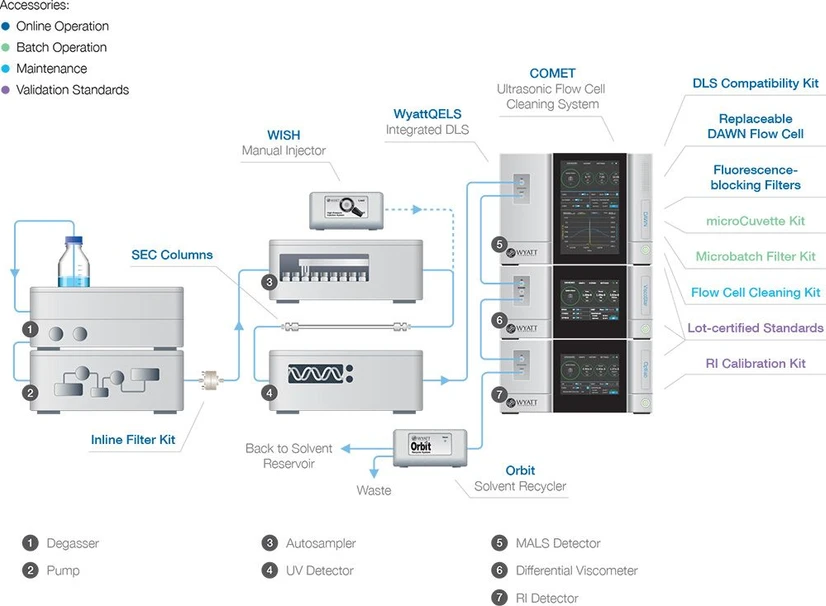 Waters DAWN™ Multi Angle Light Scattering (MALS) Instrument: Accessories
The DAWN may also be used in batch (off-line) mode to characterize the weight-average molar mass, z-average size and second virial coefficient of unfractionated samples.
In conjunction with a Calypso ™ CG-MALS system, the DAWN characterizes macromolecular interactions, label-free and immobilization-free: affinity and absolute stoichiometry of self- and hetero-association of simple or complex molecular systems. The Calypso system also automates the determination of second virial coefficients, cross virial coefficients, average molar masses and sizes.
Ultrasonic Cleaning Included
Each DAWN instrument includes an embedded COMET ™ ultrasonic transducer that cleans the flow cell automatically by agitating the fluid and loosening particles from the glass surfaces.
Temperature-Controlled Models
- Ambient model
- Ultra-High-Temperature (UHT) model, from ambient up to +210 °C
- Standard Peltier heated/cooled (H/C) model, temperature control from -15 °C to +150 °C
Specifications
Measurement Capabilities
- Molar Mass Range: From 200 Da to 1 GDa, depending on dn/dc, sample concentration, and chromatography conditions.
- Molecular Size (Radius of Gyration, Rg): Approximately 10 nm to 500 nm, extendable to 1000 nm with shape-specific models.
- Hydrodynamic Radius (Rh):
- Flow mode: 0.5 nm to 300 nm (depending on configuration and flow rate).
- Batch mode: 0.5 nm to 1 µm (requires WyattQELS™ DLS module or DynaPro™ NanoStar™ with fiber optic connection).
- Sensitivity: Detects as little as 10 ng of 100 kDa polystyrene in THF or 200 ng of BSA in PBS, using a standard 7.8 mm x 300 mm SEC column and no post-column filter.
Fluidics and Compatibility
- Mobile Phase: Compatible with both aqueous and organic solvents.
- Wetted Materials: 316 stainless steel, fused silica or F2 glass, and Kalrez.
Optical System and Detectors
- MALS Detectors: 18 photodiodes with high gain and wide dynamic range for multi-angle light scattering.
- Auxiliary Detectors:
- Laser monitor for stabilization
- Forward transmission monitor to improve data quality and correct for sample absorption
- Dynamic Range: 3,300,000:1
- Optional DLS Detection:
- Integrated WyattQELS™ module inside the DAWN
- External fiber optic connection with DynaPro NanoStar or Mobius DLS-ELS instruments
Laser Specifications
- Wavelength: Standard 658 nm ± 4 nm; optional 785 nm for fluorescent samples
- Power Control: Programmable from 10% to 100%
Flow Cell Options
- Fused Silica: Ideal for solvents with refractive index < 1.50
- F2 Glass: Recommended for solvents with refractive index > 1.50
Temperature Control Options
- Ambient operation
- Heated/Cooled (HC): -15 °C to +150 °C
- Ultra-High Temperature (UHT): Ambient to +210 °C
Electronics and Connectivity
- Analog Inputs: 4 differential inputs, 24-bit resolution, range -10 V to +10 V
- Analog Outputs: 2 outputs from selectable measurement channels, -10 V to +10 V
- I/O Options: Alarm in/out, auto-inject control, and Orbit™ valve integration
- Computer Interface: Ethernet
- Display: 10.1” high-resolution capacitive touchscreen with multi-touch controls
Instrument Dimensions
- Size: 58 cm (L) x 36 cm (W) x 26 cm (H)
Other MALS Instruments
- miniDAWN™ - Second only to the DAWN in sensitivity. Incorporates detectors at 3 angles to determine molar masses from 200 Da to 10 MDa and radii from 10 – 50 nm. Ambient only.
- microDAWN™ - The first MALS detector for UHPLC, with interdetector dispersion as low as 1.5 µL. Incorporates detectors at 3 angles to determine molar masses from 200 Da to 20 MDa and radii from 10 – 50 nm. Ambient only.
- ultraDAWN™ - Measures multi-angle light scattering and reports the results – weight-average molecular weight Mw and rms radius Rg – in real time.



