LCMS
More information
WebinarsAbout usContact usTerms of use
LabRulez s.r.o. All rights reserved. Content available under a CC BY-SA 4.0 Attribution-ShareAlike
Manufacturer
Thermo Fisher Scientific
A unique company dedicated to serving science helping our customers drive productivity and accelerate results. Through our premier brands – Thermo Scientific, Applied Biosystems, Invitrogen, Fisher Scientific and Unity Lab Services.
Distributor
Thermo Fisher Scientific (EMEA)
Thermo Fisher Scientific Inc. is the world leader in serving science, with annual revenue of approximately $40 billion. Our Mission is to enable our customers to make the world healthier, cleaner and safer.
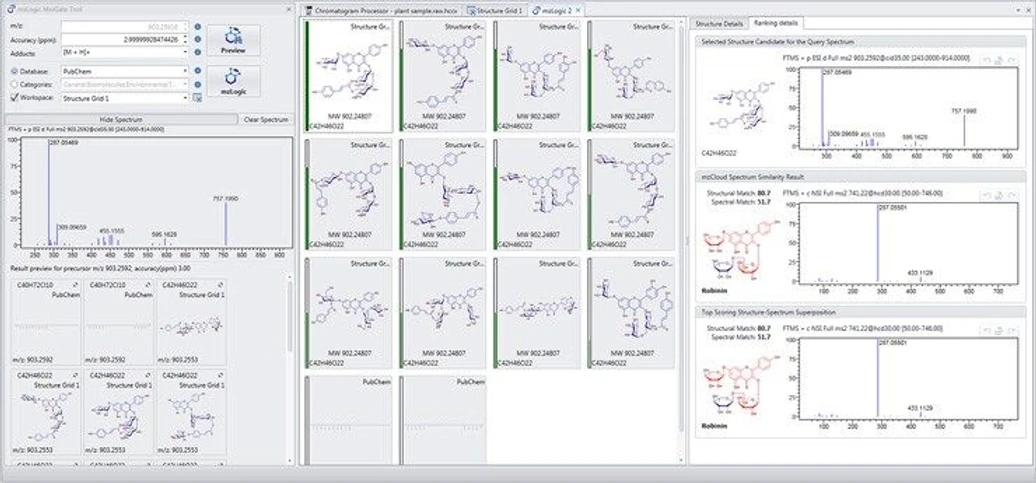
Thermo Scientific mzLogic Data Analysis AlgorithmmzLogic solves a key challenge in small molecule identification by enabling the characterization of unknowns when high-quality MSⁿ data yield no matches in spectral libraries.
Features

Thermo Scientific mzLogic Data Analysis Algorithm

Accelerate unknown small molecule identification with mzLogic

The mzLogic data analysis algorithm addresses one of the biggest challenges for small molecule characterization and identification-when, despite having sufficient high-quality and high-resolution MSn mass spectrometric data, there is no match in any spectral library, meaning you have an unknown.

mzLogic combines the extensive fragmentation information available within the mzCloud online advanced mass spectral library with the information in numerous online structural databases. As a result, mzLogic allows you to take thousands of potential structural candidates and automatically rank them based upon spectral similarity and sub-structural information – delivering confident candidates for your true unknowns.

Key benefits

Combine the benefits of multiple libraries and databases    

The ability of mzLogic to combine the extensive, high-quality and high-resolution accurate mass, multi-stage (MSn) fragmentation information in mzCloud, with numerous online structural databases provides the greatest chance to confidently identify unknowns.

Take lengthy guesswork out of unknown identification    

mzLogic uses the data from mzCloud and multiple other data sources to identify common sub-structural features from your MSn data, explaining as much of your fragmentation data as possible before the next stages of identification.

Go from thousands of potential candidates to a handful

Using elemental composition to search structural databases can return thousands of potential candidates; mzLogic uses MSn data and mzCloud fragmentation database information to explain as much structural information as possible, reducing thousands of potentials to a handful of confident candidates based upon structural similarity.

Thermo Scientific mzLogic Data Analysis Algorithm: Take the guesswork out of small molecule unknown identification through the combination of mzLogic algorithm and the high quality, structurally diverse mass spectral fragmentation information contained within mzCloud, to propose and confirm structural identification.Thermo Scientific mzLogic Data Analysis Algorithm: Take the guesswork out of small molecule unknown identification through the combination of mzLogic algorithm and the high quality, structurally diverse mass spectral fragmentation information contained within mzCloud, to propose and confirm structural identification.

How does your data relate to mass spectral libraries?

Whether you are working to better characterize and understand metabolism and drug analytes, food and environmental samples, designer drugs or extractables and leachables, the use of mass spectral libraries and online databases can help identify compounds in your samples. However, with increasing crossover between compound classes, new impurities, subtle compound transformations or metabolism and degradation products, sometimes no compelling match is made to the libraries you use.

Acquiring comprehensive high-resolution accurate- mass MS/MS and MSn data has been simplified with data acquisition tools such as AcquireX, and general hardware improvements. Obtaining mass spectral libraries that contain broad chemical diversity, extensive fragmentation and reliable and concise data has been the biggest challenge.

The mzCloud mass spectral database is the largest (in terms of total spectra and data per compound) publicly available online mass spectral fragmentation library. It contains high-resolution accurate-mass (HRAM) spectra, including exhaustive high-resolution MS/MS and multi-stage MSn spectra. Each entry contains considerable metadata and, most importantly, has been extensively curated (i.e., filtered, recalibrated, averaged, and annotated) to provide absolute confidence in the quality of its contents.

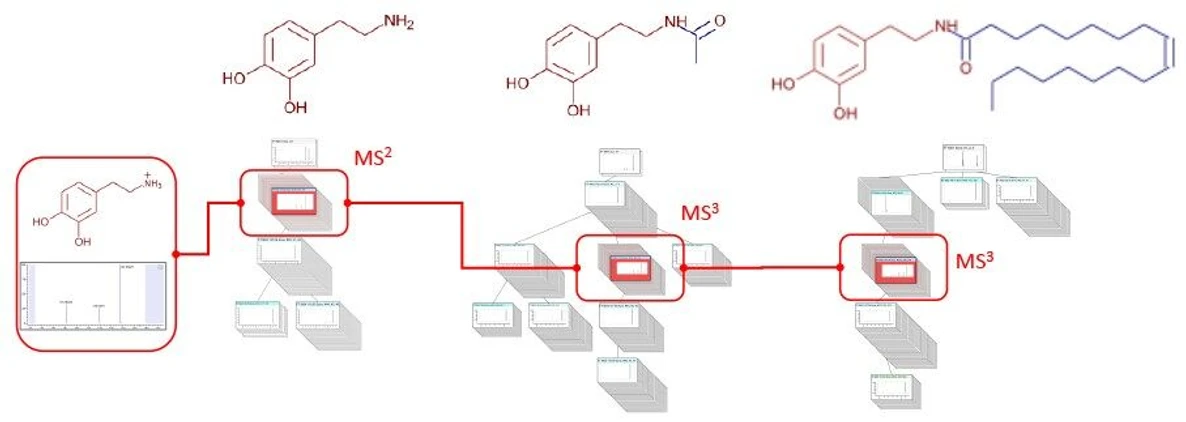
Thermo Scientific mzLogic Data Analysis Algorithm: High quality MS, MS/MS and MSn data can be used to interrogate the fully curated and annotated mass-spectral fragmentation library, mzCloud. Common substructural information can be used from the extensive fragmentation information to aid in unknown compound identification using mzLogic algorithm.Thermo Scientific mzLogic Data Analysis Algorithm: High quality MS, MS/MS and MSn data can be used to interrogate the fully curated and annotated mass-spectral fragmentation library, mzCloud. Common substructural information can be used from the extensive fragmentation information to aid in unknown compound identification using mzLogic algorithm.

How does mzLogic identify unknowns?

Each mzCloud library entry contains extensive fragmentation information, which has been acquired using both a range of collision energies and fragmentation techniques (collision induced and higher energy collisional dissociation, CID and HCD). When this information is combined with the broad chemical diversity of library entries, the likelihood that some or all of an unknown structure can be matched against an existing fragment within the library increases.

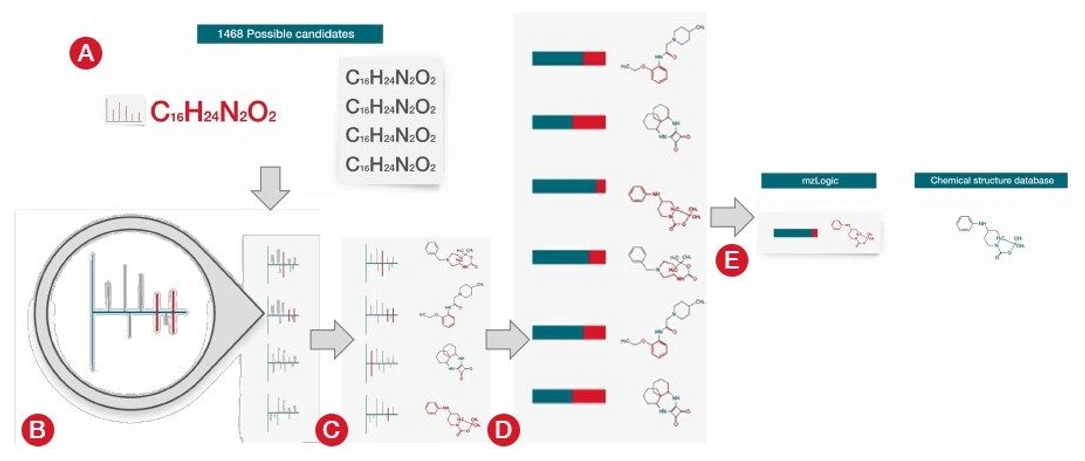
Thermo Scientific mzLogic Data Analysis Algorithm: mzLogic reduction of putative candidates using online structural databases and the extensive fragmentation information contained within mzCloud.Thermo Scientific mzLogic Data Analysis Algorithm: mzLogic reduction of putative candidates using online structural databases and the extensive fragmentation information contained within mzCloud.

As shown in the figure above, mzLogic is available as part of the Mass Frontier software and Compound Discoverer software packages, and works as follows:

  1. Online databases, such as ChemSpider, which contains more than 70 million structures, can be searched using an elemental composition. Even with the ability to use the high-resolution and accurate mass capabilities of Orbitrap mass analyzers to reveal fine isotopic information, many hundreds or even thousands of potential structures could match the elemental composition.
  2. The high-quality fragmentation information contained within mzCloud is compared to experimental data.
  3. mzLogic rapidly identifies structurally similar fragments through forward and reverse searches.
  4. Based upon the identified sub-structures, the structural candidates from the online search are ranked in order of how much of the structure can be explained through the sub-structural matching.
  5. This ranking based upon the use of real data, takes many hundreds or thousands of potential candidates and reduces them to a significantly smaller list of putative structures, with visualization tools to explain the ranking and structure accounted for by library fragments.

What is the next step to confirm any potential candidates?

The ranked results from using mzLogic will either show that all the structure can be accounted for in that candidate or that there is still some structural information from the proposed candidate that cannot be accounted for. MS/MS and/or MSn fragmentation spectra typically contains substantial amounts of structural information, which can be further investigated using Compound Discoverer or Mass Frontier software.

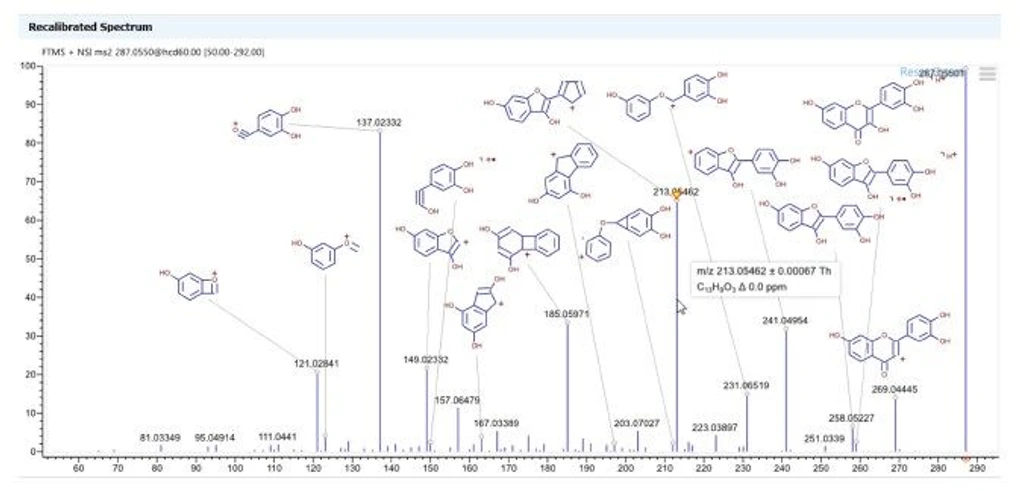
Where a complete, in-depth analysis of MSn fragmentation data is required, Mass Frontier software provides visualization and understanding of fragmentation pathways using extensive MSn data. The Fragments and Mechanism tool simulates unimolecular dissociation of the proposed structures, including rearrangements and predicted fragments, and can be used to explain the experimental fragmentation data through fragment annotations to help identify which candidates are indeed plausible. Rather than coded fragmentation algorithms, Mass Frontier software bases fragmentation on mechanisms published in more than 95% of all peer-reviewed scientific journals.

This approach adds greater certainty to putative structure identification through the deep fragmentation and characterization information provided by the high-quality data and extensive spectral trees in mzCloud.

Thermo Scientific mzLogic Data Analysis Algorithm: Confident structural elucidation using automated fragmentation annotation of MSn spectral trees. Fragmentation pathways can also be predicted based upon submission of a structure and makes full use of the HighChem Fragmentation Library. This library contains information from more than 52,000 fragmentation schemes, 217,000 individual reactions, 256,000 chemical structures and 216,000 decoded mechanisms from peer reviewed literature.Thermo Scientific mzLogic Data Analysis Algorithm: Confident structural elucidation using automated fragmentation annotation of MSn spectral trees. Fragmentation pathways can also be predicted based upon submission of a structure and makes full use of the HighChem Fragmentation Library. This library contains information from more than 52,000 fragmentation schemes, 217,000 individual reactions, 256,000 chemical structures and 216,000 decoded mechanisms from peer reviewed literature.
Manufacturer
Thermo Fisher Scientific
A unique company dedicated to serving science helping our customers drive productivity and accelerate results. Through our premier brands – Thermo Scientific, Applied Biosystems, Invitrogen, Fisher Scientific and Unity Lab Services.
Distributor
Thermo Fisher Scientific (EMEA)
Thermo Fisher Scientific Inc. is the world leader in serving science, with annual revenue of approximately $40 billion. Our Mission is to enable our customers to make the world healthier, cleaner and safer.
 

News

Toggle
Why Compound Discoverer 3.4 Software is Worth Your Attention!
Article | Product

Why Compound Discoverer 3.4 Software is Worth Your Attention!

Discover Thermo Scientific Compound Discoverer 3.4 – faster processing, improved compound ID, integrated LipidSearch, new QC tools, molecular networking, and Ardia platform support.
Thermo Fisher Scientific
tag
share
more
5 Things to Consider When Selecting Software for Targeted MS Quantitation
Article | Software

5 Things to Consider When Selecting Software for Targeted MS Quantitation

Choosing the right software for targeted MS quantitation boosts accuracy, compliance, scalability, and remote access—empowering labs to streamline workflows and protect data integrity.
Thermo Fisher Scientific
tag
share
more
Other projects
GCMS
ICPMS
Follow us
More information
WebinarsAbout usContact usTerms of use
LabRulez s.r.o. All rights reserved. Content available under a CC BY-SA 4.0 Attribution-ShareAlike