Mass spectral libraries and databases may be required to identify unknown compounds when reference standards are not available. This is particularly true for studies in areas such as metabolomics, forensic toxicology, food & beverage, environmental emerging contaminants or extractables & leachables.
In these situations, a mass spectral library, particularly a high-resolution and accurate-mass MSn fragmentation library, such as the mzCloud mass spectral library, can provide the information required to confidently identify unknown compounds.
Comprehensive curation of all library content with extensive, fully annotated and searchable fragmentation spectra to provide confidence in your results.
Identify unknowns with automated deconvolution and library searching against extensive fragmentation spectra covering a wide chemical space, including small molecule applications.
With solutions to cover infusion or LC-MS, nominal or high-resolution data, you can be sure that your MSn spectra will provide you with actionable results, even when there is no spectral library match.
Search for free online at mzCloud.org, or directly access through the Thermo Scientific Compound Discoverer and Mass Frontier software packages. Not online? mzVault provides you with the ability to perform offline spectral library searching.
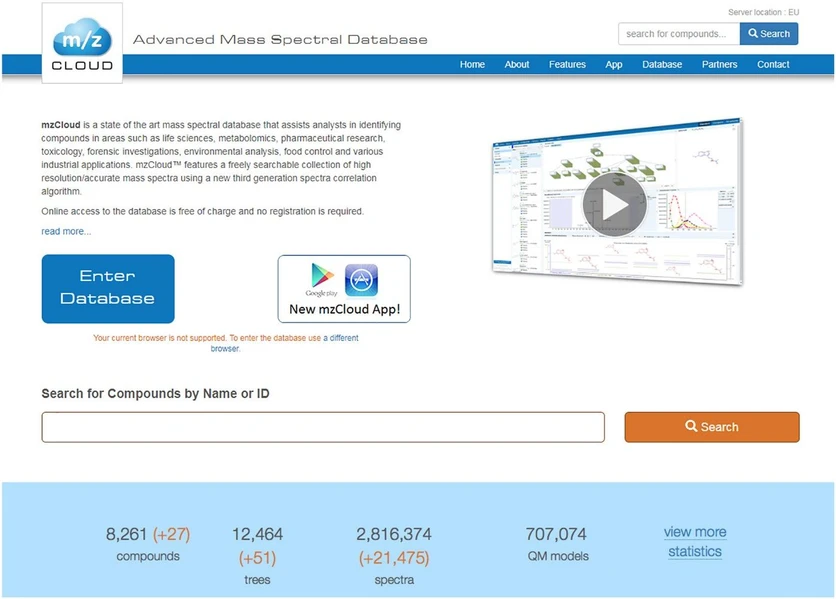
Thermo Scientific mzCloud Mass Spectral Library: mzCloud is easily and freely accessed online. Anyone can search, review, and use its extensive information. Note that the numbers above were correct at time of publication. For the most up to date numbers visit mzCloud.org.mzCloud is an extensively curated, high-quality mass spectral fragmentation library that contains significant amounts of spectra and metadata for each entry. Each entry also includes exhaustive high-resolution MS/MS and multi-stage MSn spectra, which have been acquired at various collision energies and using different fragmentation techniques.
Each raw mass spectrum has been filtered to remove noise, recalibrated to ensure absolute mass accuracy, fully annotated and curated to ensure quality and consistency.
Finally, the contents of the library are updated weekly to provide coverage of a wide chemical space, ensuring relevance to all small-molecule application areas.
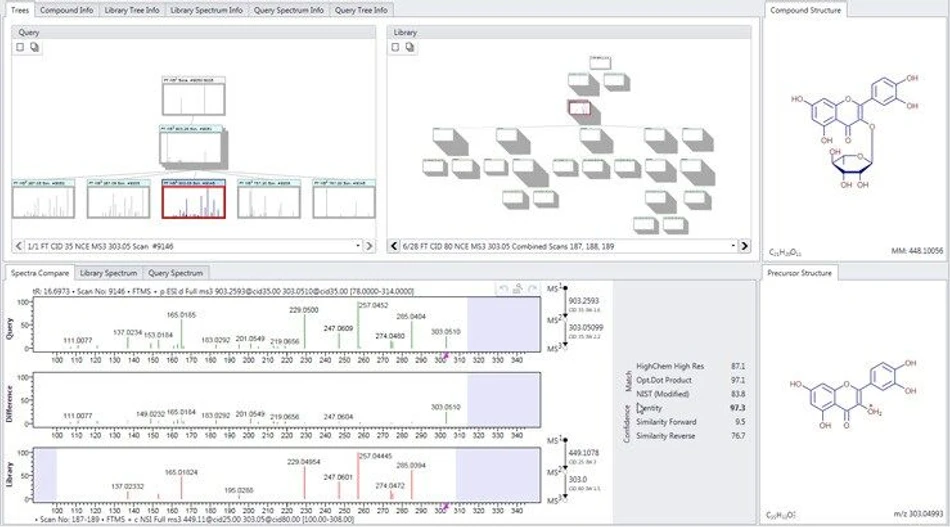
Thermo Scientific mzCloud Mass Spectral Library: Example of the Mass Frontier software utilizing the contents of mzCloud to identify an unknown compound through a sub-structural search; the experimental fragmentation spectrum (top left) is searched against the mzCloud mass spectral database, with corresponding spectral hits shown in a given spectral tree (top, middle), with supporting spectral information (bottom left) and the identified precursor structure from the matched fragmentation spectra (bottom right), and the library compound structure from which the fragment originated (top right).Distinguishing among types of databases is important, as the contents and quality of the contents typically differs significantly and may have an impact upon the reliability of the data and the confidence in any results obtained.
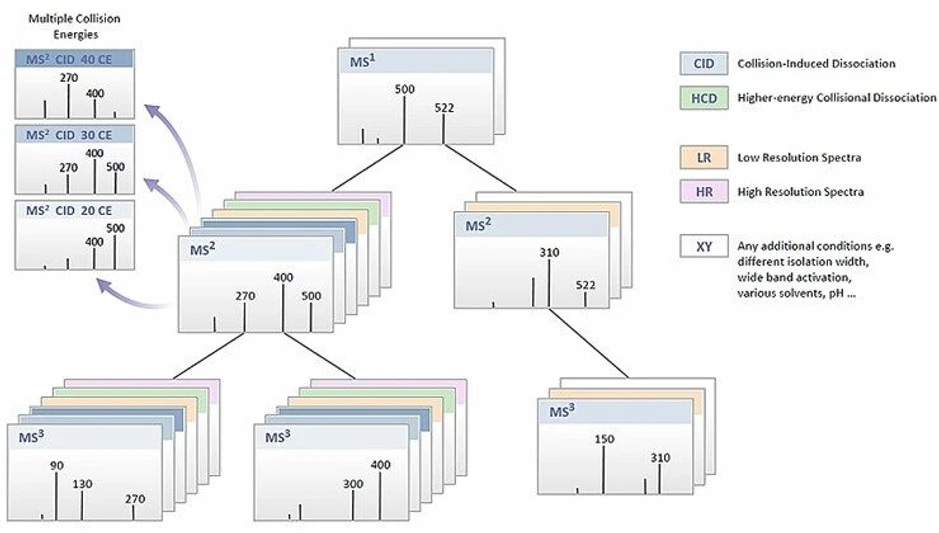
Thermo Scientific mzCloud Mass Spectral Library: A schematic representation of a spectral tree within mzCloud. The MS spectra are acquired for a given compound in multiple polarities (ESI +/-), and for a range of adducts. Each precursor is exhaustively fragmented using different fragmentation techniques (CID, HCD) and at multiple collision energies to produce collections of fragmentation spectra at each fragmentation level (MS2, MS3, MS4 etc.), generating a comprehensive spectral tree of information for each library entry.mzCloud is an all-encompassing mass spectral library with content based on a wide chemical space (therefore covering all small-molecule application areas), and acquiring high-resolution and accurate-mass data at various collision energies, for multiple adducts, using CID and HCD. Approximately 10–20 collision energies are included for every precursor ion; this multi-stage, multidimensional MSn spectral data are arranged into spectral trees, which are both extensive and comprehensive, typically containing many hundreds to thousands of spectra for each compound, with many exceeding MS4 fragmentation steps.
The extensive data for each library entry is critical for accurate compound identifications, matching experimentally obtained data to that of the library contents, with fit confidence and data visualization provided in the Compound Discoverer and Mass Frontier data analysis software. Additional tools in Compound Discoverer and Mass Frontier software, including mzLogic, use the extensive fragmentation information to confidently identify unknowns that cannot be identified based upon the spectral library compound entries alone.
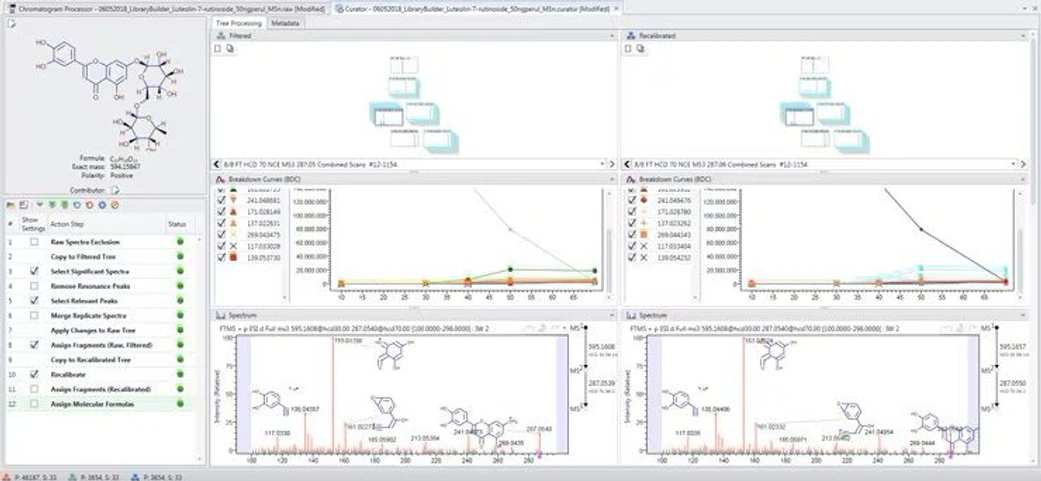
Thermo Scientific mzCloud Mass Spectral Library: An example of the mass spectral content curation tool available within the Mass Frontier software. It contains all the functionality used to manually curate the content contained within mzCloud. The power of mzCloud lies in both the extent and high quality of its content, which helps make confident compound identifications.Despite the fact that Thermo Scientific Orbitrap-based mass analyzers routinely deliver sub 3-ppm mass errors, there is a small amount of inaccuracy in any experimental data used to search against a library; these errors would be compounded if the library itself also contained data with mass errors. The compounded errors would mean that any identifications could be harder to make or have lower confidence due to match scores being higher.
Curating the content within mzCloud guards against error and variability in the reference spectra against which data is compared. The process of curation involves:
This curation process is performed for every spectra - every collision energy, every fragmentation type, every MSn level and for each precursor ion. As such, the spectral data in mzCloud is of exceedingly high quality and offers significant advantages over crowd-sourced libraries due to the high levels of control.
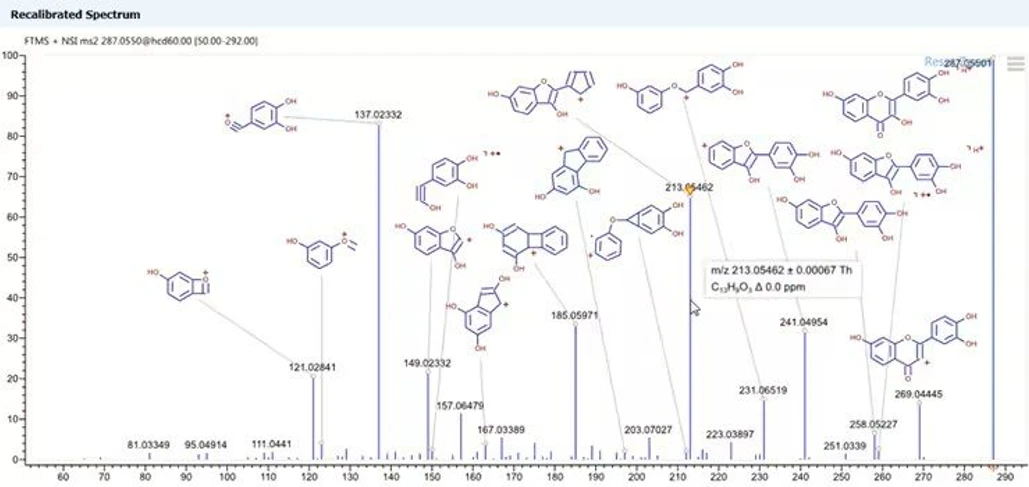
Thermo Scientific mzCloud Mass Spectral Library: A recalibrated fragmentation spectrum showing no error on the highlighted peak at m/z 213.05462, along with all of the annotation that is provided for each spectra, at each collision energy, for each fragmentation type at each MSn level.Accelerate your small molecule unknown identification studies with mzCloud, mzLogic, and the other data analysis and mass spectral prediction tools available in Compound Discoverer software and Mass Frontier software.
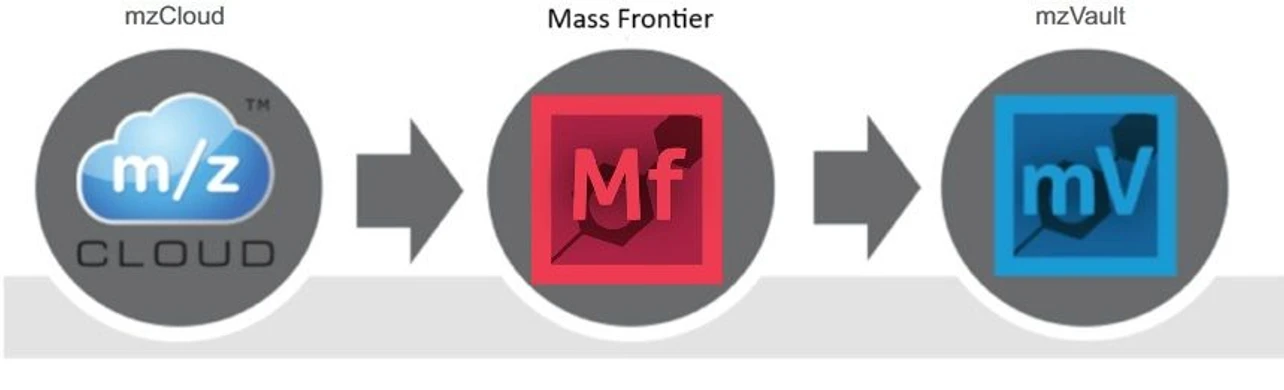
Thermo Scientific mzCloud Mass Spectral Library: Connectivity of mzCloud and mzVault to Mass Frontier.
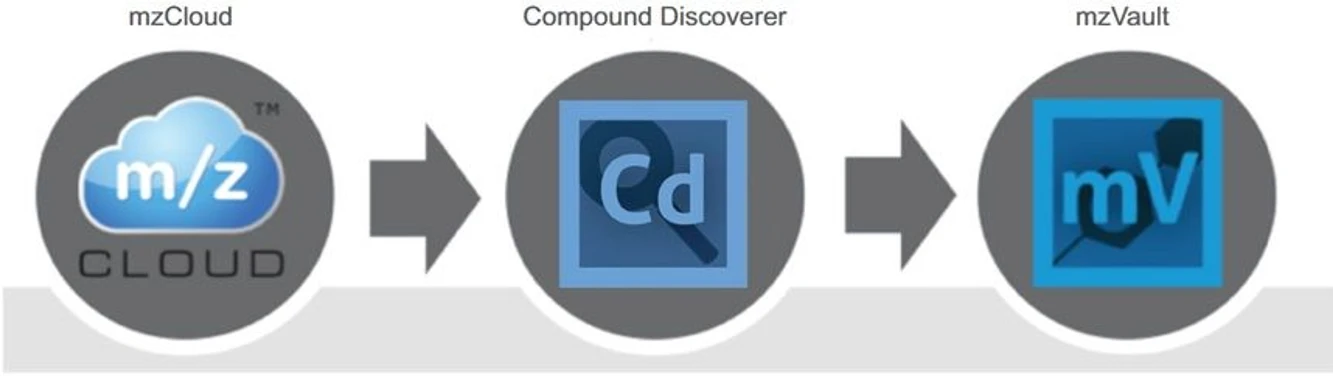
The content within mzCloud is accessible through Compound Discoverer and Mass Frontier software packages, provided you have an internet connection. No internet? No problem – mzVault, provides you with the MS and MS/MS content of mzCloud in an offline format.
Thermo Scientific mzCloud Mass Spectral Library: Connectivity of mzCloud and mzVault to Compound Discoverer.
Due to security concerns or local firewalls, not everyone can connect processing PCs to the internet. With that in mind, the contents of mzCloud are combined into an offline version twice a year. The mzVault software application helps you access this information. In addition to accessing the offline version of mzCloud, the mzVault application can store and search your high-quality custom in-house (offline) MS/MS spectral libraries.