QuEChERS (Quick, Easy, Cheap, Effective, Rugged, and Safe)is a sample preparation method that was initially developed in 2003 for analyzing veterinary drugs in food. The method was also tested for pesticide residue analysis in plant material with great success. In 2003, the detailed method was published in the journal AOAC International. Since then, the QuEChERS method has evolved into a sample preparation technique used on a variety of analytes in an expanding number of sample types before analysis by GC-MS or LC-MS.
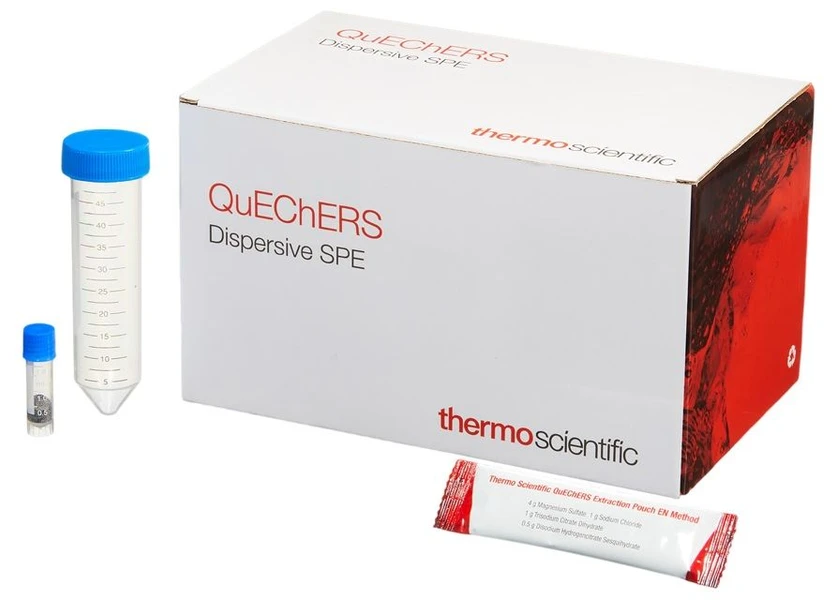
Thermo Scientific QuEChERS kits contain pre-packaged, ready-weighed salts, sorbents, and buffers to streamline your workflow and minimize the potential for error. The kits are grouped according to your analytes of interest, sample matrix, and preferred QuEChERS method:
Complete packages—including both extraction and clean-up kits—are available. Extraction-only and cleanup-only kits are also offered to suit your laboratory’s sample preparation needs. These pre-packaged kits save time and money, make QuEChERS procedures easier and more convenient, and ensure quality to yield reproducible results and excellent recoveries for a wide variety of analytes.
Thermo Scientific QuEChERS Sample Preparation Kits
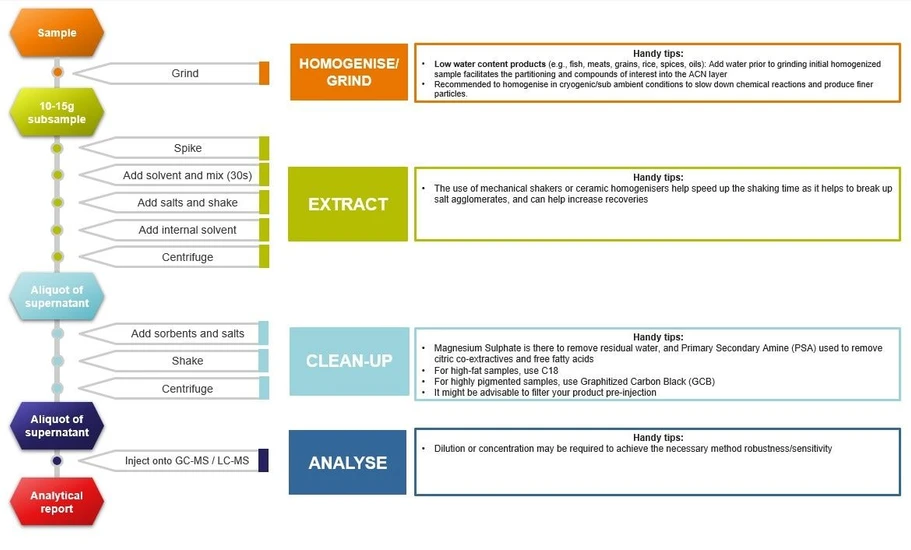
As shown in the workflow diagram below, the QuEChERS method has four basic steps:
Thermo Scientific QuEChERS Sample Preparation Kits
The original QuEChERS method (Anastassiades et al, 2003) was developed by Steven J. Lehotay and Michelangelo Anastassiades in 2003 for the determination of pesticide residues in fruits and vegetables. The original method was created to analyze non-base-sensitive compounds and uses a sodium chloride buffer to reduce polar interferences and enhance extraction. Buffering is an important part of the QuEChERS procedure because it allows for analysis of pesticides and other residues that display pH dependence in their recoveries, depending on the sample matrix. Three different extraction kits are available to support the original 2003 QuEChERS method.
The AOAC 2007.01 QuEChERS Method was developed by Steven J. Lehotay and his co-workers, who modified the original 2003 method to accommodate the use of acetate buffering at higher concentration for greater buffering strength. Buffering is an important part of the QuEChERS procedure because it allows for analysis of pesticides and other residues that display pH dependence in their recoveries, depending on the sample matrix. These extraction and clean-up products here support the AOAC 2007.01 method.
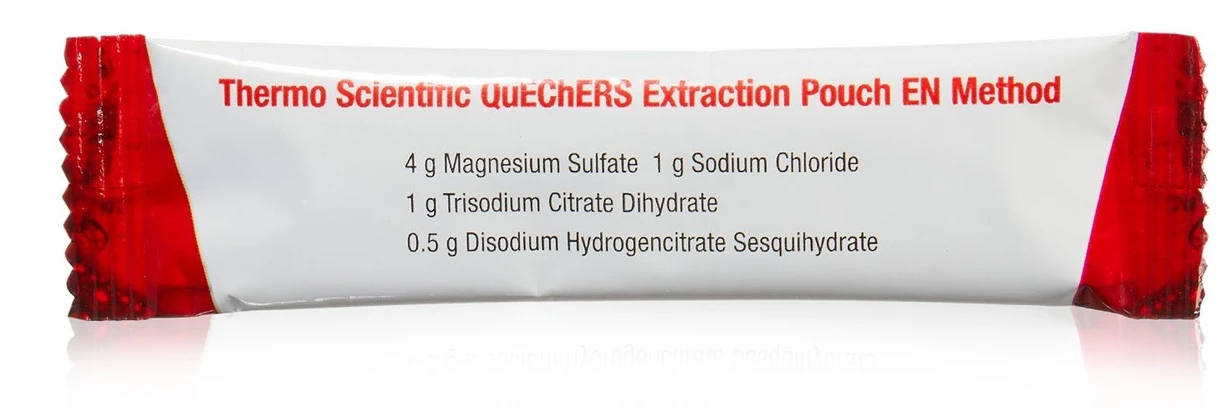
The extraction and clean-up products here support the EN 15662 method. Widely used in Europe, the EN 15662 method was developed by Michelangelo Anastassiades and co-workers, who modified the original 2003 method to accommodate the use of citrate buffering at a relatively low buffering capacity. This variation uses a sodium chloride buffer to minimize polar interferences in addition to sodium citrate dihydrate and disodium citrate sesquihydrate buffers. Buffering is an important part of the QuEChERS procedure because it allows for analysis of pesticides and other residues that display pH dependence in their recoveries, depending on the sample matrix.
Thermo Scientific QuEChERS Sample Preparation Kits
The NY/T 1380-2007 method is recommended by China Ministry of Agriculture for the QuEChERS Method sample preparation of 51 specific pesticide residues in fruits and vegetables with analysis by GC-MS.