News from LabRulezLCMS Library - Week 4, 2025
LabRulez: News from LabRulezLCMS Library - Week 4, 2025
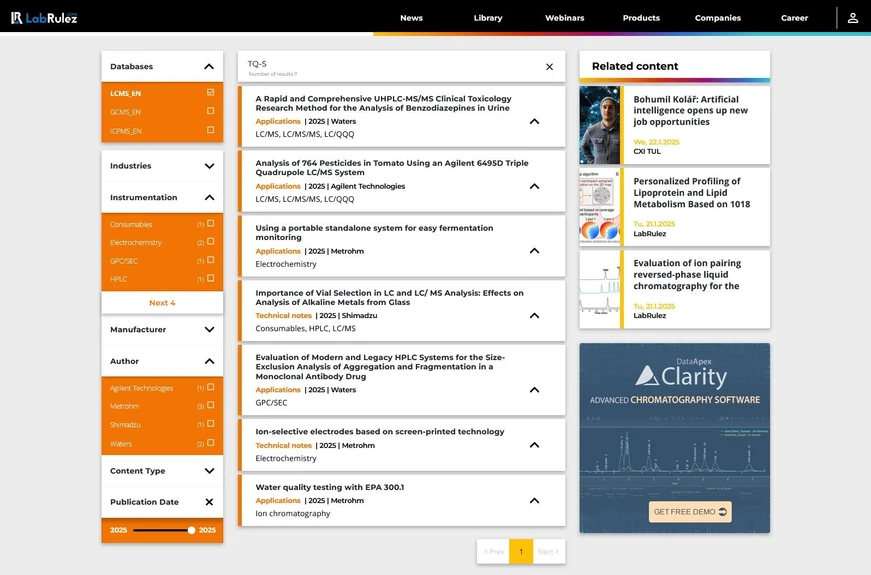
Our Library never stops expanding. What are the most recent contributions to LabRulezLCMS Library in the week of 20th January 2025? Check out new documents from the field of liquid phase, especially HPLC and LC/MS techniques!
👉 SEARCH THE LARGEST REPOSITORY OF DOCUMENTS ABOUT LCMS AND RELATED TECHNIQUES
👉 Need info about different analytical techniques? Peek into LabRulezGCMS or LabRulezICPMS libraries.
This week we bring you tech. notes by Shimadzu, and applications by Agilent Technologies, Thermo Fisher Scientific, Metrohm, and Waters Corporation!
1. Shimadzu: Importance of Vial Selection in LC and LC/MS Analysis: Effects on Analysis of Alkaline Metals from Glass
- Technical note
- Full PDF for download
In recent years, the sensitivity of mass spectrometers and other detectors has improved, enabling trace sample analysis. In LC and LC/MS analyses of trace compounds, vial selection is very important. Certain vial materials can cause unintentional compound adsorption, reducing analytical sensitivity. For instance, polypropylene (PP) vials often adsorb hydrophobic compounds on their surfaces, while glass vials minimize hydrophobic adsorption but may exhibit surface ionic adsorption of silanol bases and basic compounds due to metallic ion interactions. Additionally, the elution of sodium and other alkali metals from glass surfaces can influence analytical outcomes. To address these issues Shimadzu has developed Shim-vial™, a specially treated vial designed to minimize sodium (Na) elution. Comparative studies demonstrated that Shim-vials exhibit significantly lower Na elution levels than conventional vials. Furthermore, results showed a direct correlation between higher Na elution and increased adsorption of basic compounds, suggesting that metallic ions play a key role in this adsorption phenomenon.
Summary
It is evident that reducing Na in glass vials limits adsorption of basic compounds. Further, in LC/MS analysis, analytes become Na adducts due to the presence of Na ions, which has an impact on the sensitivity at the original m/z as well. Because adsorption and the production of Na adducts are so noticeable in the analysis of low concentration compounds, there are likely cases where the results obtained differ from the actual results, without anyone noticing. To prevent such issues, the use of high quality, low adsorption vials is recommended. The Shim-vial H/S series feature very low Na elution amounts due to a special treatment, enabling their use as vials that provide stable analysis results for both basic and acidic compounds.
2. Agilent Technologies: Analysis of 764 Pesticides in Tomato Using an Agilent 6495D Triple Quadrupole LC/MS System
- Application note
- Full PDF for download
Pesticide residue workflow for determination of 764 pesticides in tomato QuEChERS extract
Abstract
A comprehensive LC/MS/MS method for 764 pesticides in QuEChERS tomato raw extract was established using an Agilent 6495D triple quadrupole LC/MS system. With 4th-generation iFunnel technology and novel inlet design, the 6495D LC/TQ system delivers ultimate sensitivity with high precision at sub-millisecond dwell times, without compromising robustness, for the most difficult analytes in complex food matrices. The iFunnel can uniquely be tuned on a compound-by-compound basis for optimal transmission of all analytes in an assay for wide-scope multiresidue pesticide analysis that includes fragile compounds. Speed of acquisition and duty cycle are enhanced with the latest onboard computing, enabling 150% more concurrent dynamic multiple reaction monitoring (dMRM) for extended large-panel assays as well as shortened run times. The 6495D also provides excellent linearity and allows for easy method transfer from previous LC/TQ models. These improvements make it a robust and reliable option for performing routine trace analysis in the most demanding production environments. Overall, the 6495D LC/TQ is a significant upgrade in terms of performance and usability for pesticide analysis.
Conclusions
This study demonstrates the performance of an Agilent 6495D triple quadrupole LC/MS system with an Agilent 1290 Infinity III LC for the analysis of 764 pesticides in tomato QuEChERS raw extract. Enhanced onboard computing enables increased acquisition speed and up to 150% more concurrent dMRMs for extended large-panel assays and shortened run times. With 4th-generation iFunnel technology and tunable settings, users can now select the best iFunnel setting for each compound transition to achieve optimal sensitivity. Good linearity was observed for all 764 target analytes, with R2 ≥ 0.99 for the calibration range 0.1 to 100 μg/L.
3. Thermo Fisher Scientific: Unveiling hidden protein depths: a high-throughput plasma proteomics workflow for enhanced biomarker discovery
- Application note
- Full PDF for download
To develop robust plasma proteomics workflows with different sample preparation and various throughput methods for deep plasma proteomics and superior quantitation by a label-free data-independent acquisition (DIA) strategy on the latest Thermo Scientific™ Orbitrap™ Astral™ mass spectrometer.
Introduction
Cancer continues to claim countless lives and holds the second-highest ranking in overall mortality worldwide. The late diagnosis of this disease frequently leads to a poor prognosis, emphasizing the crucial need for improved early detection tools. Present diagnostic tests either lack sensitivity or require invasive biopsies and are not always feasible or comfortable for patients.
One of the significant advantages of plasma proteomics is the ease of sample collection through routine blood draws. The analysis of blood plasma for cancer biomarkers presents a promising avenue for early detection, but the complexity of the associated workflows has hindered progress in this area.1
The analysis of plasma presents a substantial challenge due to the vast concentration range of proteins in blood plasma. Detecting low abundant proteins, which hold potential as biomarkers, proves challenging as they are often greatly overshadowed by high-abundant proteins. In fact, approximately 99% of the plasma proteome is composed of proteins such as albumin, globulins, and coagulants, effectively overshadowing potentially less abundant protein biomarkers. Therefore, there is a pressing need to develop methods that can accurately identify and quantify these low-abundant proteins in plasma samples.
Mass spectrometery-based proteomic analysis, in conjunction with advanced separation technology, is a leading method for studying low-abundant proteins due to its sensitivity, unambiguous peptide identification, and accurate quantitation. The cutting-edge Orbitrap Astral mass spectrometer offers unprecedented sensitivity and reproducibility for low-abundant proteins, which enables deeper plasma proteome coverage and facilitates the discovery of potential biomarkers.
Conclusions
Neat plasma workflows, while easy to handle due to minimal sample preparation, suffer from dynamic range issues, which result in shallow coverage of the plasma proteome compared to enriched or depleted plasma workflows.
The use of High Select Depletion Spin Columns for plasma depletion has proven to significantly increase proteome coverage. Compared to neat plasma, proteome coverage is enhanced by 2- to 3-fold. This method provides an economical workflow and is a viable alternative to other depletion strategies used in plasma proteomics research.
The Seer Proteograph XT workflow coupled with the Orbitrap Astral mass spectrometer offers the most comprehensive depth of analysis, effectively balancing the need for high-throughput automated workflows with high quantitative precision. Taken together, these workflows with the Orbitrap Astral mass spectrometer enable new possibilities for biomarker discovery from large cohort plasma proteomics studies.
4. Metrohm: Water quality testing with EPA 300.1
- Application note
- Full PDF for download
Boost lab efficiency with automated eluent generation and single-run analysis of anions and disinfection byproducts
Standard analytical methods like U.S. EPA Method 300.1 (Parts A and B), ISO 10304-1, and ISO 10304-4 ensure compliance when monitoring water contaminants that affect human health. Disinfection byproducts (DBPs) in particular are linked to cancer and reproductive issues [1–5]. EPA 300.1 Part A and ISO 10304-1 outline the analytical requirements for ion chromatographic determination of major inorganic anions. Harmful DBPs (chlorite and chlorate) are included in ISO 10304-4 and EPA 300.1 Part B (plus bromate and dichloroacetic acid / DCAA). Achieving method detection limits (MDLs) for analytes with significant relative concentration differences can be challenging. The Metrosep A Supp 21 high-capacity anion-exchange column for hydroxide eluents and sequentially suppressed conductivity detection allows for a single-run analysis that meets these needs. The 948 Continuous IC Module, CEP automates KOH eluent generation. This eliminates manual preparation and ensures stable retention times along with an ultra-low baseline. Along with a single-standard calibration, this analytical approach provides a highly efficient, sustainable, reliable solution for water testing labs.
CONCLUSIONS
This application focuses on separating and measuring high concentrations of inorganic anions, (e.g., chloride, nitrate, and sulfate) along with lower concentrations of disinfection byproducts (DBPs, i.e., bromate, chlorite, and chlorate) and nitrite and bromide in a single analysis run using ion chromatography. Accurate measurement across a wide concentration range requires a detector with high linearity, such as the IC Conductivity Detector MB (linearity range of 0–15,000 μS/cm), a high-capacity column (Metrosep A Supp 21) for appropriate peak separation, and a low baseline with outstanding signal-to-noise ratio to reach the lowest detection limits.
The 948 Continuous IC Module, CEP, in combination with the suppressor designed for hydroxide eluents (MSM-HC Rotor A, Hydroxide), guarantees the best analytical conditions – a high purity eluent, low baseline, and best signal-to-noise ratios. The automatic, almost reagent-free hydroxide eluent production out of a high-purity concentrate (4 mol/L potassium hydroxide solution, Supelco, Merck) and easy, straightforward gradient generation eliminates any manual steps and associated human errors. This provides stable elution conditions, resulting in stable retention times, and is a sustainable, cost-efficient solution for any lab.
The Metrosep A Supp 21 column, designed for hydroxide eluents, enables a high resolution of all analytes required in U.S. EPA Method 300.1 Parts A and B as well as in ISO 10304-1 and ISO 10304-4. Originally, these standards intended for the analysis to be performed with two separate methods to determine the highly concentrated standard anions beside the trace anions accurately. Indeed, many methods lack an appropriate resolution and sufficient sensitivity, and two separate methods are necessary for the analyses, dramatically reducing the sample throughput.
Metrohm offers a very comprehensive way to combine the two parts of EPA 300.1 without any quality losses by using a setup with the Metrosep A Supp 21 - 250/4.0 separation column in combination with automatic high-purity hydroxide eluent generation and conductivity detection after sequential suppression and automatic inline calibration.
With this efficient setup, water laboratories can fulfill regular drinking water standards and increase their overall work efficiency. All-in-all, this is a complete, robust, and efficient solution.
5. Waters Corporation: A Rapid and Comprehensive UHPLC-MS/MS Clinical Toxicology Research Method for the Analysis of Benzodiazepines in Urine
- Application note
- Full PDF for download
This application note describes a clinical toxicology research method for the solid phase extraction and UHPLC-MS/MS analysis of traditional and designer benzodiazepines for clinical and forensic toxicological analysis. Benzodiazepines are widely prescribed and have high rates of abuse.1 The emergence of new designer benzodiazepines has increased concerns of this abuse, as they are initially not controlled and have unknown health risks.2
The described research method includes a simplified sample preparation procedure that reduces the number of manual steps, produces high recoveries, consistent matrix effects, and accurate and precise quantitative data. The use of the ACQUITY™ UPLC™ BEH™ C18 Column results in rapid analysis of a panel of 26 benzodiazepine compounds, while maintaining all required baseline separations for accurate quantification. This combination of sample preparation, UHPLC separation, and MS/MS detection optimizes the workflow and results in a rapid, method for quantification of traditional and designer benzodiazepines.
Benefits
A Rapid and Comprehensive UHPLC-MS/MS Clinical Toxicology Research Method for the Analysis of Benzodiazepines in Urine
- Rapid, simplified sample preparation protocol resulting in efficient and consistent recovery for all analytes
- All sample pretreatment and extraction performed in-well, eliminating transfer steps
- UHPLC-MS/MS analysis results in excellent separation of 26 benzodiazepines in four minutes
Conclusion
This application note describes a comprehensive clinical toxicology research method for the solid phase extraction and UHPLC-MS/MS analysis of a panel of 26 traditional and designer benzodiazepines, which has a number of advantages. The sample preparation method efficiently extracted all compounds included in the panel. The use of the ACQUITY UPLC BEH C18 Column results in rapid analysis (4 minutes) of a large panel of benzodiazepines. The Xevo TQ-S micro Mass Spectrometer ensures rapid and accurate quantitation of all compounds analyzed over a wide dynamic range. The combination of sample preparation method, UHPLC separation and MS/MS detections results in a rapid, accurate and precise method for the comprehensive analysis of benzodiazepines in urine, including new designer benzodiazepines.