News from LabRulezLCMS Library - Week 34, 2025
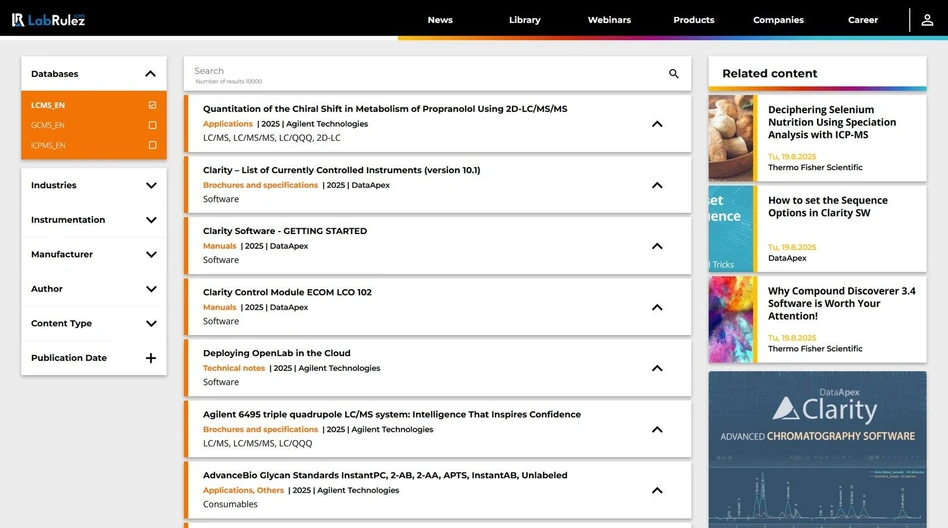
LabRulez: News from LabRulezLCMS Library - Week 34, 2025
Our Library never stops expanding. What are the most recent contributions to LabRulezLCMS Library in the week of 18th August 2025? Check out new documents from the field of liquid phase, especially HPLC and LC/MS techniques!
👉 SEARCH THE LARGEST REPOSITORY OF DOCUMENTS ABOUT LCMS AND RELATED TECHNIQUES
👉 Need info about different analytical techniques? Peek into LabRulezGCMS or LabRulezICPMS libraries.
This week we bring you application notes by Agilent Technologies and Waters Corporation and technical notes by Shimadzu and Thermo Fisher Scientific!
1. Agilent Technologies: Deciphering the Microbiome: Targeted LC/MS/MS Analysis of Bile Acids in Biological Samples
- Application note
- Full PDF for download
BA analysis using liquid chromatography-mass spectrometry (LC/MS) is both critical and challenging due to the inherent complexity of bile acids. These compounds encompass a wide range of structurally similar and isomeric species that often exhibit nearly identical mass-to-charge ratios (m/z) and retention times. This similarity makes achieving baseline separation and accurate identification particularly difficult.
Additionally, bile acids are relatively stable molecules that do not typically undergo extensive fragmentation in a mass spectrometer. Additionally, the more challenging fragmentation complicates the differentiation of isomeric bile acids emphasizing the need for a standardized method also leveraging retention times.
Compounding these issues, many of the microbiota-produced bile acid species are typically present at low concentrations in biological samples, which often contain matrix components that can lead to ion suppression or enhancement. These matrix effects can interfere with accurate quantification, further complicating the analysis. Moreover, the need for high sensitivity and specificity to distinguish closely related bile acid species adds another layer of complexity.
To address these challenges, standardized and highly optimized chromatographic methods, advanced mass spectrometric techniques, and robust sample preparation protocols are essential. Together, these strategies enhance the reliability of BA analysis, enabling accurate profiling for both research and clinical research applications.
A previously described LC/TQ method was used to analyze 26 bile acids.1 This present study introduces a new method using a 6495D LC/TQ with fourth-generation ion funnel technology, which improves sensitivity and expands the scope for the analysis of 68 unique bile acids in complex matrix. This bile acid method is compatible and consistent with the Agilent Standardized LC/MS platform for omics analysis and is easily transferable in the laboratory and therefore suitable for rapid delivery of new insights.
Experimental
Instrumentation
The LC/MS platform consisted of a 6495D triple quadrupole mass spectrometer with fourth-generation iFunnel technology, coupled with an Agilent 1290 Infinity II Bio LC system with the Agilent standardized configuration for omics applications. The acquisition method is fully compatible with an Agilent 6495C model and a regular stainless‑steel Agilent 1290 Infinity II LC with the same standard omics configuration. All methods using the Infinity II LC systems are fully compatible with Infinity III LC systems and give identical method performance.
Software
MS data were acquired using MassHunter acquisition software 12.1, which includes built-in source and compound optimizer tools for method development. Agilent MassHunter Qualitative Analysis 12.0 software was used to visualize the acquired dataset and assess data quality before quantification.
Bile acid levels from the LC/MS/MS datasets were quantified using MassHunter Quantitative Analysis 12.0 software. Quantitation methods for both relative and absolute measurements were developed using one of the quality control (QC) injections. Statistical analysis was performed with Agilent Mass Profiler Professional (MPP) 15.1.
Conclusion
A robust and standardized targeted dynamic-MRM LC/MS/MS method for the analysis of bile acids was developed on an Agilent 6495D triple quadrupole/LC platform. Optimal bile acid extraction conditions from plasma and fecal samples were established along with LC/MS conditions that allowed the measurement of a large panel of bile acids in a single chromatographic run. This analytical method is highly versatile and applicable to both plasma/serum and fecal samples, offering valuable insights into systemic and gut-specific bile acid profiles. In plasma, it provides a reliable means to assess circulating bile acids, which are key indicators of liver function, metabolic health, and disease states. In fecal samples, the method enables detailed profiling of bile acids involved in gut microbiota interactions and intestinal health, shedding light on digestion and enterohepatic circulation dynamics.
2. Shimadzu: Enhancing Selectivity in Reversed-Phase Analysis Through Effective Utilization of Mobile Phase pH
- Technical note
- Full PDF for download
When analyzing ionizable compounds, the pH of the mobile phase plays a crucial role in improving peak shape and separation. However, conventional silica-based columns have limitations in utilizing high-pH mobile phases. Additionally, while polymer-based columns can operate across a wide pH range, they have drawbacks such as lower mechanical strength and column efficiency. In this technical report, we present examples of measurements conducted using mobile phases with various pH levels, employing the Shim-pack Scepter and Shim-pack NovaCore columns—organic silica hybrid columns that combine the advantages of silica-based columns with exceptional high-pH durability.
2. The Relationship Between Compound Ionization and Mobile Phase pH
Figure 1 shows the relationship between the pKa of the compound and the pH of the mobile phase. The horizontal axis represents the value obtained by subtracting the pKa of the compound from the pH of the mobile phase. In general, the ionization ratio of weakly acidic compounds is known to become 1 % (nearly neutral) when the pH is 2 below their pKa. Conversely, when the pH is 2 above the pKa, the ionization ratio becomes 99 % (nearly ionized). On the other hand, weakly basic compounds are known to ionize 99 % (nearly ionized) when the pH is 2 below their pKa. Conversely, when the pH is 2 above the pKa, the ionization ratio becomes 1 % (nearly neutral).
3. Suppression of Ionization in Basic Compounds
In the case of basic compounds, the pH of the mobile phase must be high in order to suppress ionization. However, in general, traditional silica-based columns such as C18 with silica gel as the base particle may begin to disintegrate when the pH exceeds 7, so a high-pH mobile phase may not be usable. On the other hand, polymer-based particles have the advantage of being usable over a wide pH range from 1~14, but their mechanical strength and separation efficiency are lower than silica-based columns. Therefore, it is ideal to have a column that combines the advantages of silica-based and polymer-based packing material. The Shim-pack Scepter and Shim-pack NovaCore meet these needs (see Table 1).
4. Organic Silica Hybrid Columns in the Shim-pack Series
The fully porous Shim-pack Scepter and the core-shell Shim-pack NovaCore columns use organic silica hybrid material for the base particles to maintain the high physical strength of traditional silicabased columns while significantly improving their durability under high pH conditions. Figure 2 shows the change in column performance when a high-pH mobile phase is delivered for an extended period. This confirms the high pH durability of Shim-pack Scepter and Shimpack NovaCore compared to column A, a traditional silica-based column.
3. Thermo Fisher Scientific: Configuring a combustion-ion chromatography system using a complete workflow
- Technical note
- Full PDF for download
Analyzing samples with complex matrices can be challenging due to the incompatibility of the sample’s physical properties with the analytical technique. For example, ionic halide content can only be measured by ion chromatography (IC) when the sample is fully dissolved in a liquid, preferably water, extracted, or washed off the surface of a solid material. Combustion-ion chromatography (C-IC) has the advantage of eliminating complex sample matrices to directly measure the total halogens and total sulfur.1-5 C-IC has been demonstrated for halide determinations in other challenging liquid matrices, such as tea and wastewater.6,7 In addition, adsorbable organic fluorine (AOF), in conjunction with C-IC, has been demonstrated and incorporated into U.S. EPA Method 1621 to screen for perand polyfluoroalkyl substances (PFAS) in water samples.8-14
A new C-IC total workflow system has been introduced: the Thermo Scientific™ Cindion™ Combustion Ion Chromatography System. It includes a standalone sample preparation module, the Thermo Scientific™ Cindion™ Combustion/Absorption Module, and an autosampler that can be configured for solid or liquid samples. A standalone Thermo Scientific™ Cindion™ LPG/gas Module is also an option.
In this technical note, we describe the configuration and operation of the Cindion C-IC system with the following configurations: Cindion combustion/absorption Module with Cindion autosampler and each of numbers 1-4 below.
- Solids sampler and with the offline Cindion adsorption module needed for U.S. EPA Method 162115
- Solids sampler
- Liquids sampler
- Eluent monitor with any configuration
Instruments
Cindion C-IC system:
- Cindion combustion/absorption module (P/N B51006425) with Thermo Scientific™ Cindion™ C-IC Solids Kit (P/N B51006427)
- Thermo Scientific™ Cindion™ Solids/Liquids Autosampler (P/N B51006429)
- Thermo Scientific™ Cindion™ Adsorption Module (P/N B51006430) that includes 6 column holders
- Thermo Scientific™ Dionex™ Inuvion™ with Reagent-free Ion Chromatography (RFIC™) System (P/N 22185-60108)
- Optional Thermo Scientific™ Dionex™ Inuvion™ Eluent Monitor, 4 L (P/N 22185-62708)
- Thermo Scientific™ Muffle Furnace, 2 L small bench top, to clean combustion cups, (Thermo Scientific FB1415M, Fisher Scientific 10-552) – recommended for U.S. EPA Method 1621
Software
Thermo Scientific™ Chromeleon™ Chromatography Data System (CDS), version 7.3.2 MUd with Cindion C-IC and eluent monitor drivers.
Conclusion
This technical note provides comprehensive guidance on configuring and operating the full Cindion C-IC system workflow. The system offers a complete workflow, starting from offline sample preparation for AOX analysis, progressing through combustion and absorption, and concluding with IC analysis. It includes an autosampler for solids and liquids, along with an optional module for compressed and liquefied gases, ensuring versatility in sample handling. The Z-fold combustion tube is designed to introduce oxygen at multiple points and create an extended flow path that enhances combustion efficiency while minimizing length. To minimize devitrification, the system introduces water only during combustion. Additionally, Chromeleon CDS seamlessly controls Cindion C-IC system operation and data processing.
4. Waters Corporation: Slalom-Aided Anion Exchange Chromatography for Enhanced Analysis of Plasmid DNA Topological Impurities
- Application note
- Full PDF for download
Benefits
- Baseline resolution of DNA isoforms achieves complete separation of supercoiled, open circular, and linear forms of pBR322, ΦX174 RFI/RFII, and Cas9 plasmid
- Dual mode retention mechanism demonstrates separation driven by both anion exchange and flowdependent slalom chromatography mechanisms
- Single method offers broad applicability using a single gradient method on the Protein-Pak Hi Res Q Column to analyze diverse nucleic acid structures with flow rate optimization to achieve desired selectivity through slalom effects
In the present study, for the first time, the synergy between traditional AEX and slalom retention mechanisms using a Protein-Pak Hi Res Q Column has been systematically investigated. More specifically, two experimental variables have been purposely manipulated to optimize the separation of 3 unique plasmids. The salt gradients (for AEX selectivity) and shear force-inducing flow rates were adjusted to optimize the slalom-based selectivity of the separations. The dual-mode AEX–slalom separation was evaluated and optimized for three biologically relevant DNA constructs: ΦX174 RF I/II (5.4 kbp), pBR322 (4.4 kbp), and a 7.0 kbp Cas9-encoding plasmid. Using defined mobile phase conditions consisting of Tris buffer with 5% urea and a precisely controlled sodium chloride (NaCl) gradient, flow-rate-dependent resolution of OC, L, and SC topological forms was observed. The resulting data elucidates key operational parameters that can be leveraged to significantly enhance resolution, method reproducibility, and scalability, ultimately achieving a powerful analytical approach tailored for emerging gene therapy applications.
Experimental
LC Conditions
LC system:
- ACQUITY™ Premier System with:
- Binary Solvent Manager (BSM, p/n: 186018000)
- Flow-Through Needle Sample Manager (SMFTN, p/n: 186018002)
- Column Manager-A (CM-A, p/n: 186018003)
Conclusion
This application note demonstrates the utility of Protein-Pak Hi Res Q Column and strong anion-exchange chromatography for resolving the three plasmid DNA isoforms, supercoiled (SC), open circular (OC), and linear (L), across a wide range of DNA sizes, including pBR322 (4.361 kbp), ΦX174 RF I/II (5.386 kbp), and the pCMVCas9 (7.037 kbp) plasmid. Using a mobile phase system containing 5% urea and a NaCl gradient, the method achieved excellent resolution of all topological forms by tuning the flow rate applied throughout the gradient method. Notably, this strategy offers a streamlined alternative to traditional method development approaches that require manual changes in mobile phase additives or compositions. Indeed, flow rate was found to influence resolution significantly due to the difference in entropic elasticity of DNA plasmid (open-circular, supercoiled) and linear isoforms. For example, optimum flow rates were found to be equal to 0.8, 0.5, and 0.3 mL/min for the separation of pBR322, ΦX174 RFI RFII Mixture, and pCMV-Cas9 plasmids, respectively. Higher flow rates are needed to increase the retention of shorter linear DNA isoforms relative to the open circular plasmid. These results highlight the method’s adaptability and precision for analyzing plasmid topology, providing analysts with enhanced control critical for assessing identity, integrity, and purity in plasmid-based therapeutics and gene therapy workflows.