News from LabRulezLCMS Library - Week 21, 2026
LabRulez: News from LabRulezLCMS Library - Week 21, 2026
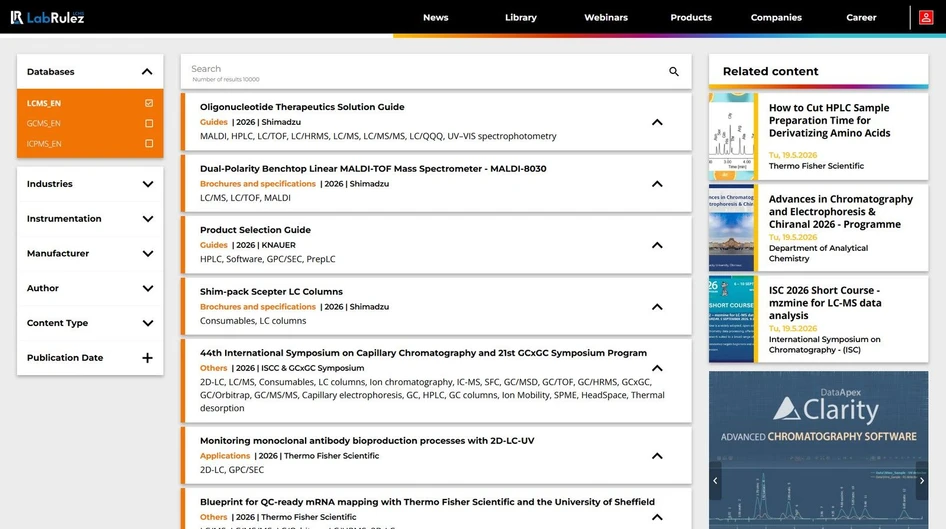
Our Library never stops expanding. What are the most recent contributions to LabRulezLCMS Library in the week of 18th May 2026? Check out new documents from the field of liquid phase, especially HPLC and LC/MS techniques!
👉 SEARCH THE LARGEST REPOSITORY OF DOCUMENTS ABOUT LCMS AND RELATED TECHNIQUES
👉 Need info about different analytical techniques? Peek into LabRulezGCMS or LabRulezICPMS libraries.
This week we bring you application notes by Agilent Technologies, Metrohm and Shimadzu, technical note by Thermo Fisher Scientific and poster by Waters Corporation!
1. Agilent Technologies: Top-Down Sequence Analysis of Intact Proteins Using an Agilent AdvanceBio 6545XT LC/Q-TOF with ExD
- Application note
- Full PDF for download
A proteoform is a specific form of a protein consisting of a unique amino acid sequence and its post-translational modifications (PTMs). A single gene can give rise to hundreds or thousands of distinct proteoforms containing unique patterns of modifications such as phosphorylation, glycosylation, methylation, and acetylation.1,2 These variations in sequence and PTMs often play critical roles in determining protein function or dysfunction in disease MOAs.3,4
While traditional bottom-up proteomics has unrivaled ability to rapidly identify proteins and PTMs, full characterization of proteoforms is not possible via bottom-up due to the reliance on peptide mixtures. For example, the peptides produced during digestion may not be observable in the mass spectrometer, causing gaps in sequence coverage. More importantly, digestion of the protein obscures possible correlations of PTM occurrences or may even make splice variants indistinguishable.
In contrast, top-down proteomics analyzes intact proteins directly, preserving proteoform-level information.5 Top-down proteomics is becoming increasingly practical and is now being used by researchers to characterize proteoforms from complex samples such as brain and heart tissues.6–8 Effective sequence analysis of intact proteins requires gas-phase fragmentation techniques outside of commonly implemented collision induced dissociation (CID). Instead of favoring the weakest bonds, electron capture dissociation (ECD) enables radical-driven fragmentation that is more evenly distributed across accessible regions of the protein sequence. Additionally, combining ECD with CID can enhance top-down fragmentation and generate complimentary fragments, leading to more confident sequence assignments.9,10
This application note describes the process of performing top-down fragmentation on intact proteins by direct infusion into an Agilent 6545XT AdvanceBio LC/Q-TOF equipped with an ExD cell. The goal of this publication is to provide guidance for how to get started with top-down mass spectrometry using denatured proteins and deliver practical insights including how parameters such as added CID energy and spectral averaging can influence TDMS outcomes like sequence coverage and ion detection. These insights establish a foundation for future TDMS method development on Agilent Q-TOF platforms, enabling researchers to confidently characterize intact proteins and accelerate biopharmaceutical innovation.
Experimental
Instrumentation
- Agilent 6545XT AdvanceBio LC/Q-TOF (part number G6549AA)
- Agilent ExD cell for LC/Q-TOF (part number G1997AA)
- Agilent AJS Source (part number G1959A)
Software
- Agilent ExDControl, v3.7.8
- Agilent MassHunter Data Acquisition for LC/TOF and LC/Q-TOF, v11.0 Update 2
- Agilent ExDViewer, v4.6.28
Results and discussion
Top-down mass spectrometry is emerging as a powerful approach for characterizing intact proteoforms, offering insights that are often inaccessible through traditional bottom-up approaches. Here, we demonstrate how electron capture dissociation expands the capabilities of the Agilent 6545XT AdvanceBio LC/Q-TOF, enabling sequence analysis of intact proteins.
To illustrate the advantages of ECD fragmentation, we compare fragmentation results for ubiquitin (8 kDa) and carbonic anhydrase (29 kDa) using CID or ECD. For ubiquitin, CID required optimization of collision energy to achieve 91% sequence coverage with 126 unique fragment ions detected.
In contrast, ECD alone yielded complete (100%) sequence coverage and 166 unique fragment ions detected. This resulted in the assignment of multiple complementary ions, leading to more confident sequence confirmation (Figure 3A).
Carbonic anhydrase presents a more challenging case for top-down fragmentation. For example, using CID only, the maximum sequence coverage for carbonic anhydrase was limited to 41% with 40 V CE. Using higher CE values resulted in fewer detectable unique fragment ions and reduced sequence coverage. However, using ECD, the sequence coverage of carbonic anhydrase was 62% with 156 unique fragment ions detected (Figure 3B and 3C), underscoring the value of ECD for fragmentation of larger proteins.
Conclusion
This application note presents a practical framework for implementing top-down fragmentation of denatured proteins using the Agilent 6545XT AdvanceBio LC/Q-TOF mass spectrometer with an ExD cell. These results provide a baseline for expected results across a range of protein sizes and charge states. By optimizing key parameters such as collision energy and acquisition time, researchers can enhance fragment ion generation and improve sequence coverage of intact proteins. The combination of ECD with low-level collisional activation consistently increases the number of unique fragment ions detected, supporting confident proteoform-level analysis. This approach is particularly relevant for characterizing mid-sized, industrially relevant proteins such as erythropoietin, interleukin-6, and protein hormones like insulin and human growth hormone. Proteoform-level analysis of these proteins can reveal structural variants and modifications which are important biotherapeutic quality attributes. The integrated solution for top-down analysis presented here enables researchers to gain deeper insights from proteoform biology, accelerating biopharmaceutical innovation.
2. Metrohm: Differential electrochemical mass spectrometry
Integrating Metrohm Autolab potentiostats with Hiden mass spectrometers
- Application note
- Full PDF for download
Energy conversion and storage has emerged as the leading application of electrochemistry. Its application is broad and includes branches of electrocatalysis, fuel cells, and electrolysis. In electrocatalysis, when benchmarking new electrocatalysts for CO2 reduction, it is important to quantify parameters such as the turnover rate – or how much material is produced in a given amount of time. There are many approaches to determine the turnover rate. Differential electrochemical mass spectrometry (DEMS) offers an easy, in situ method to do this. DEMS can also be extended to OEMS (online electrochemical mass spectrometry).
A typical DEMS setup includes a half-cell, a nanoporous membrane, and a quadrupole mass spectrometer. In materials science (particularly in cathode studies), electrochemical half-cells, which use a single electrode in an electrolyte solution, are common and are convenient for quickly screening new materials. However, they provide limited in situ reaction information. DEMS enhances this by analyzing the half-cell experiment with mass spectrometry, quantitatively identifying gaseous or volatile products, including reactants and intermediates. Like other hyphenated techniques (e.g., spectroelectrochemistry), DEMS correlates a second signal (in this case mass ion currents of the electrolyte flow) with the faradaic current of the electrode, offering reliable, mass-resolved observations of electrochemical reactions.
EXPERIMENTAL
The setup consists of a DEMS cell, a peristaltic pump, and an electrolyte reservoir. The electrolyte is 1 mol/L NaOH. The CE is platinum, the WE is gold sputtered onto a PTFE membrane, and the reference electrode is Ag/AgCl. More can be read about the cell and the setup in the reference provided [1]. The mass spectrometry analysis is conducted with the HPR-40 OEMS system for online mass spectrometry. The electrochemistry is handled by VIONIC powered by INTELLO. The procedure used in INTELLO is shown in Figure 1.
The voltage and current signals measured by VIONIC are sent to the software of the mass spectrometer using the I- and E- monitor functionality in INTELLO (Figure 2). The current signal is fed to the Hiden software by connecting the iout of the Hiden cable to the A-OUT1 port of the VIONIC. The potential signal is provided to the software by connecting the Eout of the Hiden cable to the A-OUT2 port of the VIONIC. The auxiliary inputs of the Hiden software must be configured according to the Hiden document HA131-524.
Automatic current ranging should also be disabled in order to ensure that the current passed to the Hiden software is correct. Using a trigger cable, INTELLO is able to trigger the mass spectrometer to begin scanning. The Hiden software utilizes a falling edge trigger. The initial/end state of the DIO port on the potentiostat (Figure 3) prior to the measurement should therefore be set to high (1). Pin 5 is used for this.
3. Shimadzu: Analysis of Inorganic Anions in Drinking Water According to EPA Method 300.1 Using Nexera IC -Part A
- Application note
- Full PDF for download
User Benefits
- Nexera IC system is suitable for analyzing drinking water in compliance with EPA Method 300.1 (Part B).
- Utilizing optimized conditions for the Shim-pack IC-SA3 allows for the separation of four inorganic disinfection by-products in under 16 minutes.
- Employing an electrodialytic suppressor with superior baseline suppression enables highly sensitive analysis.
Reliable determination of inorganic anions in drinking water is essential for regulatory compliance and protection of public health. In the United States, the Environmental Protection Agency (EPA) provides methods for the analysis of inorganic anions in water by ion chromatography in Method 300.11) (EPA Method 300.1).
The anion suppressor installed in the Nexera IC (Fig. 1) removes conductive ions from the eluent before detection, reducing background and noise and enhancing analyte signals. In this report, we introduce examples of analysis of four inorganic disinfection by-products (DBPs) in accordance with EPA Method 300.1 Part B using the Nexera IC.
Conclusion
Using the Nexera IC system, anion analysis was implemented inPart B in accordance with EPA Method 300.1. Four target anionswere successfully separated on a Shim-pack IC SA3 column anddetected by conductivity detection, with a total analysis time of less than 16 minutes.
The Nexera IC demonstrated outstanding analytical performance, as DCA recoveries consistently met the qualitycontrol acceptance criteria (90–115%). Spike recoveryexperiments further confirmed the robustness and accuracy of the method, yielding excellent recoveries in the range of 92–111% with very low precision values (%RSD < 1.57). In addition, continuing calibration check standards remained stable andwithin 100 ± 10% throughout the entire study period.
All method verification tests produced satisfactory results, confirming full compliance with EPA Method 300.1 and highlighting the high reliability and reproducibility of the Nexera IC platform.
4. Thermo Fisher Scientific: Unlocking the archived proteome: High-throughput, deep FFPE proteome profiling using the Orbitrap Astral mass spectrometer
- Technical note
- Full PDF for download
This technical note presents a high-throughput proteomics workflow for analyzing formalin-fixed, paraffin-embedded (FFPE) tissue samples using the Orbitrap Astral Mass Spectrometer and the OptiSpray Ion Source. FFPE tissues are widely used in clinical pathology and cancer research because they preserve tissue morphology and can be archived long term together with valuable patient information. However, FFPE proteomics is traditionally challenging due to formaldehyde-induced protein crosslinking, labor-intensive sample preparation, and limitations in throughput and reproducibility.
To address these issues, the authors developed a streamlined workflow combining rapid deparaffinization, efficient protein extraction, peptide digestion, and fast LC-MS analysis. The workflow uses the Vanquish Neo UHPLC System, Evosep Eno, EasyPep Mini MS Sample Prep Kit, and Orbitrap Astral mass spectrometer. Data analysis was performed using Spectronaut software in directDIA mode. The complete end-to-end workflow, including sample preparation, LC-MS analysis, and automated data processing, can be completed in less than one day.
The study demonstrated deep proteome coverage from FFPE lung tumor and normal lung tissue samples across different acquisition speeds. Using a 20-minute gradient (60 samples/day), the system identified up to approximately 8,600 protein groups and more than 100,000 peptides from 200 ng sample input. Even at much faster acquisition rates of 180 and 500 samples per day, the workflow maintained substantial proteome depth and sensitivity. At 500 samples/day using approximately 2-minute gradients, around 3,700–3,900 protein groups were still identified, demonstrating the ability to combine very high throughput with meaningful biological information.
Quantitative reproducibility remained excellent across all acquisition speeds and sample loads. Median protein abundance coefficients of variation (CVs) remained below 10% even at the highest throughput settings, showing that rapid analysis did not significantly compromise precision. The study also demonstrated strong agreement in protein fold-change measurements between tumor and normal tissues across all acquisition modes, confirming that biologically relevant differences can still be reliably detected under accelerated workflows.
Finally, the workflow successfully identified biologically important differences between lung tumor and normal FFPE tissues. Approximately 1,500 proteins were found to be significantly differentially expressed. Pathway analysis revealed tumor-associated biological processes including glycolysis, HIF-1 signaling, extracellular matrix remodeling, neutrophil extracellular trap formation, and cancer-related metabolic pathways. The authors conclude that this integrated high-throughput FFPE proteomics workflow enables scalable, reproducible, and biologically informative analysis of archived clinical tissue samples, supporting applications such as biomarker discovery, translational oncology research, and large clinical cohort studies.
5. Waters Corporation: Automated solid phase extraction and UHPLC-MS/MS analysis of per- and Poly- fluoroalkyl substances in milk
- Poster
- Full PDF for download
This poster presents a validated automated workflow for the determination of per- and polyfluoroalkyl substances (PFAS) in milk and dairy-based products using automated solid-phase extraction (SPE) combined with UHPLC-MS/MS analysis. The work was developed in response to increasingly strict global PFAS monitoring requirements, especially European regulations targeting PFOS, PFOA, PFNA, and PFHxS in food products. Because milk and infant nutrition products can significantly contribute to PFAS exposure in vulnerable populations, the study focused on developing a sensitive and reproducible method suitable for complex dairy matrices.
The analytical workflow used automated sample preparation with the Andrew+ Pipetting Robot and Extraction+ Vacuum Manifold together with Oasis PFAS GCB/WAX SPE Cartridges for sample cleanup. LC-MS/MS analysis was performed using the ACQUITY Premier System coupled to the Xevo TQ Absolute MS operating in negative electrospray ionization mode with time-windowed MRM acquisition. The method targeted 25 PFAS compounds and used automated OneLab software protocols to streamline preparation and extraction workflows.
The study demonstrated that automated and manual workflows delivered highly comparable analytical performance. Calibration curves achieved coefficients of determination (R²) above 0.99, while validation followed EURL guidance for PFAS analysis in food and feed. The method achieved a limit of quantitation (LOQ) of 0.005 µg/kg for the four priority PFAS compounds in milk matrices. Recovery experiments performed at three fortification levels showed mean recoveries of 102 ± 18% across all native PFAS analytes, with most compounds meeting regulatory criteria for trueness and precision.
The poster also discusses challenges associated with PFAS contamination and matrix effects during LC-ESI-MS/MS analysis. To minimize interferences, the automated SPE cleanup procedure was extensively optimized, including automated tube rinsing protocols within the OneLab software to improve PFAS recovery from sample containers. Process blank studies showed low background contamination levels that complied with EURL PFAS guidelines and confirmed that detected contamination originated primarily from solvents rather than the automation platform itself.
Overall, the authors conclude that the automated workflow substantially improves laboratory efficiency while maintaining analytical robustness. More than 100 preparation steps were automated during calibration standard preparation, saving approximately 88 minutes of hands-on analyst time, while automation of 12-sample SPE batches eliminated 236 manual steps and saved roughly two hours of laboratory work. The workflow therefore offers an effective high-throughput solution for routine PFAS monitoring in milk and dairy products under demanding regulatory environments.