News from LabRulezLCMS Library - Week 33, 2026

LabRulez / AI: News from LabRulezLCMS Library - Week 33, 2026
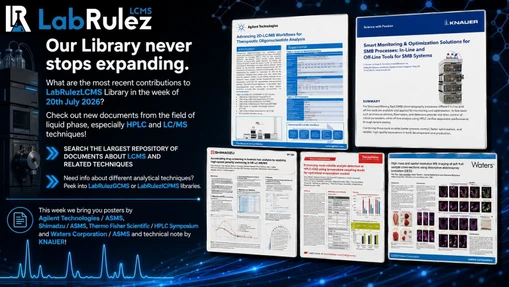
Our Library never stops expanding. What are the most recent contributions to LabRulezLCMS Library in the week of 10th August 2026? Check out new documents from the field of liquid phase, especially HPLC and LC/MS techniques!
👉 SEARCH THE LARGEST REPOSITORY OF DOCUMENTS ABOUT LCMS AND RELATED TECHNIQUES
👉 Need info about different analytical techniques? Peek into LabRulezGCMS or LabRulezICPMS libraries.
This week we bring you posters by Agilent Technologies / ASMS, Thermo Fisher Scientific / ASMS and Waters Corporation / ASMS and application notes by Metrohm and Shimadzu!
1. Agilent Technologies / ASMS: Impurity Monitoring of GLP-1 Therapeutic Peptide RetatrutideUsing a 2D-LC/TOF System
- Poster
- Full PDF for download
Retatrutide is a next-generation triple agonist (GLP1/GIP/glucagon) and an emerging candidate among multivalent GLP1–based therapeutics. Its structural complexity and diverse impurity profile challenge conventional one-dimensional LC methods, which often lack sufficient resolving power to separate closely related impurities, sequence variants, and synthetic byproducts.
In this study, we demonstrate an Agilent multiple heart-cutting 2D-LC platform that enables rapid online solvent exchange and enhanced chromatographic selectivity, allowing targeted isolation of impurity peaks from a TFA-based first-dimension separation. When coupled with the Agilent 6230C Accurate Mass TOF LC/MS system, the workflow delivers fast, sensitive, and accurate mass profiling under MS-friendly second-dimension conditions, providing a robust solution for comprehensive impurity characterization of GLP-1 peptides such as Retatrutide.
Experimental
Instrumentation
- Agilent 1290 Infinity III 2D-LC system comprised the following modules:
- 1290 Infinity III Bio Multisampler with Thermostat (G7137A)
- 1290 Infinity III Multicolumn Thermostat (G7116B)
- 1290 Infinity III Diode Array Detector (G7117B) with Max-Light cartridge cell (G7117-60020)
- 1260 Infinity III Bio Flexible Pump (G7131C)
- 1290 Infinity III Bio High-speed Pump (G7132A)
- 1290 Infinity Valve Drive (G1170A) with 2D-LC ASM Valve (G5643B)
- Two 1290 Infinity III Valve Drives (G1170A) with multiple heart-cutting valves (G5642-64000) equipped with 40 µL Bio loops
- Agilent 6230C Accurate Mass TOF LC/MS System
Conclusions
Agilent 2D-LC with multiple heart-cutting effectively bridges TFA-driven chromatographic performance with FA-compatible MS detection, overcoming ion suppression limitations.
The integrated 2D-LC/Accurate Mass TOF workflow delivers confident impurity identification and robust characterization, supporting peptide analysis in both QA/QC and development environments.
2. Metrohm: Vinylene carbonate water determination via coulometric Karl Fischer titration
Water determination in vinylene carbonate by Karl Fischer coulometric titration made simple with alcohol-free reagents
- Application note
- Full PDF for download
Vinylene carbonate (vc) is commonly used as a battery electrolyte additive in lithium-ion batteries. Its popularity is due to the positive impact it has on anode cyclability and reduction of irreversible capacity. Small amounts of moisture in Li-ion batteries can significantly decrease performance and lifetime. Therefore, moisture levels in electrolyte solutions and their additives are controlled for use in manufacturing. Until recent years, accurate moisture quantification in vinylene carbonate samples was difficult due to side reactions. With the commercial development of alcohol-free coulometric Karl Fischer reagents, accurate determination is now much more accessible to end-users.
EXPERIMENTAL
This analysis was performed using an 852 Titrando (2.852.0060) instrument, equipped with the electrodes listed in Table 1.
CONCLUSION
During battery manufacturing, control of all moisture present is important to guarantee adequate performance in the finished product. More easily quantifying the moisture contribution from additives such as vinylene carbonate makes this a much simpler task. The introduction of alcohol-free Karl Fischer reagents accomplishes this effectively, allowing the generation of accurate and repeatable moisture data—even for a difficult sample matrix.
3. Shimadzu: Non-Targeted Analysis of Metabolites in Alcoholic Beverages Using LabSolutions Insight Profiler
- Application note
- Full PDF for download
User Benefits
- Using an LC-QTOFMS system with LabSolutions Insight Profiler non-targeted analysis software enables comprehensive comparative analysis of metabolites in food samples.
- Principal component analysis and volcano plots can be used to detect characteristic features in each sample.
- A variety of functions, including MS/MS spectral library searching, enable easy qualitative analysis of components.
Metabolomics, a technique that analyzes metabolites in living organisms, is increasingly being applied in the food industry for product development and quality control. A particularly powerful approach is non-targeted metabolomics, which aims to analyze not only known metabolites but also unknown compounds without prior assumptions to reveal unexpected chemical differences between samples. Quadrupole time-of-flight mass spectrometry (QTOFMS), with its accurate-mass capability, is well suited for this purpose. However, the large volume of generated data creates challenges for feature identification and data comparison.
This article presents a case study in which LabSolutions Insight Profiler, a software platform for non-targeted analysis, was used to characterize compounds in beer and beer-like beverages. Peak detection, retention-time alignment, and library searching were performed across multiple datasets. Multivariate analysisrevealed compound profiles that likely reflect the differences in raw materials and manufacturing processes, demonstrating the utility of the approach for beverage characterization.
LabSolutions Insight Profiler
LabSolutions Insight Profiler is software for batch processing of LC-QTOFMS data that enables non-targeted analysis through an intuitive workflow. It readily supports easy spectral feature detection, alignment, statistical processing, filtering, list screening, MS/MS spectra-based library searching, principal component analysis (PCA), displaying volcano or box plots, and more. Fig. 1 shows the data analysis workflow.
Analysis Conditions
Nexera X3 UHPLC and LCMS-9030 systems were used as the analytical instruments. The LC method included in the LC/MS/MS Method Package for Primary Metabolites was used as the method. The data-dependent acquisition (DDA) mode was used to simultaneously acquire precursor m/z and MS/MS data. Table 2 shows the analysis conditions.
Conclusion
In this study, compounds in various beer and beer-like beverages were analyzed by non-targeted analysis using an LCMS-9030 quadrupole time-of-flight mass spectrometer system. Analyzing compounds characteristic of each sample with LabSolutions Insight Profiler software confirmed that the resulting profiles reflected differences in raw materials and manufacturing methods.
LabSolutions Insight Profiler enables efficient non-targeted analysis by processing LC-QTOFMS data with an intuitive workflow. This workflow allows for objective evaluation of the taste, quality, and nutritional value of food products. Furthermore, this method is applicable not only to the analysis of compounds in beverages but also to non-targeted analysis of other types of samples.
4. Thermo Fisher Scientific / ASMS: High throughput targeted proteomic workflows with Adaptive Retention Time on the Orbitrap Astral Zoom MS
- Poster
- Full PDF for download
Advances in MS instrumentation have accelerated the identification of biomarkers, but validating and translating these discoveries into assays for clinical use remains challenging and typically requires robust and accurate targeted approaches. While these often rely on predetermined reference target retention time (RT) windows, analytical column degradation or replacement, aging solvents, sample matrix effects, etc. can cause peptide RT shifts between injections and across longer-term analyses. To accommodate this, targeted MS experiments generally schedule wide target RT windows (>1 min) or rely on heavy labeled peptides to trigger acquisition of endogenous peptides. Both greatly limit the number of quantifiable targets per assay. To overcome this, we utilize adaptive RT (aRT) alignment for live correction of RTs together with the speed and sensitivity of the Orbitrap Astral Zoom MS. This allows reproducible tracking of >2000 targets with narrow RT windows, high throughputs, such as 300 samples per day (SPD), and hybrid workflows combining targeting, of up to 1000 targets, and discovery.
Materials and methods
LC-MS Experiments
Experiments were performed using Thermo Scientific Pierce HeLa protein digest resuspended in 0.1% TFA, or individual or pooled human plasma samples. Peptides were separated using a 15 cm Thermo Scientific PepMap analytical columns (150 µm inner diameter) and the Thermo Scientific Vanquish Neo UHPLC system at throughputs of 60 or 300 SPD. The liquid chromatography (LC) system was interfaced with the Orbitrap Astral Zoom MS. Reference runs using MS1 and/or data-independent-acquisition (DIA) scans were acquired to obtain reference aRT spectra, and to determine target RTs. For aRT alignment, methods consisting of aRT MS1 and/or DIA scans, as well as targeted MS2 scans with RT correction were optimized. For hybrid DIA workflows, we used aRT MS1 scans for reference acquisition and alignment, combined with narrow window DIA and a targeted MS2 experiment. Observed RT shifts were caused by natural column degradation, sample matrix effects or when indicated induced by variation in gradient flow rate and buffer composition.
Data analysis
Reference DIA data was analyzed using Spectronaut. Targets lists were then generated from the search output by selecting varying number of targets evenly distributed across the RT dimension. Target RTs for smaller scale assays were manually validated and exported from Skyline, while target RTs for large scale assays were exported from Spectronaut. For alignment runs, DIA and PRM data were analyzed using Spectronaut and Skyline respectively.
Conclusions
- Adaptive RT alignment on Orbitrap Astral Zoom MS shows robustness against various sources of RT shifts and has high target recovery even for thousands of targets
- aRT enables the use of target acquisition windows <15 s for robust targeting at high throughput
- aRT Hybrid DIA allows targeting of up to 1000 targets with minimal cost to DIA depth
5. Waters Corporation / ASMS: BOOSTING SENSITIVITY IN TOP-DOWN PROTEIN STUDIES USING CYCLIC IMS-ENABLED WIDEBAND ENHANCEMENT
- Poster
- Full PDF for download
This poster pres