News from LabRulezLCMS Library - Week 30, 2026
LabRulez / AI: News from LabRulezLCMS Library - Week 30, 2026
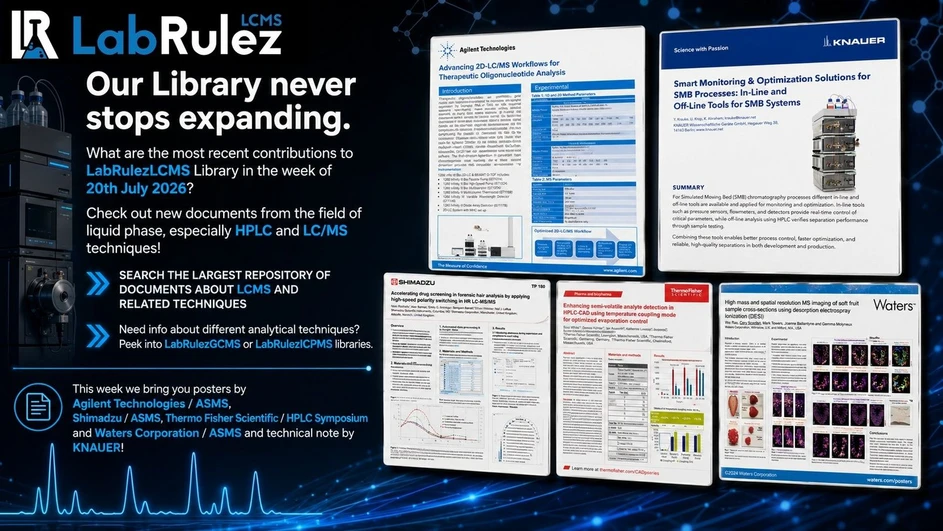
Our Library never stops expanding. What are the most recent contributions to LabRulezLCMS Library in the week of 20th July 2026? Check out new documents from the field of liquid phase, especially HPLC and LC/MS techniques!
👉 SEARCH THE LARGEST REPOSITORY OF DOCUMENTS ABOUT LCMS AND RELATED TECHNIQUES
👉 Need info about different analytical techniques? Peek into LabRulezGCMS or LabRulezICPMS libraries.
This week we bring you posters by Agilent Technologies / ASMS, Shimadzu / ASMS, Thermo Fisher Scientific / HPLC Symposium and Waters Corporation / ASMS and technical note by KNAUER!
1. Agilent Technologies / ASMS: Comprehensive characterization of oligonucleotides and related impurities using advanced LC/Q-TOF analytical workflows
- Poster
- Full PDF for download
Therapeutic oligonucleotides are synthetic, short nucleic acid sequences designed to modulate gene expression by targeting RNA or DNA with high sequence specificity. However, their inherent structural heterogeneity makes impurity profiling essential, as during GMP manufacturing, impurities like phosphorothioate to phosphodiester, 5′ and 3′ truncations or extensions, depurination, and abasic species can directly impact both product safety and efficacy. Antisense oligonucleotides (ASO) like Nusinersen (7127.171 g/mol) are indicated for the treatment of spinal muscular atrophy (SMA). Their closely related variants coelute with the main peak, complicating their characterization in conventional one-dimensional LC/MS workflows. To address this challenge, a 2D LC/MS strategy was implemented using the Agilent 1290 Infinity III Bio LC system with multiple heart cutting, coupled to the 6545XT AdvanceBio LC/Q-TOF and MassHunter BioConfirm software. The first-dimension separation uses an ion pairing buffer-based method to achieve higher chromatographic peak resolution, while the second dimension provides MS compatible desalting, enabling enhanced mass spectrometric sensitivity and improved detection of low-level impurities.
Instrumentation
1290 Infinity III Bio 2D-LC & 6545XT Q-TOF includes:
- 1290 Infinity III Bio Flexible Pump (G7131A)
- 1290 Infinity III Bio High-Speed Pump (G7132A)
- 1290 Infinity III Bio Multisampler (G7137A)
- 1290 Infinity III Multicolumn Thermostat (G7116B)
- 1290 Infinity III Variable Wavelength Detector (G7114B)
- 1290 Infinity III Diode Array Detector (G7117B)
- 2D-LC System with MHC set up
Conclusions
- A 2D-LC/MS workflow enabled effective separation and identification of coeluting impurities.
- HiRes sampling with multi-injection improved resolution and throughput while preserving 1D separation for MScompatible desalting.
- 6545XT AdvanceBio LC/Q-TOF delivered accurate mass and MS/MS data for low-abundance impurity detection.
- MassHunter BioConfirm software enabled automated sequence confirmation and impurity identification.
- This integrated platform offers a robust solution for oligonucleotide characterization in therapeutic development.
2. KNAUER: Smart Monitoring & Optimization Solutions for SMB Processes: In-Line and Off-Line Tools for SMB Systems
- Technical note
- Full PDF for download
In liquid chromatography, the purification of target compounds is classically carried out using single column batch chromatography. More efficient approaches include semi – continuous systems with two to three columns and continuous multicolumn systems. The most widely used of the latter is the simulated moving bed (SMB) chromatography which enables the continuous separation of binary or pseudo-binary mixtures. SMB purification is used in various areas such as petrochemical, pharmaceutical or food industry for the production of fine chemicals in different quantities and purities ranging from gram to tons per day. SMB systems vary significantly in size from small lab scale systems operating columns with 8 mm inner diameter (ID) to industrial systems operating columns of onemeter ID or larger.
Ideally, an SMB process is developed in a smaller lab scale system to reduce solvent and sample consumption compared to development at production scale. Once the separation parameters are established, the SMB process allows for accurate up scaling from lab to production scale. During method development but also production, different tools can be used to monitor and control the process which can be distinguished between in-line and off-line measures. The most crucial parameter, in addition to measuring the pressure, is monitoring the flow rates of the pumps, outlets and/or zones accurately with additional flowmeters. Normally, SMB systems are not equipped with detectors, but UV or RI detectors can be integrated to monitor process stability.
A standard off-line tool is used to analyse samples taken for one switch or cycle at the raffinate and extract outlets. The resulting chromatograms are used to check, if the separation is working. Further, samples can be taken during the process allowing the depiction of concentration profiles in the different zones. These tools will be described in more detail in the following sections.
MATERIAL AND METHODS
- AZURA Lab SMB system: SMB, biocompatible, 30 ml/min zone1, 4 ml/min feed, 10 – 130 bar
- AZURA Lab SMB system: SMB, stainless steel, 30 ml/min zone1, 4 ml/min feed, 10 – 130 bar
- AZURA Pilot SMB system, standard: SMB, stainless steel, 250 ml/min zone1, 40 ml/min feed, 2 – 100 bar
- AZURA Pilot SMB system, high flow: SMB, stainless steel, 400 ml/min zone1, 100 ml/min feed, 2 – 60 bar
- Refractive index detector: AZURA® RID2.1L HighFlow detector 100 ml/min
- UV detector: AZURA®UVD 2.1S detector, w/o flow cell
- UV detector: AZURA®UVD2.1S UV detector, fiber optics w/o flow cell
CONCLUSION
SMB is a continuous separation process that can run for several hours or days without interruption. Therefore, it is important to monitor the process and to be able to adapt to changes during the run. Different tools are available that can be used for process monitoring and method development. These tools can be divided into two main categories: in-line and off-line tools. In-line tools monitor parameters such as pressure and flow rate directly during the run, whereas off-line tools take a sample, which is then analyzed by an HPLC system. The tools described can be added to the KNAUER SMB systems depending on the customer’s needs. The more parameters that are measured, the better the process can be monitored. This is especially helpful during SMB method development.
3. Shimadzu / ASMS: Accelerating drug screening in forensic hair analysis by applying high-speed polarity switching in HR LC-MS/MS
- Poster
- Full PDF for download
In 2023, the Society of Hair Testing (SoHT) published updated consensus guidelines for the forensic analysis of drugs of abuse in hair, defining recommended targets across eight major drug classes: opiates, cocaine, amphetamines, cannabinoids, opioids, methadone, buprenorphine, and ketamine. Legal drivers, accepted use cases, and degree of prescription differ between US and Europe but in both jurisdictions, mass spectrometry is widely applied to support legally defensible conclusions. The challenge for any drug testing in hair samples, whether it is in forensic and safeguarding contexts, workplace testing or a judicial setting is the need to develop methods capable of detecting expanded search panels with the increased prevalence of new psychoactive substances (NPS) and non-medical prescription drug use. The approach applied in this work considered a LC/QTOF analysis using DDAMS/MS with rapid polarity switching with a novel data processing application, Insight Profiler. The software was designed to support a single click approach to automate data processing of complex data sets in non-targeted analysis from feature detection to compound identification.
Materials and Methods
Reversed phase LC Separation: Nexera X2
- Shim-pack Velox Biphenyl (100 x 2.1 mm, 2.7 µm) column; column temp. 40 ºC, flow rate: 0.3 mL/min, 17 min total analysis time. Methanol:water gradient with 2 mM ammonium formate and 0.002% formic acid
High resolution QTOF analysis: LCMS-9050
- MS scan m/z 100-1000, 100 msec scan time. Polarity switching time 800 msec.
- MS/MS DDA: 4 scans in positive ion mode (m/z 40-1000, 33 msec), 2 scans in negative ion mode (m/z 40-1050, 33 msec) CE 5-55V (1.998 sec total cycle time).
Data processing
Insight Profiler, feature detection threshold set to low, compound identification search lists included NIST, HighResNPS, Shimadzu Forensic Toxicology database.
Conclusions
- The targeted DDA-MS/MS polarity switching approach successfully identified a significant number of unknown compounds in the samples not routinely targeted by triple quadrupole analysis.
- The method using DDA-MS/MS was easily configured to support an expanded DoA target panel to meet the needs of forensic toxicology screening.
- Non-targeted analysis using Insight Profiler accelerated data analysis by aligning identified compounds from the same hair donor showing direction of change for pharmaceutical and illicit compounds detected.
4. Thermo Fisher Scientific / HPLC Symposium: Enhancing semi-volatile analyte detection in HPLC-CAD using temperature coupling mode for optimized evaporation control
- Poster
- Full PDF for download
Polysorbates are widely used in biopharmaceutical formulations but can degrade or contain FAs impurities that must be accurately measured to ensure product quality and safety. Charged Aerosol Detection is commonly used for FA analysis, though its performance depends strongly on EvapT. Higher EvapT improves S/N ratios but can reduce sensitivity for semi-volatile compounds like FAs, while lower EvapT has the opposite effect. The Thermo Scientific Vanquish Charged Aerosol Detector P series introduces a Temperature Coupling Mode that links EvapT with the charging detection module (CDM) temperature, overcoming limitations of earlier systems with fixed CDM temperature of 40 ºC. This coupling improves response and measurement reliability for semi-volatile species, enabling better optimization of FA analysis1.
Conclusions
- Advanced temperature control in CAD improved method sensitivity up to ~47% for semi-volatile fatty acids.
- The best overall S/N was achieved at 25.0 °C EvapT with Temperature Coupling Mode enabled.
- The optimized CAD approach supports more sensitive FA impurities and degradants quantification in pharmaceutical and biopharmaceutical formulations.
5. Waters Corporation / ASMS: High mass and spatial resolution MS imaging of soft fruit sample cross-sections using desorption electrospray ionization (DESI)
- Poster
- Full PDF for download
This poster demonstrates the use of desorption electrospray ionization mass spectrometry imaging (DESI MSI) for visualizing the spatial distribution of metabolites in high-water-content soft fruits, specifically strawberries and raspberries. The authors developed a simple direct-transfer workflow to overcome the challenges associated with imaging delicate fruit tissues and compared three transfer substrates: plain glass microscope slides, nitrocellulose membranes, and Hamamatsu Poropare plates. The goal was to determine which surface best preserves metabolite localization while enabling high-quality mass spectrometry imaging.
Fresh fruit cross-sections were transferred to each substrate by direct contact for 10 seconds before analysis using a Waters DESI XS ion source coupled to a Waters Xevo™ MRT P10 high-resolution mass spectrometer operating in negative electrospray ionization mode. MS imaging was performed with a 50 µm pixel size, using a 95:5 methanol/water spray solvent, while sucrose (m/z 341.1089) served as the lock mass for accurate mass calibration. High mass resolution enabled tentative assignment of metabolites such as citric acid, asparagine, malic acid, glutamic acid, palmitic acid, stearic acid, and sucrose.
The comparison of transfer substrates revealed significant differences in metabolite localization and image quality. Glass slides produced the strongest metabolite signals but also exhibited considerable metabolite delocalization during sample transfer, reducing spatial accuracy. Nitrocellulose membranes transferred a broader range of metabolites and provided complementary chemical information, although they also showed greater analyte spreading and suffered physical damage after a single DESI acquisition. In contrast, Poropare plates minimized metabolite delocalization and preserved fine structural details within the fruit cross-sections, despite producing somewhat lower signal intensities than glass slides.
The study concludes that direct transfer combined with DESI MSI is an effective approach for imaging soft fruit tissues that are otherwise difficult to analyze because of their high water content. Among the evaluated substrates, Hamamatsu Poropare plates provided the best balance between spatial resolution and preservation of metabolite localization, making them particularly suitable for high-resolution metabolomic imaging, while high mass accuracy facilitated confident tentative metabolite identification.