News from LabRulezLCMS Library - Week 22, 2026
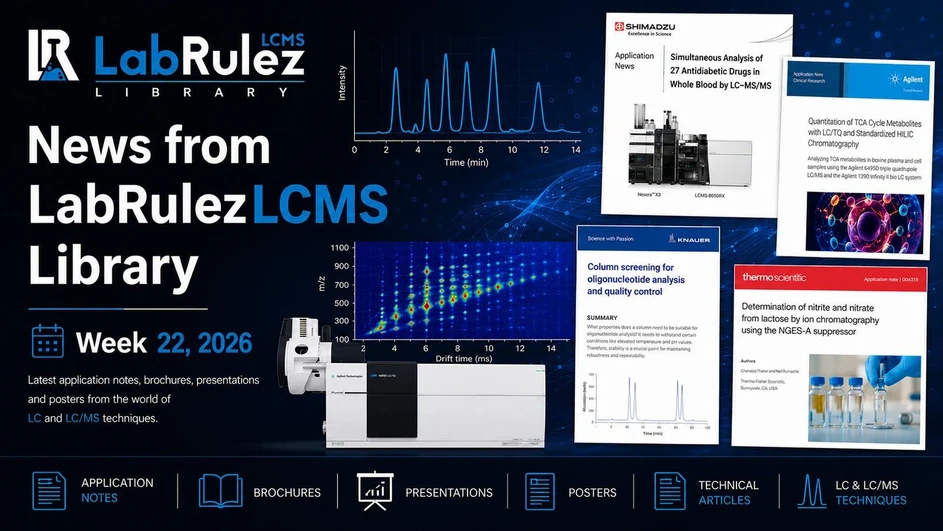
LabRulez / AI: News from LabRulezLCMS Library - Week 22, 2026
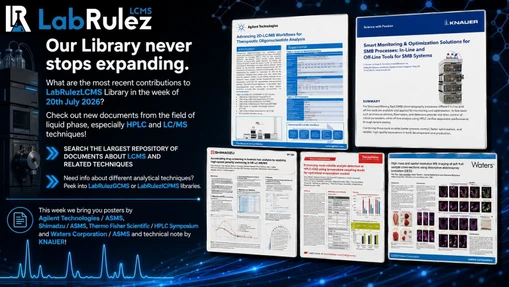
Our Library never stops expanding. What are the most recent contributions to LabRulezLCMS Library in the week of 25th May 2026? Check out new documents from the field of liquid phase, especially HPLC and LC/MS techniques!
👉 SEARCH THE LARGEST REPOSITORY OF DOCUMENTS ABOUT LCMS AND RELATED TECHNIQUES
👉 Need info about different analytical techniques? Peek into LabRulezGCMS or LabRulezICPMS libraries.
This week we bring you application notes by Agilent Technologies, KNAUER, Shimadzu, Thermo Fisher Scientific and Waters Corporation!
1. Agilent Technologies: Quantitation of TCA Cycle Metabolites with LC/TQ and Standardized HILIC Chromatography
Analyzing TCA metabolites in bovine plasma and cell samples using the Agilent 6495D triple quadrupole LC/MS and the Agilent 1290 Infinity II bio LC system
- Application note
- Full PDF for download
The TCA cycle has been known for several decades as a central metabolic pathway that performs the essential function of oxidizing nutrients to support cellular bioenergetics. More recently, it has become evident that TCA cycle behavior is dynamic, and products of the TCA cycle can be co-opted in cancer, other pathologic states, and in the regulation of immune responses.1 In this study, we present a metabolomics-targeted workflow for the absolute quantitation of TCA cycle metabolites in bovine plasma and cell samples using automated sample prep, an iron-free 1290 Infinity II bio LC, and a 6495D LC/TQ for robust and sensitive detection.
Targeted metabolomics methods provide sensitive and precise measurements of metabolites across a wide dynamic range. Agilent’s end-to-end targeted metabolomics workflow uses the Agilent Bravo Metabolomics Sample Prep Platform for the extraction from cells or plasma, a 1290 Infinity II bio LC for improved performance of metal-sensitive analytes, and a 6495D LC/TQ featuring fourth-generation Agilent iFunnel technology, paired with a database of over 500 polar metabolites with retention times for sensitive and reproducible metabolomics analysis.2 This workflow and database can be deployed in several ways, from metabolite pathway discovery (profiling), to semi-quantitative analysis of hundreds of analytes in a sample, or absolute quantitation using heavy-labeled internal standards. Quantitation of TCA metabolites is achieved with the standardized HILIC metabolomics methodology.
Experimental
Equipment
This experiment was conducted using the following instrument configuration:
- Agilent 6495D triple quadrupole LC/MS (G6495D)
- Agilent 1290 Infinity II bio high-speed pump (G7132A)
- Agilent 1290 Infinity II bio multisampler (G7137A)
- Agilent 1290 Infinity II multicolumn thermostat (G7116B)
- Agilent 1260 Infinity II diode array detector HS (G7117C)
Although this analysis used a 1290 Infinity II bio LC configuration, comparable results can be achieved on the 1290 Infinity III bio LC system with no changes to method parameters.
Conclusion
This application note applies newly optimized transitions for 13C-labeled TCA metabolites that facilitate absolute quantitation in complex matrices. The use of Fragilemode Agilent iFunnel settings improved sensitivity for all TCA metabolites. The new Agilent 6495D triple quadrupole LC/MS is fast, sensitive, precise, and can measure six orders of dynamic range. This end-to-end HILIC polar metabolite workflow can jump start your metabolomics research with methods for sample preparation, HILIC chromatography, and a database with over 500 metabolites, for highly sensitive profiling and quantitation.
2. KNAUER: Column screening for oligonucleotide analysis and quality control
- Application note
- Full PDF for download
The interest in oligonucleotides in various areas of research, but especially in medical research, has been enormous since the corona pandemic. A reliable and highresolution analytical method is the basis for any application of the variant-rich oligonucleotide molecules. One of the most chosen methods for oligonucleotide analysis is ion pairing reversed phase (IP-RP) chromatography. IP-RP uses an ion-pairing reagent to mask the charge on the molecule, that would prevent retention on a classical RP column. The quantification of oligonucleotides can easily be done by UV detection because oligonucleotides show strong absorption at 260 nm. For comparison of the screened columns, the purity of an oligonucleotide was determined. The crude product, the final product and a purified strand from a DNA full thiolate 43mer was used.
In this work once more we collaborated with the BianoGMP GmbH. The company specializes in the production of high purity and quality oligonucleotides and has many years of experience in the development of therapeutic oligonucleotides with a focus on GMP services and oligonucleotide analytical methods.
CONCLUSION
The measurements show nearly no differences between the columns. The KNAUER Sepapure oliGO column is a good alternative to the commonly used competitor column for oligonucleotide analysis.
3. Shimadzu: Simultaneous Analysis of 27 Antidiabetic Drugs in Whole Blood by LC–MS/MS
- Application note
- Full PDF for download
User Benefits
- 27 antidiabetic drugs with diverse chemical structures can be quantified in a single run.
- Antidiabetic drugs can be detected with high sensitivity at concentrations of 0.1 ng/mL in whole blood
- Analysis can be run on the same workflow and analytical conditions of “LC/MS/MS Forensic Toxicology Database.
Antidiabetic (glucose-lowering) drugs, mainly prescribed for the treatment of diabetes, include many classes with different mechanisms of action, such as biguanides, sulfonylureas (SUs), DPP-4 inhibitors, and SGLT2 inhibitors. Overdose or polypharmacy use of these drugs causes severe hypoglycemia. It can lead to the loss of consciousness and may result in falls, traffic accidents, and other serious incidents. In recent years, some antidiabetic drugs have been promoted on social media as “weight-loss drugs,” and their non-medical use for beauty care or diet purposes has become a social concern. In addition, these drugs have become easier to obtain through personal importation, raising concerns about adverse health effects from overdose or polypharmacy without medicalsupervision1). This study introduces the evaluation results of a simultaneous LCMS/MS method using the LCMS-8050RX for 27 antidiabetic drugs in blood.
Analytical Conditions
The LC–MS/MS analytical conditions are shown in Table 2, and the transitions for each compound are shown in Table 3. Fig. 3 shows the MRM chromatograms obtained under these conditions.
- LC System: Nexera X3
- Column: Kinetex XB-C18 (100 mm×2.1 mm I.D., 2.6 µm, Phenomenex, P/N:00D4496-AN)
- MS System: LCMS-8050RX (Corespray ESI)
Summary
This method enables the quantitation of 27 antidiabetic drugs in a single analysis run. The method provides high sensitivity, allowing detection even at low concentrations around 0.1 ng/mL in whole blood, and enables quantification over a wide concentration range. The Micro Volume QuEChERS kit can be carried out using the same workflow and same analytical conditions as the “LC/MS/MS Forensic Toxicology Database”. This allows parallel analysis alongside other drugs of abuse and supports more efficient, comprehensive toxicological analysis in research and forensic applications.
4. Thermo Fisher Scientific: Determination of nitrite and nitrate from lactose by ion chromatography using the NGES-A suppressor
- Application note
- Full PDF for download
Nitrite (NO₂⁻) and nitrate (NO₃⁻) impurities in pharmaceutical excipients are of growing concern due to their potential role in forming carcinogenic N-nitrosamines when secondary or tertiary amines are present in the active pharmaceutical ingredients or formulation process.1,2 Consequently, accurate quantification of these anions at trace levels is essential for ensuring drug safety and compliance with regulatory standards.1
Ion chromatography (IC) with suppressed conductivity has emerged as the preferred analytical technique for the simultaneous determination of nitrite and nitrate. Since its development in the 1970s, IC has become widely adopted in laboratories due to its high sensitivity, selectivity, and capacity for multianalyte separation.3,4 Moreover, IC methods have been incorporated into official pharmacopeial monographs, underpinning their relevance for quality control in the pharmaceutical industry.3
In pharmaceutical matrices, analytical challenges, such as high concentrations of chloride ions that may mask nitrite peaks, have been successfully addressed.5,6 For example, UV detection at ~210 nm, in conjunction with conductivity detection in IC, can effectively mitigate chloride interference, enabling sensitive nitrite quantification down to sub-µg/L levels, with excellent linearity and recovery rates; however, use of UV can also be challenging because of interference from UV-absorbing organic compounds in complex matrices and because of an inconsistent baseline during gradient analysis.5 Alternative approaches, such as gas chromatography–mass spectrometry (GC-MS), have also been investigated. One headspace GC-MS method achieved a quantification limit of 0.05 ppm for nitrite across diverse excipients, offering robustness and specificity, but sometimes requiring specialized instrumentation that can be more difficult to operate.2 These headspace GC-MS methods often involve derivatization under acidic conditions or the use of secondary amines, which can lead to the formation of nitrosamines. These nitrosamines pose a safety concern that complicates the analysis, introducing uncertainty, variability, and unwanted complexity into the analytical workflow. Also, inconsistent derivatization efficiency can cause poor reproducibility and quantification errors.
Liquid chromatography-tandem mass spectrometry (LC-MS/ MS) methods have also been utilized, but these methods often require derivatization for enhanced sensitivity in detecting nitrites. This frequently involves more complex sample handling and risks contamination, highlighting the balance between method simplicity and sensitivity in pharmaceutical analysis.1
Thus, IC stands out as a robust, reliable, and accessible tool for the simultaneous detection of nitrite and nitrate in excipients. Its adaptability across detection modes (conductivity, UV) and sensitivity to low levels make it a valuable asset for safeguarding drug quality.
IC, though widely used for nitrite analysis in pharmaceuticals, faces several limitations when applied to complex excipient matrices. The relatively low molar absorptivity of nitrite at 210 nm further challenges sensitivity, particularly in ultra-trace-level (low parts per billion or parts per trillion level) quantification, which might be required for nitrosamine risk assessment.5 Sample preparation may be minimal, but excipients with high ionic loads can necessitate dilution or cleanup to prevent column overload and detector saturation. Additionally, suppressed conductivity detection may suffer from baseline instability in complex formulations.5 Derivatization-based methods like Griess or DAN (2,3-diaminonapthalene) provide good sensitivity and specificity, but their derivatization reaction can be hindered by constituents present in the sample.5 IC with post-column derivatization using Griess can be used to match the required sensitivity for nitrite.5,7
Here, we demonstrate the application of a novel suppressor for multiple application notes (ANs) proposed by the U.S. Pharmacopeia (USP) for the determination of nitrite and nitrate using suppressed conductivity. The USP ANs specify the Thermo Scientific™ Dionex™ IonPac™ AS19-4µm Analytical Column (4 × 250 mm) for excellent separation of anions.8–10 The method detailed here was found to determine nitrite and nitrate from lactose monohydrate and colloidal silicon dioxide excipients successfully, and it can also be applied to other pharmaceutical excipients. One notable difference is the use of the Thermo Scientific™ Dionex™ NGES Next Generation Electrolytic Suppressor for anion analysis (NGES-A) here, which provides improved robustness over previous generations of suppressors without any sacrifice to performance. This ensures constant and routine testing of pharmaceuticals without interruption, saving the user time and intervention. The new suppressor also provides the advantage of faster baseline stabilization and decreased noise relative to older generation suppressors.
Summarily, this method helps labs ensure compliance with USP methodology while ensuring the pharma excipient products are free of harmful nitrosamine products and precursors.
Experimental
Equipment
- Thermo Scientific™ Dionex™ Integrion™ HPIC™ System (Part No. 22153-60305),* including:
- Thermo Scientific™ Dionex™ EGC KOH 500 Eluent Generator Cartridge (Part No. 075778)
- CD detector
- Thermostatted column oven
- Thermo Scientific™ Dionex™ AS-AP Autosampler (Part No. 074926) with 10 mL Thermo Scientific™ Dionex™ Vial Tray (Part No. 074938)
- Thermo Scientific™ Dionex™ AS-AP Autosampler Vial Kit, 10 mL polystyrene with caps and septa (Part No. 055058)
Software
- Thermo Scientific™ Chromeleon™ Chromatography Data System (CDS), software version 7.3.2.14225 MUe
Conclusion
This application note presents an IC method that enables precise and selective quantification of nitrite and nitrate in lactose monohydrate and colloidal silicon dioxide using a Dionex NGES-A suppressor. The technique demonstrates reliable detection at trace levels—specifically 0.1 μg/g nitrite and 0.2 μg/g nitrate— based on a 25 mg/mL sample concentration. Its sensitivity makes it well-suited for low-level nitrite and nitrate impurity analysis in lactose and colloidal silicon dioxide. Use of the Dionex NGES-A suppressor for this application afforded decreased noise, which improved detection limits of nitrite and nitrate and enabled faster equilibration.
This analytical approach can assist pharmaceutical manufacturers in conducting comprehensive risk assessments and implementing control measures. These may include choosing suitable excipients, verifying supplier quality, determining optimal excipient levels, and refining the production process.
5. Waters Corporation: High Resolution Characterization of Lipid Nanoparticles Using the Xevo™ Charge Detection Mass Spectrometry (CDMS) Instrument - Single Particle Mass Analysis of Intact LNP-mRNA Formulations
- Application note
- Full PDF for download
Benefits
- CDMS measures every particle directly, delivering true single particle masses without deconvolution or charge state assumptions and accurately capturing particle‑to‑particle variability.
- CDMS delivers unmatched clarity, exposing subpopulations that ensemble methods obscure and revealing the full landscape of LNP heterogeneity and loading differences.
- CDMS delivers actionable insight from early formulation through process development and quality comparisons, enabled by high resolution mass readouts and rapid data acquisition.
LNPs support the successful delivery of mRNA therapeutics by protecting nucleic acid payloads, improving cellular entry, and enabling controlled pharmacokinetic profiles.1 These particles consist of ionizable and helper lipids, cholesterol, and PEG lipids (Figure 1). The interplay of these components results in a highly diverse set of particle structures with a broad range of sizes and payloads.
Accurate characterization of this complexity is essential for understanding LNP formulation behavior and ensuring product consistency.1 A broad range of analytical techniques is used to interrogate LNPs, each contributing complementary information. These techniques include light scattering approaches (DLS, SEC‑MALS, FFF‑MALS), microscopy methods such as cryo‑EM and AFM, capillary electrophoresis, analytical ultracentrifugation, and other orthogonal tools.1,5 While each technique provides valuable insight, they also carry inherent limitations: many rely on ensemble‑averaged measurements, require model‑dependent assumptions, or probe only a single component of the particle (lipids, RNA, or morphology).1,5 Critically, none of these conventional methods measure the intact mass of individual particles or resolve particle‑to‑particle heterogeneity across the full distribution. A recent study from the Mitchell Group, which utilized multiple ensemble methods, further underscores that even well‑established LNP systems exhibit substantial nano‑ to mesoscale heterogeneity that remains obscured when relying solely on ensemble techniques.5 These limitations highlight the need for truly particle‑resolved analytics, and CDMS meets this need by directly revealing the multimodal and compositional landscape hidden within LNP formulations.
CDMS enables direct, simultaneous measurement of the m/z and charge of each ion,2 allowing accurate mass determination of intact LNPs on a particle‑by‑particle basis. This single‑particle capability provides analytical resolution that cannot be achieved with traditional ensemble solution‑phase techniques.2 In a recent study, Miller et al. used a research‑grade CDMS platform to analyze thousands of empty and mRNA‑loaded LNPs, demonstrating strong agreement between CDMS‑derived particle sizes and cryo‑TEM measurements.4 These findings confirm that LNPs remain structurally stable under CDMS vacuum conditions and highlight the technique’s suitability for intact‑particle characterization.4 Together, these results establish CDMS as a rapid, label‑free analytical approach for assessing LNP mass, size distribution, and structural stability, providing a powerful complement to existing biophysical methods.4
Here, the Xevo CDMS Instrument is applied to characterize LNP mass distributions and population heterogeneity. The results illustrate how single particle mass analysis can enhance understanding of formulation quality.
Experimental
COMIRNATY® (Pfizer-BioNTech) COVID-19 vaccine (2025-2026 formula) was stored and handled following the manufacturers’ guidelines over the duration of the experiments. The samples were buffer exchanged into 20 mM ammonium acetate solution (pH 7.4) using Slide-A-Lyzer™ MINI Dialysis Devices (Thermo Fisher Scientific®) for 15 minutes at 4 °C before CDMS analysis. Ions were generated in positive ion mode using nano-electrospray ionization (nESI) and mass analysis was performed using the ELIT-based Xevo CDMS Instrument (Figure 2). All data were acquired within the waters_connect™ Informatics Platform (version 4.2.0) using the CDMS Toolkit application and processed within the same application.
Conclusion
This work presents the first LNP–mRNA data generated on a commercial Xevo CDMS Platform, demonstrating its ability to directly measure single‑particle masses and resolve the intrinsic heterogeneity of LNP formulations. By reporting intact particle mass without deconvolution or charge‑state assumptions, CDMS distinguishes coexisting subpopulations and preserves low‑abundance features that are routinely obscured in ensemble‑based measurements. Applied to COMIRNATY, CDMS produces well‑resolved, peak‑structured mass profiles that reflect meaningful differences in particle loading and composition, enabling deeper insight into formulation behavior, process development, and lot‑to‑lot comparability. Ultimately, Xevo CDMS Instrument provides the high resolution insight necessary to streamline development and strengthen LNP program outcomes.