News from LabRulezLCMS Library - Week 53, 2025
LabRulez: News from LabRulezLCMS Library - Week 53, 2025
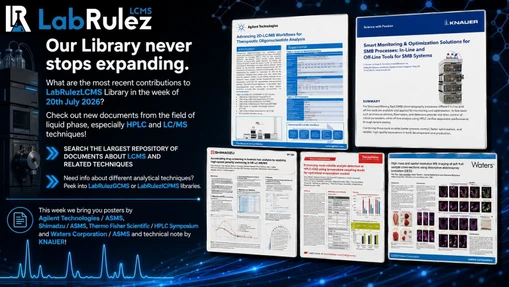
Our Library never stops expanding. What are the most recent contributions to LabRulezLCMS Library in the week of 29th December 2025? Check out new documents from the field of liquid phase, especially HPLC and LC/MS techniques!
👉 SEARCH THE LARGEST REPOSITORY OF DOCUMENTS ABOUT LCMS AND RELATED TECHNIQUES
👉 Need info about different analytical techniques? Peek into LabRulezGCMS or LabRulezICPMS libraries.
This week we bring you application notes by Agilent Technologies, Metrohm, Thermo Fisher Scientific / HPLC and Waters Corporation!
1. Agilent Technologies: Determination of Explosives in Soil Using the Agilent 1260 Infinity III LC System
Injector workflows for reliable calibration without manual work
- Application note
- Full PDF for download
Residues of nitroaromatics and nitramines used as explosives can be found in the environment due to military activities, as well as civil activities such as mining and construction. In Germany, a new regulation (Bundes-Bodenschutz- und Altlastenverordnung (BBodSchV)) came into effect in 2023 and requires the determination of the explosives 2,4-dinitrotoluene, 2,6-dinitrotoluene, Hexyl, RDX, PETN, and TNT.1 Hexyl is not included in established methods, such as US EPA method 8330B.2 According to the BBodSchV, the above-mentioned explosives in soil must be determined using the procedure described in DIN ISO 11916-11, which describes the determination of selected explosives and related compounds using HPLC with UV detection.3 Figure 1 shows the explosives and related compounds covered in DIN ISO 11916-1.
As seen in Figure 1, some of the explosives and related compounds are structurally very similar, which makes it difficult to separate them chromatographically.4 Accordingly, the US EPA method 8330B recommends analysis employing a C18 phase as a primary column and an additional analysis for confirmation employing a CN or phenyl-hexyl phase.2,4,5 The Agilent InfinityLab Poroshell 120 PFP (pentafluorophenyl) stationary phase provides extra retention and selectivity for positional isomers of nitro-substituted benzenes6 , allowing complete separation of the explosives and related compounds shown in Figure 1.
This application note demonstrates analysis of the explosives and related compounds covered in DIN ISO 11916-1 in soil samples, employing the Agilent 1260 Infinity III LC and an InfinityLab Poroshell 120 PFP column. Preparation of calibration standards is performed using the injector workflows available with Agilent InfinityLab autosamplers. The automated preparation of calibration standards avoids manual liquid handling steps, saving time and cost, and achieving results independent of operator skills.7 The 1260 Infinity III LC is equipped with Agilent InfinityLab Assist and Agilent InfinityLab Level Sensing. The InfinityLab Assist allows for automation of system preparation and flushing, thereby avoiding manual work and saving time. InfinityLab Level Sensing facilitates accurate tracking of HPLC solvent levels, preventing the LC from running dry.
Experimental
Equipment
The Agilent 1260 Infinity III LC System comprised the following modules:
- Agilent InfinityLab Assist (G7180A)
- Agilent InfinityLab Level Sensing (G7175A)
- Agilent 1260 Infinity III Quaternary Pump (G7111B)
- Agilent 1260 Infinity III Vialsampler (G7129C)
- Agilent 1260 Infinity III Multicolumn Thermostat (G7116A)
- Agilent 1260 Infinity III Diode Array Detector HS (G7117C) with Agilent InfinityLab Max-Light Cartridge Cell 10 mm, (G4212-60008)
Software
- Agilent OpenLab CDS, version 2.8 update 07 (or later versions)
Columns
- Agilent InfinityLab Poroshell 120 PFP, 3.0 × 150 mm, 2.7 µm (part number 693975-308)
Results and discussion
The separation of explosives and related compounds was successfully accomplished employing the 1260 Infinity III LC and an InfinityLab Poroshell 120 PFP column, as can be seen in Figure 3. The combination of the InfinityLab Poroshell 120 PFP column and a methanolic gradient enabled baseline separation of all 16 compounds covered in DIN ISO 11916‑1 within a single analysis. It is known that tetryl shows decomposition in methanol/water solutions as well as with temperatures at or above room temperature2,3 and that acidic conditions help to prevent decomposition.2,4 The employed 10 mM pH 3.0 potassium phosphate buffer successfully avoids decomposition of tetryl.
Conclusion
Employing the Agilent 1260 Infinity III LC and an Agilent InfinityLab Poroshell 120 PFP column, all 16 explosives and related compounds covered in DIN ISO 11916-1 were successfully analyzed in soil samples within a single analysis. Excellent reproducibility is observed. The injector workflows available with Agilent InfinityLab autosamplers allow fast and easy automation of the preparation of calibration standards, resulting in calibration with excellent linearity while saving time and cost by avoiding manual liquid handling steps.
2. Metrohm: Power generation: analysis of the mnumber (alkalinity) in cooling water
- Application note
- Full PDF for download
One way to maximize heat transfer efficiency and reduce costs in a power plant is by controlling the water chemistry in the cooling circuit (Figure 1). Cooling water is used to condense the exhaust steam from the turbine to water, which is then sent back to the water-steam circuit as feed water. The heat of condensation (energy) from the steam is transferred to this cooling water as it flows through kilometers of (titanium) piping in the condenser. The water chemistry depends on the type of power plant, cooling circuit design, and construction materials. Every cooling circuit has a unique design and its own analytical requirements.
The cooling water temperature is reduced either by once-through cooling, in which the water is taken from the environment and returned at a slightly higher temperature, or in a circuit in a cooling tower. Water requirements for once-through cooling circuits are much more demanding because of the large volumes needed for continuous cooling. Oxygen (among other impurities) is also prevalent in the water taken from rivers and lakes, leading to corrosion in the pipelines if not removed adequately. Continuous circulation of the cooling water increases the concentration of contaminants in the circuit but uses much less water.
Application
Titration is performed with 0.1 mol/L hydrochloric acid (HCl) to pH 4.5. The endpoint is detected automatically by recording the change of pH/mV signal in relation with the dosed amount of titrant. A suitable pH electrode is used for accurate indication of this pH/mV change. In addition to the 2026 Titrolyzer, the 2035 Potentiometric, and 2060 TI Process Analyzers (Figures 2 and 3) can also monitor alkalinity online, guaranteeing high process efficiency and low operating and energy costs.
CONCLUSION
Metrohm Process Analytics offers a wide range of online process analyzers to monitor power plants around the clock. From single parameter analyzers (e.g., 2026 Titrolyzer) to multiparameter analyzers (e.g., 2035 Process Analyzer – Potentiometric and the 2060 TI Process Analyzer)—all of these solutions can measure alkalinity, helping to safeguard plant operation and optimize process cooling efficiency.
3. Thermo Fisher Scientific / HPLC: Method transfer case study for instrument and LC column migration of the purification and analysis workflow for synthetic oligonucleotides
- Poster
- Full PDF for download
In recent years, there has been a growing interest in oligonucleotides within the fields of biochemical research, diagnostics, and pharmaceuticals.[1] Significant efforts have been made to optimize and automate their synthesis. However, the process of oligonucleotide synthesis involves multiple reactions, leading to the accumulation of impurities, such as truncated nucleotide sequences, partial deprotection biproducts, and fluorophore/quencher degradation impurities. Therefore, it is crucial to purify the desired oligonucleotides effectively and with high purity for downstream applications.
Since the 1970s, various chromatographic methods have been utilized for the analysis and purification of synthetic oligonucleotides.[2] Reversed-phase high-performance liquid chromatography (RP-HPLC) is the widely employed technique for high-resolution separation of nucleic acids.[3] However, the purity specification for oligonucleotides is on the rise. For example, the chromatographic analysis of active pharmaceutical ingredients (API) is required to ensure the detection of contaminants at concentration levels down to, in some cases, sub-ppb amounts relative to the drug.[4] For other applications, oligonucleotide purity needs to exceed 90%. The increasing demand for oligonucleotides as therapeutic agents necessitates the development of a HPLC purification scheme that satisfies a high purity specification.
When developing methods to separate and purify oligonucleotides, it is essential to consider their unique characteristics. These include the length of the oligo, specific sequence, fluorophore/quencher combination, and ability to form secondary structures. Other factors that influence an oligonucleotide’s interaction with the stationary phase, and therefore retention time, include buffer (pH and salt concentration), reversed-phase column, and the wetted parts of the HPLC system.[2] As a result, the ability to seamlessly transfer oligonucleotide purification methods from one vendor instrumentation and columns to another while meeting or exceeding the expected quality criteria is a critical aspect. This work demonstrates the successful method transfer of the semi-preparative RP-HPLC purification of two different duallabeled 15mer oligonucleotides from an Agilent 1260 Infinity II Preparative-Scale LC Purification system and various third-party columns to the Vanquish Analytical LC Purification system and Thermo Scientific columns.
Methods
A method transfer of semi-preparative reversed phase purification and RP-LC quality control was performed from a non-Thermo Fisher Scientific liquid chromatographic system to the Thermo Scientific Vanquish Flex Binary UHPLC System. This included the use of purification and quality assurance columns to facilitate a Thermo Fisher Scientific workflow solution. A straightforward method was employed to purify oligonucleotides using the Thermo Scientific Vanquish Analytical Purification LC system and to perform quality control with UHPLC high-resolution mass spectrometry (HRMS).
Data Analysis
Thermo Scientific Chromeleon Chromatography Data System (CDS) 7.3.2 was used for data acquisition and processing.
Results
The method transfer for purifying dual-labelled oligonucleotide samples from a non-Thermo Fisher LC system to the Vanquish Analytical Purification LC System was successful. Vanquish yielded comparable quantitation/QC data to Agilent for ABY/JUN-MGB probes. The Thermo Scientific Hypersil GOLD column matched previous purification performance and reduced fraction volume. For QC, it met all criteria as a suitable substitute.
Conclusions
The focus of this study was to compare the purity, yield, and mass identification from the source instrumentation to the Vanquish LC platform to provide evidence of a successful method transfer. This was proven via the purities and yields of the Thermo Fisher Scientific workflow solution where the derived yields and purities are comparable to that of the non-Thermo Fisher Scientific workflow.
- In Figure 5, the LC instrument-to-instrument comparison was made, and the result showed comparable yields and purities for both oligonucleotide samples. This experiment uses the non-Thermo Fisher Scientific columns and only compares the source LC and Vanquish LC instrumentation showing a straightforward method transfer.
- In Table 5, the analytical columns were compared to show that the Hypersil GOLD analytical column gives results similar to the source column. This provides users with the option to apply the Hypersil GOLD analytical column for LC-UV QC purity analysis.
- In Table 6, the semi-preparative column comparison was made. The result illustrates the capabilities to purify the oligonucleotide samples with passing R&D requirements on the Hypersil GOLD semi-preparative column.
4. Waters: A Rapid Approach to Metabolite Identification Using Xevo MRT Mass Spectrometer and MassMetaSite Software
- Application note
- Full PDF for download
Benefits
- The Xevo MRT Mass Spectrometer delivers sub-ppm mass accuracy in both MS1 and MS2 modes, enabling precise localization of biotransformation sites
- The fast DIA and DDA acquisition capabilities of the Xevo MRT Mass Spectrometer make it ideal for highresolution mass spectrometry (HRMS), supporting short LC run times and significantly boosting throughput
- Seamless data transfer from waters_connect Software to Mass Analytica’s MassMetaSite metabolite identification software simplifies the workflow, efficiently converting LC-MS data into clear metabolite identifications
Metabolite identification is a vital step in the pharmaceutical R&D process. It provides essential insights during drug discovery supporting in vitro screening, lead candidate selection, and pharmacokinetic profiling, and continues to play a key role in development by informing interspecies comparisons, dose escalation safety studies, and clinical evaluations.
In the discovery phase, the volume of new chemical entities is high, necessitating rapid, broadly applicable methodologies that do not require compound-specific customization. At this stage, limited information is available about a compound’s metabolic fate. As such, identification relies on mass spectral characteristics and known biotransformation pathways.
In contrast, the development phase demands comprehensive metabolite profiling across species, though throughput is less critical due to fewer compounds. By this point, prior metabolic data (e.g., from in vitro studies) often exists, allowing researchers to confirm known metabolites and identify new ones. Additionally, radiolabeled compounds may be used to highlight drug-related species.
To meet these needs, a high-throughput, accurate, and reliable system for metabolite detection, data mining, and identification is essential. This application note describes a solution combining the Waters Xevo MRT Mass Spectrometer, ACQUITY Premier UPLC Chromatography System, and MassMetaSite software. This integrated platform leverages fast chromatographic performance, high-speed MS1 and MS2 data acquisition with sub-ppm accuracy, and intelligent data analysis to rapidly detect and assign drug metabolites.
Experimental
LC-MS Data Analysis
The samples were analyzed by reversed–phase chromatography using an ACQUITY Premier UPLC Chromatography System coupled to a Xevo MRT Mass Spectrometer. The chromatography was performed on a CORTECS™ C18, 1.6 µm, 2.1 x 50 mm analytical Column (p/n: 186007114). Following sample injection (1 µL), the column was eluted with a 5–95% organo – aqueous gradient over 5 minutes at 0.6 mL/min, where mobile phase A comprised 0.1% formic acid containing 1 mMol ammonium formate and mobile phase B 95:5 ACN:water (v/v), 0.1% formic acid, 1 mMol ammonium formate).
Data Management
- Chromatography software: waters_connect Software Platform
- MS software: waters_connect Software Platform
Conclusion
Rapid and accurate metabolite identification is essential to support pharmaceutical research and development. With the growing number of compounds requiring DMPK (drug metabolism and pharmacokinetics) assessment, there is a clear need for a high-throughput platform capable of both analyzing samples and efficiently processing the resulting data.
This application note describes a robust solution that combines:
- Fast, high-resolution chromatography from the ACQUITY Premier UPLC System
- Sub-1 ppm mass accuracy and wide dynamic range from the Xevo MRT Mass Spectrometer
With the advanced data processing capabilities of MassMetaSite software Using a rapid 5-minute generic reversed-phase LC gradient, this platform successfully detected and identified over 40 in vivo metabolites of methapyrilene. The exceptional mass accuracy of the Xevo MRT Mass Spectrometer in both MS1 and MS2 modes significantly enhances confidence in the proposed metabolite structures.