Seasonal update on liquid handling
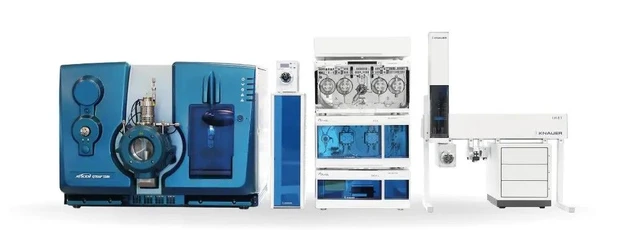
- Photo: KNAUER: Seasonal update on liquid handling
- Video: KnauerHPLC: KNAUER LH 8.1 - Overlapped Injections
In German, there is a well-known saying: “Der April macht, was er will!” — loosely translated as “April does whatever it wants.” While this usually refers to unpredictable weather, it can sometimes describe other situations just as well.
As an analytical application specialist at KNAUER, I was genuinely excited when, at the end of 2023, my colleague and product manager Mareike Myrach and I were assigned the project of the Liquid Handler LH 8.1. At that time, we had no prior hands-on experience with the system, but we quickly got up to speed — largely because learning by doing turned out to be surprisingly intuitive.
Following an intensive phase of testing, method development, and optimization, the Liquid Handler LH 8.1 was officially introduced by KNAUER in April 2025. Returning to the April proverb — this time, April behaved quite differently. Rather than being unpredictable, everything came together smoothly (even if not weather-wise!). All documentation was finalized, product configurations defined, and specifications locked in. It was a very satisfying milestone.
What makes the Liquid Handler LH 8.1 stand out?
Let’s take a closer look at some of its key features.
Flexible configuration tailored to your workflow
The KNAUER LH 8.1 is a highly customizable XYZ autosampler designed to adapt to a wide range of laboratory requirements. It supports numerous modules and accessories, allowing users to build a system that fits their specific applications.
Core components include the injection valve, the Robotic Cooler, and the fast wash station — all essential for efficient operation. Beyond these, we are continuously exploring additional enhancements.
For example, how about seasonal upgrade kits?
- LH 8.1 Easter edition
- LH 8.1 Christmas edition
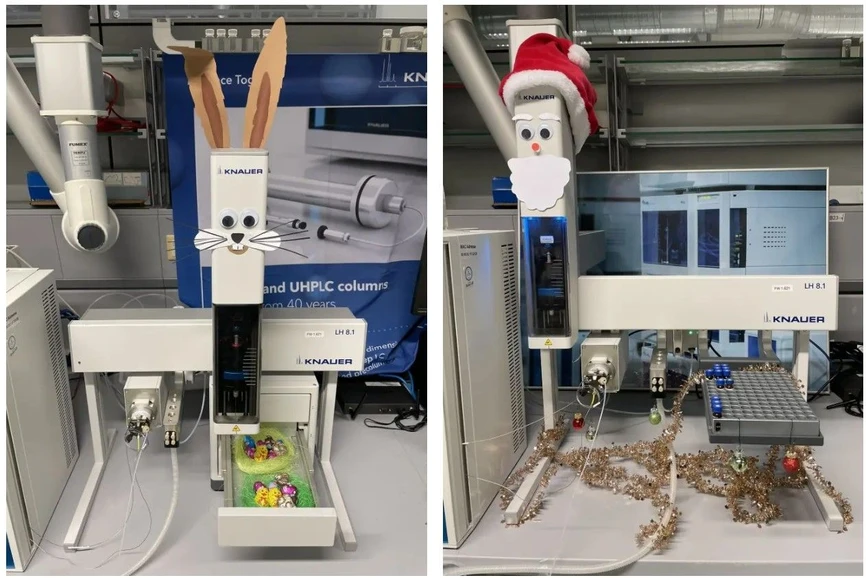 KNAUER: Fig. 1: Left: LH 8.1 Upgrade Kit “Easter”, right: LH 8.1 Upgrade Kit “Christmas” (limited availability — only 1 in stock!)
Flexible sample storage and high-throughput capability
For laboratories focused on high-throughput analysis, the Robotic Cooler module is indispensable. Each unit can accommodate up to three sample racks, with 130 vials per rack — totaling 390 vials per module.
Depending on the rail length, multiple Robotic Coolers can be installed and operated independently. On the longest rail configuration, up to three modules can be used simultaneously, increasing the total capacity of a single LH 8.1 system to as many as 1,170 vials (1.5 mL each).
Naturally, the system is not limited to standard vials. It can store a variety of sample types within a temperature range of 4–40 °C.
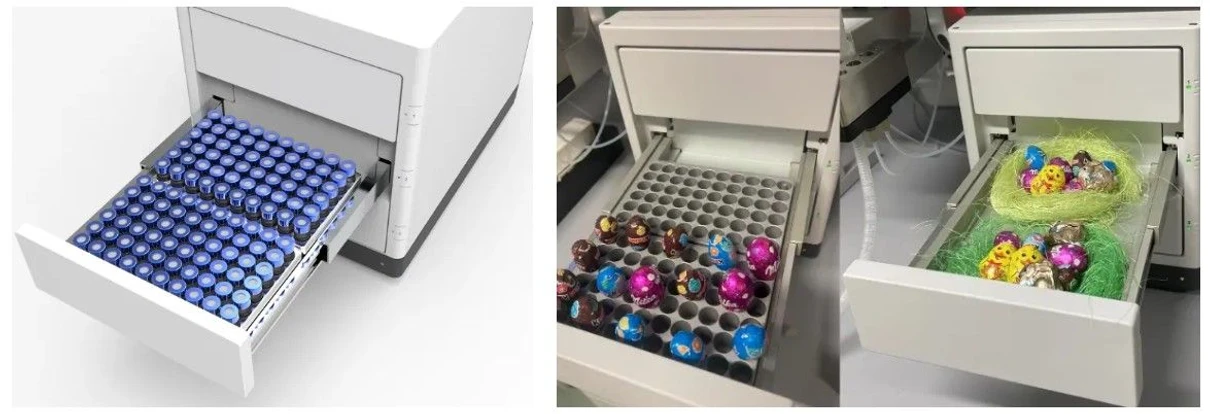 KNAUER: Fig. 2: Left: tray with standard samples, middle: tray with specialized samples, right: very special samples
True zero sample loss
Have you ever encountered the concept of “sandwich injections” in liquid chromatography? It may sound unusual at first. Replace the bread with standard HPLC solvents and the filling with your sample, separated by small air gaps — and you have a liquid “sandwich.”
The LH 8.1 takes this concept even further. It allows sampling from virtually any container type. Whether it’s a standard vial or something more unconventional — like a filled chocolate egg — the system can handle it. The result? A rather creative “egg sandwich.”
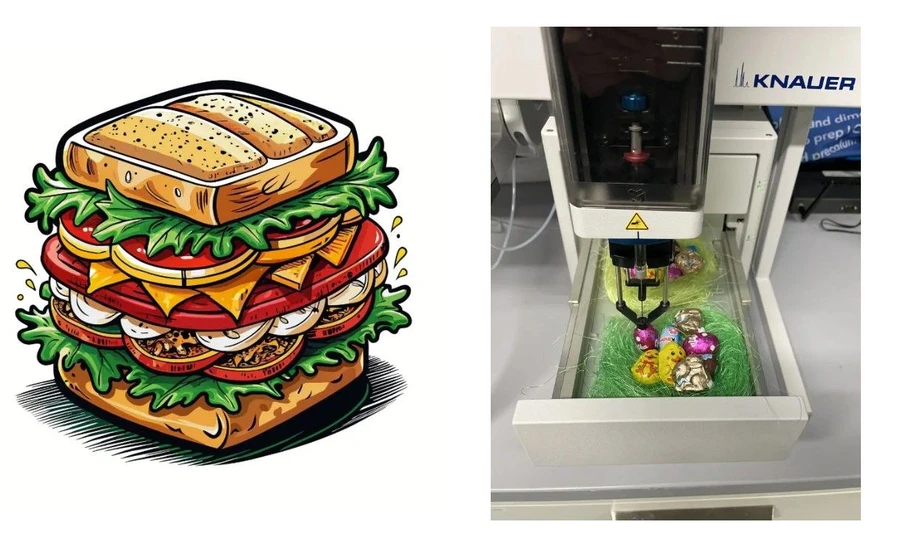 KNAUER: Fig. 3: Left: example of sandwich configuration, right: aspiration from a chocolate-based sample container
Please note: using such unconventional containers may significantly increase both carryover and... enjoyment.
Carryover and injection precision
When evaluating HPLC injectors, injection precision is one of the most critical parameters. After optimizing the injection conditions, we achieved excellent performance.
To ensure ease of use, all optimized parameters have been integrated into the software drivers. This allows users to benefit from high precision without complex programming.
Injection precision (RSD):
- Full loop injection: ≤ 0.10%
- Sandwich injection (>5 µL): ≤ 0.15%
Another key parameter is sample carryover, evaluated using recommended washing protocols. During testing, we measured carryover using chlorhexidine as a standard compound to allow comparison with other autosamplers. Additionally, caffeine was tested due to its widespread use and accessibility in laboratories.
Taking advantage of the LH 8.1’s flexibility, we also explored sampling from unconventional containers.
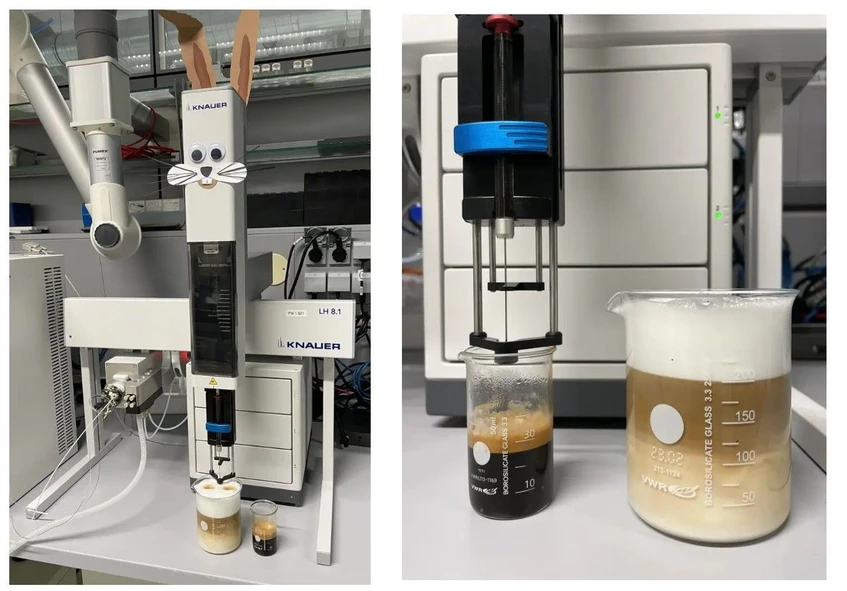 KNAUER: Fig. 4: Left: injection of diluted caffeine sample for quantification, right: injection of concentrated sample for carryover assessment
Measured carryover values:
- Chlorhexidine: < 0.005%
- Caffeine: < 0.002%
Returning to the beginning of this article — you may have noticed that not only “April does whatever it wants,” but sometimes KNAUER blog authors do as well.
Despite the seasonal theme, we hope you discovered a few hidden “Easter eggs” throughout the text — and didn’t take everything too seriously.
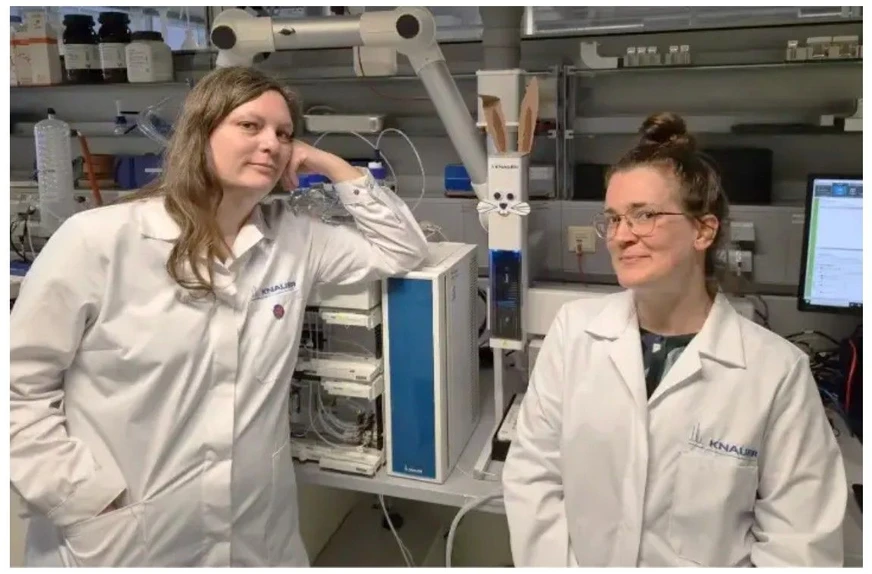 KNAUER: Fig. 5: KNAUER blog authors
- More reputable information: KNAUER Liquid Handler LH 8.1