Introducing Our System Solution for High Throughput Quality Control – HTQC
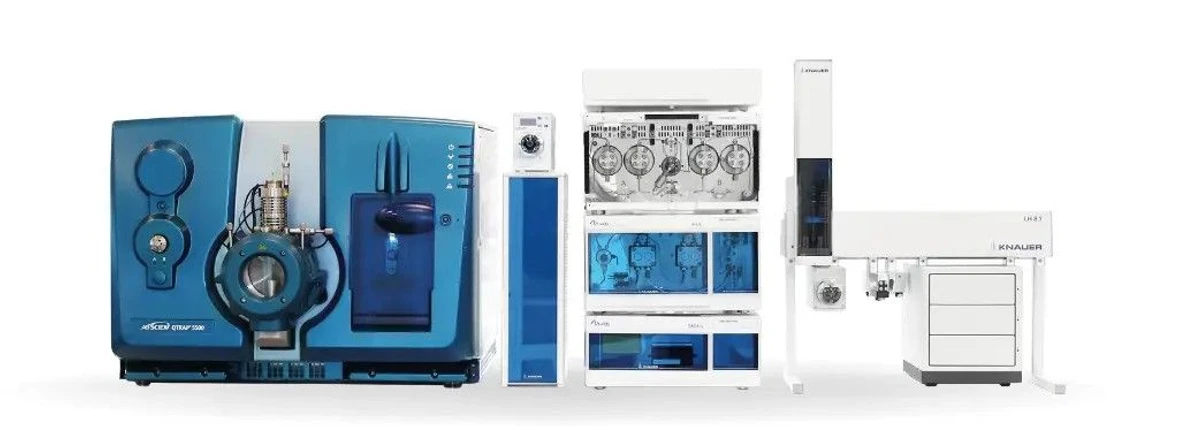
KNAUER: Introducing Our System Solution for High Throughput Quality Control – HTQC
Let’s begin with a simple question: what do we actually mean by high throughput?
In the laboratory, high throughput usually refers to the ability to analyze tens, hundreds, or even thousands of samples per day, either across a laboratory workflow or on a single analytical system. Achieving this requires more than just a fast method. It depends on reliable instrumentation, automation, sufficient sample capacity, and smart system design that minimizes idle time between runs.
In this article, we look at the key requirements for high-throughput HPLC analysis and how they are addressed in the HTQC system.
Speed
High-throughput HPLC workflows typically rely on short methods. This includes both the chromatographic runtime and the cycle time of the injection module.
With the HTQC system, fast gradient applications up to 1200 bar can be implemented using two integrated UHPLC high-pressure gradient pumps.
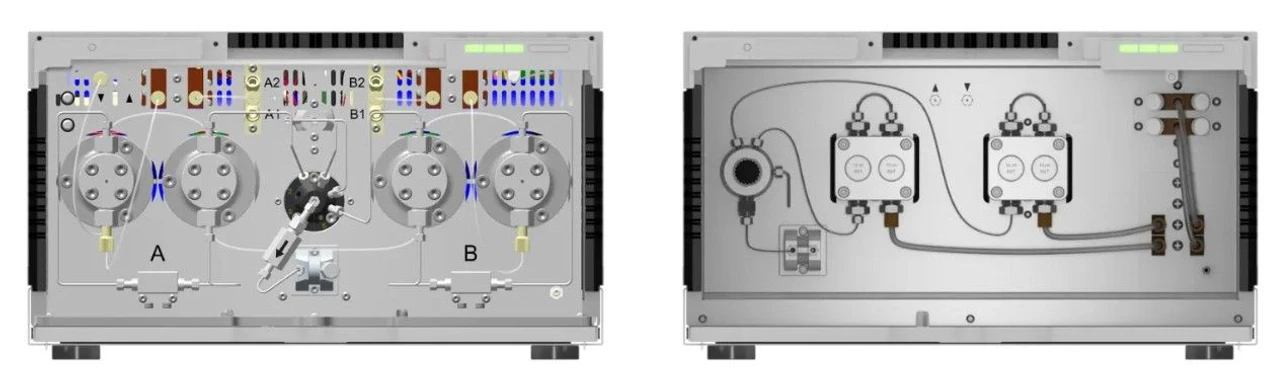 KNAUER: Fig. 1–2 HPG pumps of HTQC system, left: P 8.1L (max. pressure 1240 bar), right: P 6.1L (max. pressure 1000 bar)
We will not discuss the full details of transferring classical HPLC methods to fast, high-resolution UHPLC methods here, but UHPLC implementation can dramatically reduce total analysis time.
Let’s use a hypothetical example. Imagine Giorgia, a randomly chosen name, working in pharmaceutical quality control in 1998. She must have travelled back in time, because she would have been too young to work in a lab then, but the example still works. With a classical HPLC method, each sample takes approximately 75 minutes, including equilibration, analysis, and backflushing of a 250 × 4.6 mm ID column. This type of method has been common in QC laboratories around the world. During an eight-hour working day, Giorgia can analyze around six samples.
Now let’s transfer the same method to UHPLC. The improvement is substantial. Analysis time, equilibration time, and backflushing time are all reduced to under six minutes per sample. Giorgia can now process around 90 samples in one working day.
You may wonder why the HTQC system requires two UHPLC gradient pumps. We will come back to that shortly.
The next way to increase speed is to reduce injector cycle time. Injection procedures and washing steps can sometimes take a significant amount of time. This is where the LH 8.1 liquid handler becomes important.
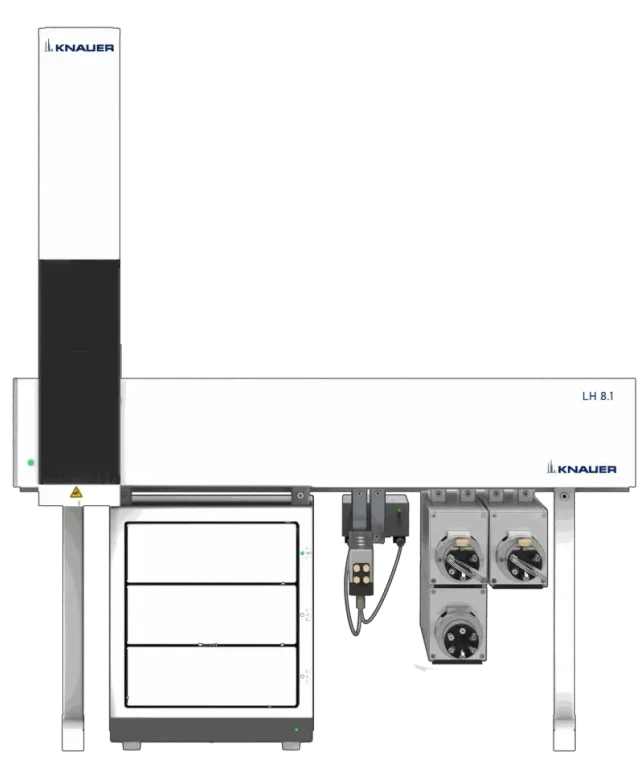 KNAUER: Fig. 3 KNAUER LH 8.1 Liquid Handler
The LH 8.1 supports overlapped injections. This means that the next injection can already be prepared while the current analysis is still running. Necessary cleaning steps of the injection system are still maintained, but idle time is reduced.
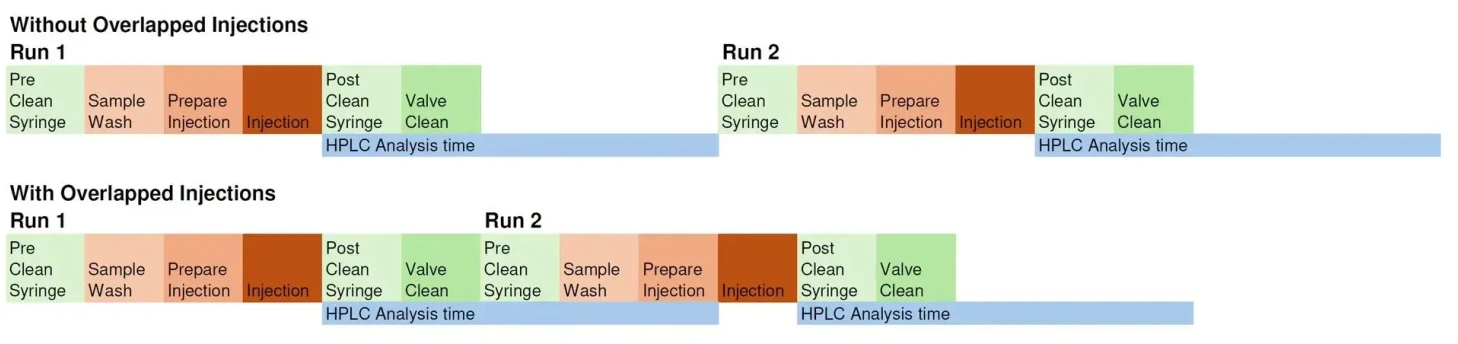 KNAUER: Fig. 4 Schematic buildup of injections with and without overlapped injections
Let’s return to Giorgia. By using overlapped injections in her QC method, she saves about one minute per sample. This increases her capacity to approximately 105 samples per day.
Sample Throughput
A high-throughput system must also be able to handle and store a sufficient number of samples. Here, the LH 8.1 provides another major advantage. In the long-rail version, it can be equipped with up to three robotic coolers.
With three coolers, each containing three drawers, the system can hold nine 10 × 13 sample trays. That means a total capacity of 1170 vials. The samples are also temperature controlled.
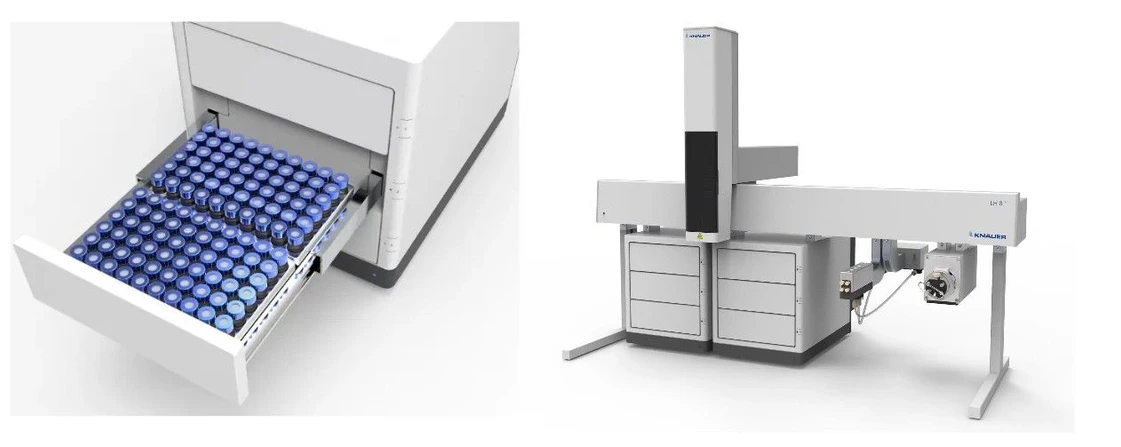 KNAUER: Fig. 5–6 Robotic Cooler with two 10x6 trays, LH 8.1 (887 version) with two Robotic Coolers
Combined with the low eluent consumption typical of UHPLC, this large sample capacity makes it possible to extend operation from an eight-hour workday to 24-hour operation.
For Giorgia and her QC lab, this changes everything again. The same UHPLC method, including overlapped injections, can now run continuously around the clock. This allows approximately 320 samples to be processed per day.
Is that enough? Maybe not. As the blog title suggests: we just can’t get enough.
Automation
In addition to a standard 6-port, 2-position injection valve, the HTQC system includes an additional valve. This special column-switching and backflushing valve enables two columns to be operated alternately within a single UHPLC system.
While one column is used for analysis, the second column can be backflushed and equilibrated in the reverse flow direction at the same time. This is particularly useful for reducing matrix effects, which are often encountered in QC laboratories when complex sample matrices are analyzed. It also helps reduce overall method runtime.
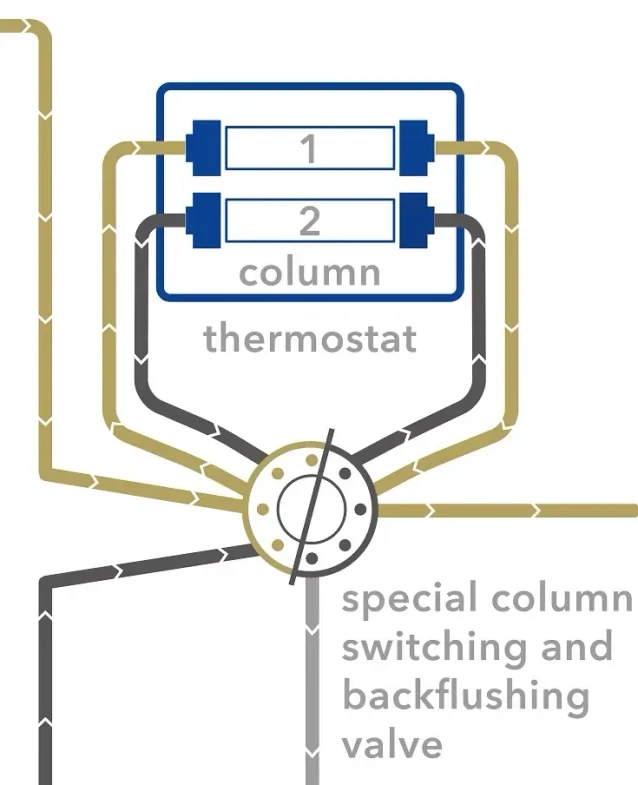 KNAUER: Fig. 7 Exemplary flow scheme of special column switching valve
Parallel Processing
Remember the earlier question: why does the system use two UHPLC gradient pumps?
The reason is now clear. The second gradient pump is required to backflush one column while the other column is connected to the analytical flow path through the special switching valve.
 KNAUER: Fig. 8 Schematic illustration of column cleaning, equilibration and analysis with special backflush valve
Giorgia immediately ordered a second UHPLC pump and the special valve for her QC lab. She now has a complete HTQC system and is very pleased with the result.
Why? Let’s calculate it one final time. With all automation features in place, Giorgia can clean one column while the other column analyzes a sample. This enables her to process an impressive 600 samples per day.
Compared with the classical HPLC method she used in 1998, the daily sample throughput has increased from six samples to 600 samples. That is a 100-fold increase.
Summary
We started with a question, so let’s end with one too: what steps increased the throughput?
First, the method was scaled down from classical HPLC to a fast UHPLC approach. Then, a second pump and a special column-switching and backflushing valve were added to the UHPLC setup. Together with the LH 8.1 liquid handler and its exceptional sample capacity, the HTQC system becomes a flexible and powerful configuration for high-throughput analysis.
The system can also be coupled to nearly any detector used in HPLC. Because of its ability to operate at very high speed, it is especially well suited for mass spectrometric methods.
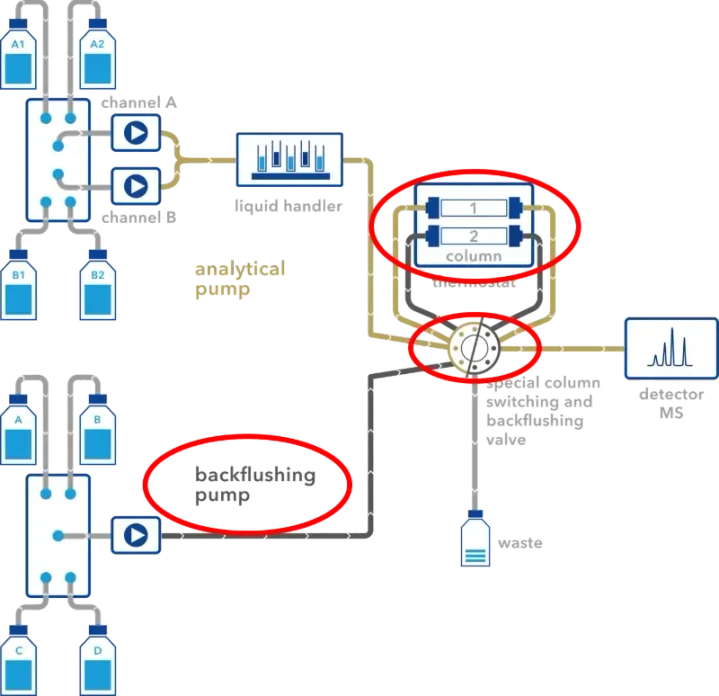 KNAUER: Fig. 9 Complete flow scheme of HTQC system with highlighted system components
For further information on this topic, please contact our authors: [email protected], [email protected]