From the Road to the Field: Decoding Chemical Transformation in Aging Tire and Artificial Turf Crumb Rubber
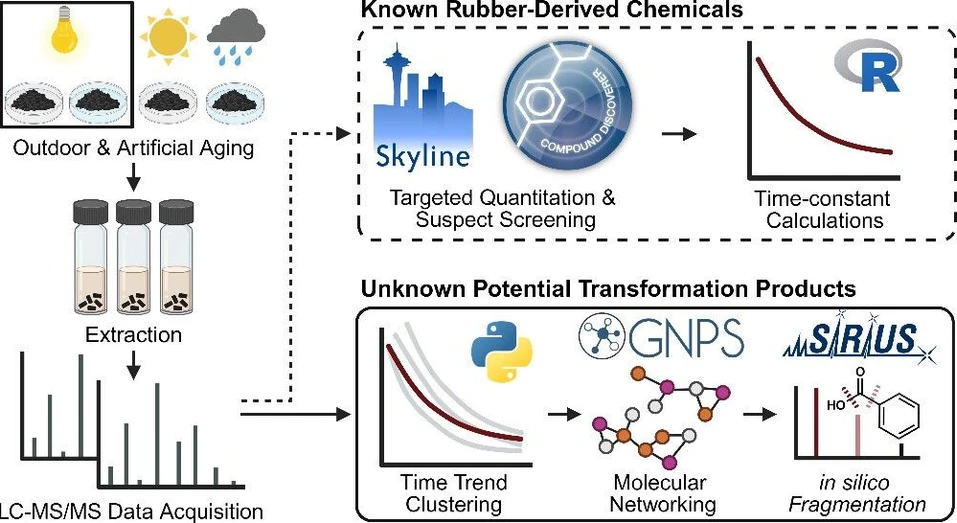
Environ. Sci. Technol. 2026, 60, 1, 1051–1062: Figure 1. Workflow of sample preparation, data acquisition, and the data analysis approach.
This study examines how tire and artificial turf crumb rubber chemicals transform during environmental aging. Samples were subjected to outdoor and accelerated photoaging under dry and wet conditions, followed by targeted, suspect, and nontarget LC-MS analysis combined with temporal trend evaluation and molecular networking.
The results revealed accelerated degradation in the presence of light and water and identified 572 potential transformation products, including 37 candidate aging markers. Several previously unknown transformation products related to rubber additives were also detected, highlighting the complexity of rubber aging processes and the need for further investigation of their environmental and health impacts.
The original article
From the Road to the Field: Decoding Chemical Transformation in Aging Tire and Artificial Turf Crumb Rubber
Madison H. McMinn, Yuqiao Tang, Phillip Berger, Katherine Poisson, Andresa Oliveira Tavares Lima, Aron Stubbins, Arzu Tuğçe Güler, and Zhenyu Tian*
Environ. Sci. Technol. 2026, 60, 1, 1051–1062
https://doi.org/10.1021/acs.est.5c08260
licensed under CC-BY 4.0
Selected sections from the article follow. Formats and hyperlinks were adapted from the original.
The increasing use of tires across the globe raises concerns about potential environmental impacts. Approximately 3 billion new tires were produced, and 800 million entered the waste stream in 2019. (1) Tire-derived particles and chemicals can enter the environment through various pathways, such as generation of tire road wear particles from active use tires, (2,3) and the use of end-of-life tires as artificial turf infill. (4−6) Of particular concern are the potential impacts of rubber-derived chemicals (RDCs) on human and environmental health, which have been detected in roadway runoff and roadway-impacted waterways, (7−10) soil, (4,11,12) air, (13,14) and consumer products. (7) Numerous RDCs have been found harmful for wildlife and the ecosystem (15−17) such as the tire antiozonant N-(1,3-dimethylbutyl)-N′-phenyl-1,4-benzenediamine (6PPD) and its transformation product (TP), 6PPD-quinone, which is reported to cause acute mortality of aquatic species. (18,19)
Rubber toxicities can vary drastically due to aging and formation of TPs. (20−29) To understand this variance in toxicity and the formation of TPs, recent studies have been conducted to gain insight into the changes to the chemical profile of RDCs under various aging conditions. However, current studies focused on RDCs (7,28,30) or rubber leachate, (31−36) and investigation of aging in tire rubber particles remains limited. In research focused on rubber particles, tire wear particles (TWPs) or cryomilled tire tread (CMTT) are typically utilized, with limited investigation of tire crumb rubber from artificial turf fields. (23,37) Comparisons between the aging processes of tire crumb rubber and TWP/CMTT are crucial, as the variation in size and age of different rubber samples could impact aging mechanisms and rate. (23,38) These studies found that photooxidation, ozonation, and thermal aging contributed to aging and the formation of TPs. (37,39−43) However, the importance of these aging mechanisms is not fully elucidated, as evident by inconsistent reports discussing the impact of UV radiation. (37,43) Additionally, limited studies suggest that artificial photoaging may not accurately reflect the aging process of natural conditions, leading to potentially inaccurate estimations of environmental toxicity and the degradation/transformation rate of RDCs. (37,43,44) Preliminary research indicates that water may influence how tire crumb rubber ages, presenting an important area for further investigation. (42,43) While there is agreement on trends of known RDCs, such as the decreasing trends of parent RDCs and increasing trends of known TPs, discrepancies are present in the rates of degradation/transformation. (37,43) Additionally, studies of well-known parent compounds may not fully capture the chemical complexity of RDCs and could overlook unexpected or unknown compounds of interest and their interactions. To address current research gaps, we designed aging studies investigating a variety of tire samples under dry and wet conditions, subjected to natural and artificial photoaging.
To understand the chemical transformation process of rubber aging, we performed controlled aging experiments on rubber samples of different origins under both outdoor and accelerated photoaging in dry and wet conditions (Figure 1). We characterized their chemical profiles with targeted quantitation, suspect screening, and nontarget screening (NTS), using liquid chromatography-tandem mass spectrometry (LC-MS/MS). Targeted analyses quantified known compounds, (37,43) and NTS identified other potential TPs. (8,9,45,46) For features detected from NTS, trend-based clustering aided in prioritization of potential TPs. (47−49) After trend-based prioritization was performed, molecular networking was applied to identify potential TPs. This approach was applied to assign potential identities to unknowns based upon their clustering with known compounds based on fragmentation/structural similarity. (50−56) Integrating these approaches, aging markers of RDCs were assessed to provide insight into potential human and environmental toxicity and inform proper recycling/management of end-of-life tires.
Environ. Sci. Technol. 2026, 60, 1, 1051–1062: Figure 1. Workflow of sample preparation, data acquisition, and the data analysis approach.
2. Materials and Methods
2.5. Targeted Quantitation
Extracts were analyzed using an Agilent 1200 liquid chromatograph interfaced to a Thermo Fisher TSQ Altis triple quadrupole mass spectrometer equipped with a heated electrospray ionization source (HESI). Chromatographic separation was performed using a C18 column (Agilent InfinityLab Poroshell 120 EC-C18, 2.1 mm × 50 mm, 2.7 μm). Method details including instrument parameters (Table S4) and targeted MS/MS transitions (Table S5) are present in the Supporting Information. Solvent blanks and ISTD controls were analyzed every 15 samples. The isotope-dilution method was utilized to compensate for matrix effects and recovery during sample preparation. (60,61) The retention time (RT) variations of ISTD mixture components were ± 0.1 min across all samples. Data analysis was performed in Skyline Daily ver. 24.1.1.449 (62) with settings in the Supporting Information (Table S6). Ten-point calibration curves were prepared using a standard mixture ranging from 0.05 to 1000 ng/mL (0.05, 0.1, 1, 5, 10, 50, 100, 250, 500, and 1000 ng/mL) spiked with ISTDs at 50 ng/mL. Sample concentrations were adjusted to account for background by subtracting method blank concentrations. Analytical figures of merit including R2, limit of detection, limit of quantitation, interday precision, and relative and absolute recovery were assessed in accordance with previous studies (Table S7). (59)
2.6. Nontarget and Suspect Screening
Crumb rubber extracts were analyzed by using a Thermo Fisher Scientific Vanquish Flex ultrahigh-performance liquid chromatograph interfaced to a Thermo Fisher Scientific Exploris 240 quadrupole-orbitrap mass spectrometer equipped with an HESI source. Chromatographic separation was performed using a C18 column (Agilent ZORBAX RRHD Eclipse Plus C18, 2.1 mm × 100 mm, 1.8 μm). Method details are present in the Supporting Information (Table S8). Solvent blanks and ISTD controls were analyzed every 15 samples. The RT variations of ISTD components were ±0.1 min, and precursor mass errors were <3 ppm across all samples. Spectral preprocessing including peak picking, retention time alignment, compound grouping, library, and mass list searches were done in Compound Discoverer v3.3 (Thermo Fisher Scientific, Table S9). Features with average peak area 3X higher in at least one sample group compared to the average blank were kept for further analysis. For NTS and temporal trend-based clustering, a further restriction of 50% CV for the artificial turf crumb rubber sample and 30% CV for the TWP and CMTT samples was added. Compounds underwent molecular networking using GNPS (Text S1, Table S10), and Cytoscape was used for visualization. (63,64) SIRIUS was used for in silico structural identification (Table S11). (65) Identification confidence was assigned based on the Schymanski levels. (66) The nontarget screening study reporting tool developed by Peter et al. (67) was used in the preparation of this manuscript, and NORMAN guidance (68) was followed.
3. Results and Discussion
3.2.2. Integrating Temporal Trends and Molecular Networking for Identification of Potential Transformation Products
After the potential TPs were prioritized based on their temporal trend (increasing or intermediate) within samples, molecular networking was employed to aid in structural identification through similarity analysis. By performing temporal trend analysis prior to molecular networking, network clusters were employed to assess what compounds were structurally similar to the 572 potential TPs, by grouping chemical features based on MS/MS similarity. When annotating potential TPs using molecular networking, we utilized compounds identified/annotated during suspect screening (Figure 4, pink squares) that were present within the same cluster as potential TPs to annotate TPs to a class of known RDCs based on their MS/MS similarity within each cluster (Figure 4, orange circles). By utilizing this approach, we assigned unknown TPs to a broad class of RDCs without proposing direct precursor-TP pairs. Utilizing this approach, we were able to identify/annotate 63 potential TPs related to known RDCs 6PPD, benzothiazole, 1,3-dipehynlguanidine (DPG), hexamethoxymethylmelamine (HMMM), (71) and TMQ, including 45 that were not reported previously (Table S21). DPG and it's suspected TP, N,N′-diphenylurea (72,73) were prioritized as potential TPs, along with 12 DPG-related compounds and six N,N′-diphenylurea-related compounds. Seven of these, including oxidized DPG-OH isomers, N-cyclohexyl-N′-phenylguanidine, 1,2-diphenyl-3-cyclohexylguanidine, and N,N″-bis[2-(propan-2-yl)phenyl]-guanidine, were previously reported in road dust samples, but this is the first time they are proposed as potential TPs. (24) Additionally, 2 of these compounds were prioritized in the 37 aging markers, including 4-(aminomethyl)-N-cyclohexylaniline (TP-7) and 1-phenylguanidine (TP-2, Table 2).
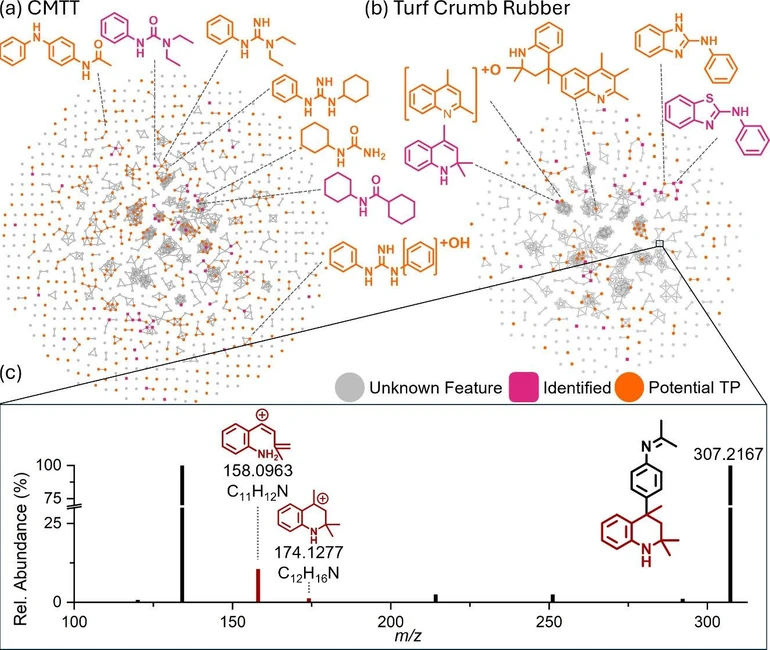 Environ. Sci. Technol. 2026, 60, 1, 1051–1062: Figure 4. Molecular networks of all NTS features in (a) cryomilled tire tread (CMTT) and (b) turf crumb rubber with identified compounds from suspect screening in pink and potential TPs in orange (c) MS/MS of TMQ-C21H26N2 with TMQ diagnostic fragments in dark red.
We also annotated 13 potential PPD-related TPs, including 6PPD-quinone. Twelve of the potential PPD-related TPs are likely results of oxidation, in line with previous studies. (2,18,35,55,74) Additionally, we identified three TPs related to N-(4-anilinophenyl)formamide, including one new potential TP, N-(4-anilinophenyl)hexanamide. (24) These PPD TPs are related to N-(4-anilinophenyl)formamide (PPD-CHO) and were previously found in road dust but were not confirmed as TPs. (24) While PPD-CHO was detected in all three samples, it was found to have no trend in CMTT, and a decreasing trend in the TWP and turf crumb rubber samples, suggesting that it may be formed during the rubber manufacturing process. Three PPD-related TPs were prioritized in the 37 aging markers, including two that have been previously annotated (TP-13, TP-14). (35)
3.2.3. Application of Integrated Prioritization to Elucidate Selected Network Clusters
Each sample contained a major cluster (second largest in turf crumb rubber and TWP, third in CMTT) with many nodes of unknown compounds, which may be potential TPs but no identified or annotated compounds, suggesting a group of structurally related compounds that were not closely related to any compound within the known compound library used for network analysis. Further investigation of MS/MS spectra for these compounds revealed common fragments of m/z 174.1276, 159.1040, 158.0967, 132.0806, 118.0649, and 106.0653 (Figure 4c, Figure S4, and Table S22), which suggested that they were related to tire antioxidant, TMQ (2,2,4-trimethyl-1,2-dihydroquinoline). While monomeric TMQ is typically utilized in targeted analysis of rubber-derived materials, TMQ is added during the rubber manufacturing process in a polymeric form and may produce TMQ oligomers in rubber materials (Table S18). (75−80) We tentatively identified two TMQ-oligomeric compounds, N-(4-(2,2,4-trimethyl-1,2,3,4-tetrahydroquinolin-4-yl)phenyl)propan-2-imine (TMQ-C23H26N2, m/z 331.2168, Figure S5b) and 2,2,2′,4,4′-pentamethyl-1,2,3,4-tetrahydro-4,6′-biquinoline (TMQ-C21H26N2, m/z 307.2167, Figure 4c and Figure S6b). Identification of these two TMQ-oligomeric compounds was further confirmed by the analysis of a commercially available poly-TMQ standard (AmBeed, Catalog #A615697, Figures S5a and Figure S6a). A previous lumpfish exposure study prioritized two compounds with the same formulas (C23H26N2 and C21H26N2) as the most bioavailable rubber contaminants. (81) While the authors suspected that the two unknowns are PPD-derivatives, MS/MS fragments m/z 174.1276 and 158.0967 indicated their correlation with TMQ. By comparing spectra from the poly-TMQ standard, rubber samples, and from Hagg et al. (Figure S6c), (81) we propose that these bioavailable compounds may be TMQ oligomers, instead of PPD-derivatives as previously reported. However, due to differences in the instrumentation utilized herein (LC-MS equipped with an electrospray ionization source) and that of Hagg et al. (81) (GC-MS equipped with an electron ionization source), direct comparison of the MS/MS spectra is challenging. As a result, we can only classify the compounds reported by Hagg et al. (81) as potential TMQ oligomers without additional analysis using similar instrumentation to that of this study. These bioavailable potential TMQ oligomers warrant further investigation on their occurrence and potential toxicity.
The presence of TMQ-oligomeric compounds led to a re-examination of the molecular networking results to determine if additional features could be tentatively annotated as TMQ-related compounds. After the analysis of the poly-TMQ standard, we expanded the list of diagnostic TMQ fragments to include those related to the TMQ dimer (C24H30N2, [M + H]+ = m/z 347.2488, [M]+ = m/z 346.2403, and fragment [TMQ-C23H26N2 + H]+ = m/z 331.2168, Figure S7). To classify a compound as TMQ-related, at least one of these nine diagnostic MS/MS fragments must be present. When only one diagnostic TMQ fragment was present, a feature was annotated as potentially TMQ-related if connected in the molecular network to another potential TMQ-related feature with two or more diagnostic fragments. As a result, we tentatively annotated 180 TMQ-related features (Table S23). Of particular interest was the presence of TMQ-related features in the 37 aging markers that were found in at least two of the three sample types (Table 2 and Table S20). Nineteen of the 37 aging markers had a molecular weight above 300 Da and were mostly unknown without TMQ-oligomeric information. However, molecular networking allowed the tentative identification of 16 TMQ-related TPs, including 8 of the 37 aging markers of interest (Table 2 and Tables S20 and S24). Six of the TMQ-related TPs have molecular mass >300 and contain oxygen/sulfur atoms. Among these, TP-25, TP-34, TP-35, and TP-36 included one or more TMQ-related oligomers (diagnostic MS/MS fragments: m/z 346.2403 TMQ dimer, m/z 331.2168 TMQ-C23H26N2, m/z 174.1276 TMQ monomer, and TMQ fragment m/z 158.0967, Figures S8–S11) and benzothiazole analogs (TP-35 and 36 isomers, Figure 5b,c), implying that these higher molecular weight TPs originated from continuous reactions between TMQ-related oligomers and other compounds. While more common environmental transformation pathways such as oxidation may explain some TMQ-related TPs, the presence of TMQ oligomers potentially reacting with other RDCs (e.g., benzothiazoles, Figure 5c) is novel. With growing interest in investigating oligomers as environmental pollutants and toxicants, (82) further investigation in TMQ, its oligomers, and aging processes is crucial.
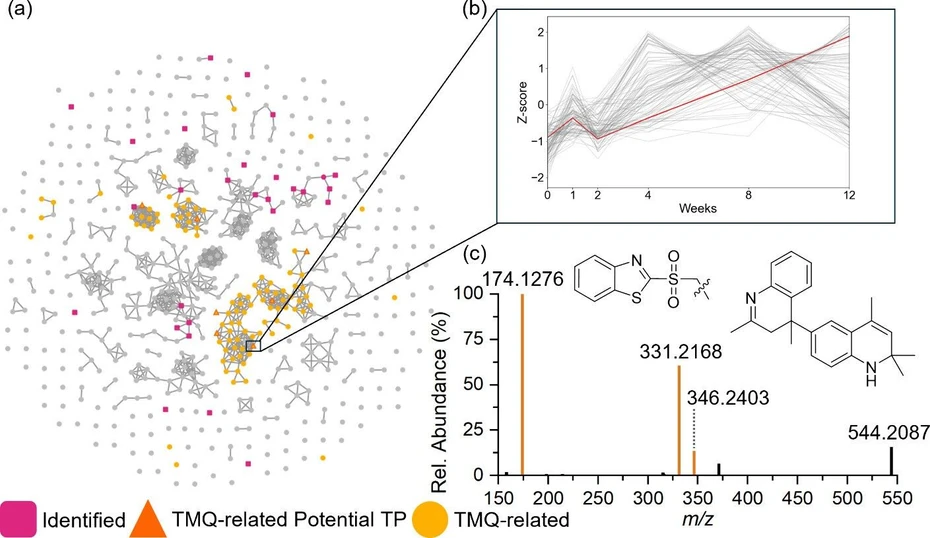 Environ. Sci. Technol. 2026, 60, 1, 1051–1062: Figure 5. (a) Turf crumb rubber molecular network with TMQ-related features; (b) temporal trend of TP-35; and (c) MS/MS of TP-35 with TMQ diagnostic fragments m/z 346.2403 (TMQ dimer), m/z 331.2168 (TMQ-C23H26N2), and m/z 174.1276 (TMQ monomer) marked in orange.
3.3. Limitations and Environmental Implications
While our outdoor aging experiments provide more environmentally relevant conditions than accelerated laboratory studies, the 12-week time frame represents only a fraction of the decades-long environmental persistence of tire materials. Longer-term and field studies on rubber aging will provide further information to help inform the recycling and handling of end-of-life tires. Since all samples were analyzed in ESI positive mode, the results could bias toward N-containing compounds and overlook hydroxylated TPs. The NTS was semiquantitative, so temporal trends might not be conclusive. The faster than predicted degradation rates under outdoor aging suggest the importance of water in aging experiments. The prioritization of 572 potential TPs─of which only ∼63 were tentatively identified─underscores the vast unknown chemical complexity entering environmental systems from the 3 billion tires produced annually. (1) Our findings on previously detected (81) but unidentified potential TMQ oligomers and their related high-molecular-weight TPs warrant further investigation given their known bioavailability and potential toxicity. This is especially prevalent from the prioritization of 37 aging markers, of which 8 are TMQ-related. The 37 aging markers provide a benchmark for future research and can guide studies using different tire rubber materials. These markers may reveal which RDCs are most susceptible to transformation, potentially informing rubber manufacturing processes. Additionally, the formation of TPs resulting from reactions of TMQ and other RDCs underscores the need for a deeper understanding of aging and transformation product formation within tire particles. Consequently, current risk assessments on tire rubber and crumb rubber may underestimate TP formation, leaving gaps for exposure monitoring and toxicological studies. The chemical complexity revealed in the rubber aging process suggests that a narrow focus on PPD-related compounds may ignore the more prevalent/abundant contaminants, especially in the context of potential human exposure.