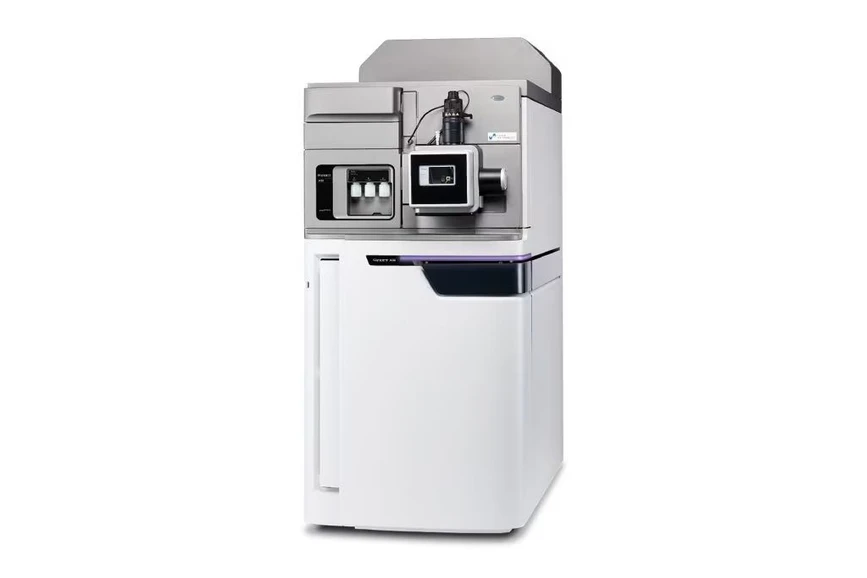
In the arena of scientific discovery, the slow pace of advancement and escalating costs of research can prove to be a challenge. Unlike competitor systems with restricted inlet options, scan function limitations, or requiring multiple platforms, only Waters offers an all-encompassing high-performing LC-MS solution, the SYNAPT XS mass spectrometer, for ultimate flexibility and greater freedom of analytical choice – supporting scientific creativity and technical success for any application.
For deeper discovery by aligning complimentary workflows on a single Ion mobility enabled time-of-flight mass spectrometer with the flexibility of multiple ion sources and acquisition modes.
Waters SYNAPT XS High Resolution Mass Spectrometer: The Waters SYNAPT XS offers flexibility and freedom of analytical choice with an extensive range of chromatographic inlets.
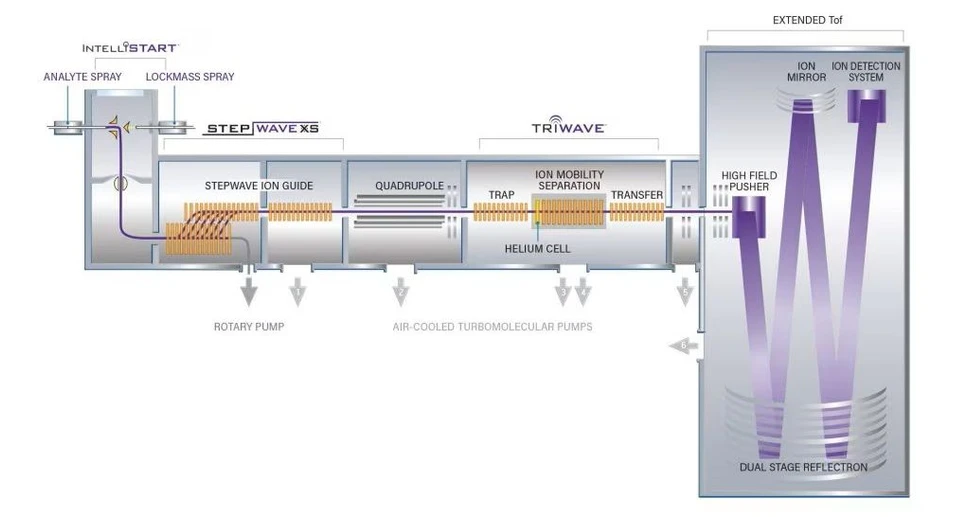
With technology building blocks inherited from the Waters Advanced Mass Spectrometry SELECT SERIES, advanced innovation is built-in, ensuring scientists using this platform are at the cutting edge of mass spectrometry while retaining the ease of use and established end-to-end workflows for which the SYNAPT is well known.
Waters SYNAPT XS High Resolution Mass Spectrometer: SYNAPT XS schematic.
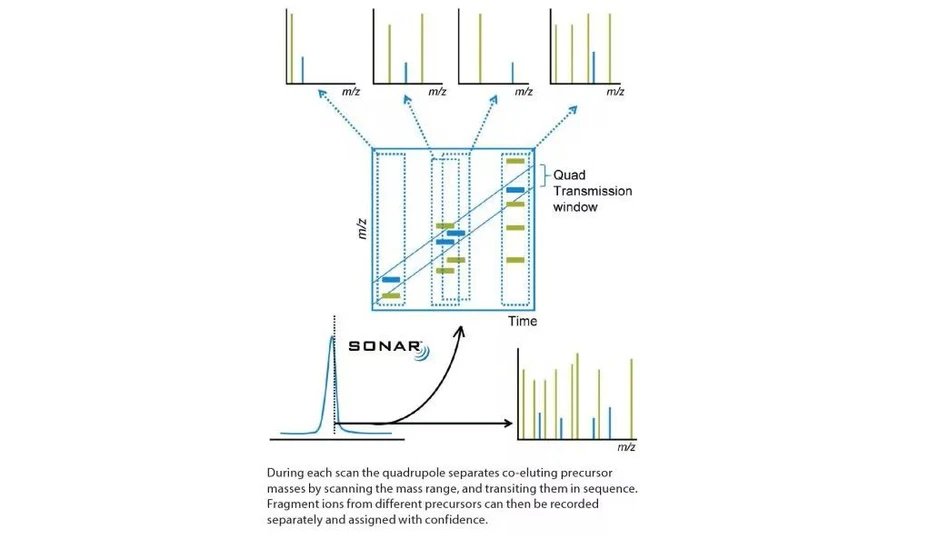
A complete analytical strategy requires the combination of appropriate complementary techniques to see the bigger picture. With both SONAR and IMS-based data independent acquisition (DIA) modes of operation on the SYNAPT XS, the discovery analyst is in a unique position to interrogate complex mixtures by complementary mechanisms. Both types of acquisition increase analytical peak capacity, providing ‘clean and clear’ fragmentation data, but based on different molecular properties. This provides a truly unique investigative toolbox for the in-depth interrogation of complex mixtures.
Waters SYNAPT XS High Resolution Mass Spectrometer: During each scan the quadrupole separates co-eluting precursor masses by scanning the mass range, and transiting them in sequence. Fragment ions from different precursors can then be recorded separately and assigned with confidence.
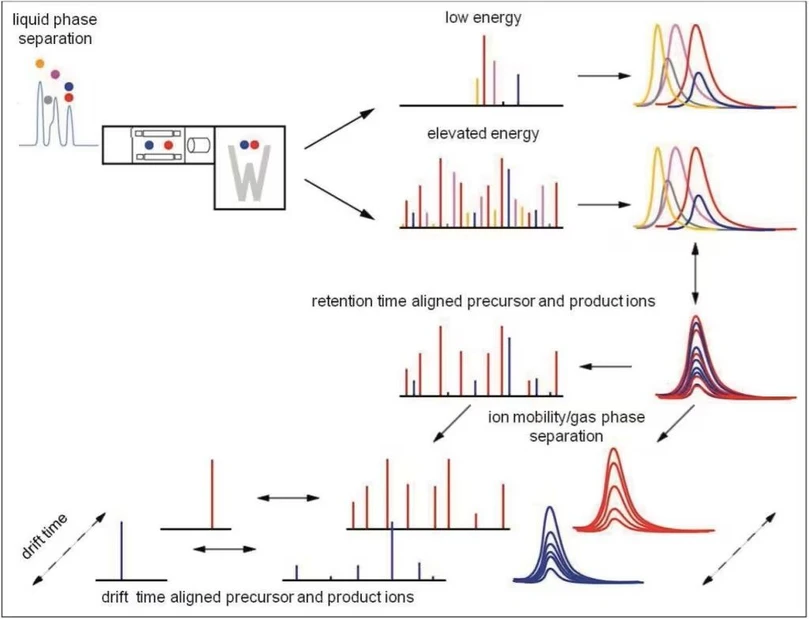
Conventional mass spectrometers separate components based on m/z. The SYNAPT XS also allows separation of molecules according to their size, shape, and charge during ion mobility experiments as a function of their collisional cross section (CCS). As well as ion mobility offering an additional dimension of resolution, multiplying peak capacity, and selectivity of analysis the measurement of CCS offers additional molecular identifiers. The measured CCS of an ion can be used to help confirm an ion’s identity or investigate its structure. The inclusion of ion mobility significantly increases the extent and confidence with which a scientist can profile complex mixtures and complex molecules – dramatically enhancing sample definition.
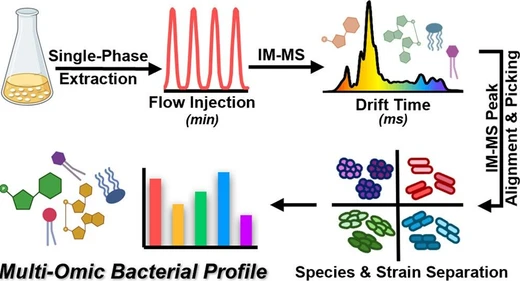
Waters SYNAPT XS High Resolution Mass Spectrometer: Retention and drift time principle ion mobility enabled data-independent LC-HDMSE analysis (LC-DIA-IM-MS).
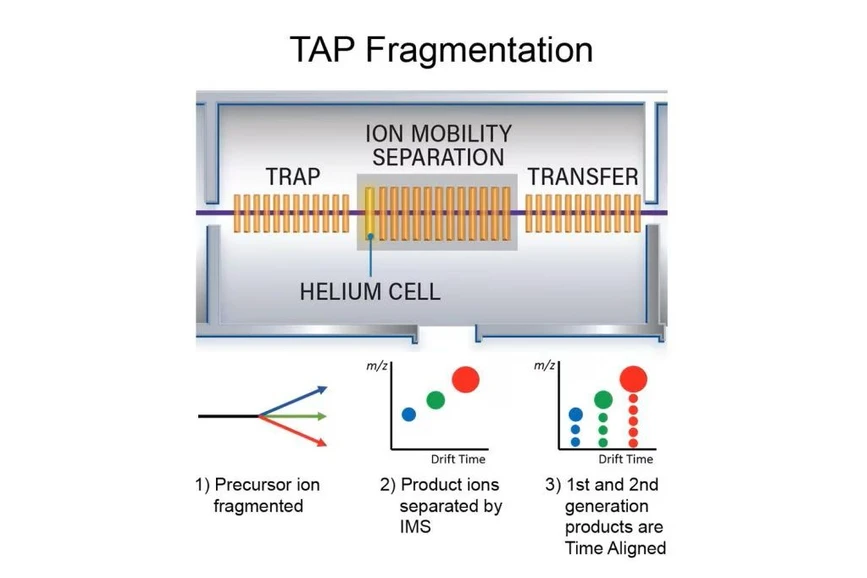
Time aligned parallel (TAP) fragmentation is an acquisition mode unique to the T-Wave IMS design. It permits users to take the advantage of the TriWave configuration, which allows the pre-IMS T-Wave and post-IMS T-Wave to operate as two separate collision cells. The resultant CID-IMS-CID instrumental operation helps to provide ultra-confident structural characterization of components. TAP fragmentation provides a distinct advantage for building a complete structure, through superior fragment ion coverage, sensitivity, and accuracy compared to traditional MSⁿ or MS/MS techniques.
Waters SYNAPT XS High Resolution Mass Spectrometer: Schematic showing Time Aligned Parallel Fragmentation.