News from LabRulezLCMS Library - Week 32, 2025
LabRulez: News from LabRulezLCMS Library - Week 32, 2025
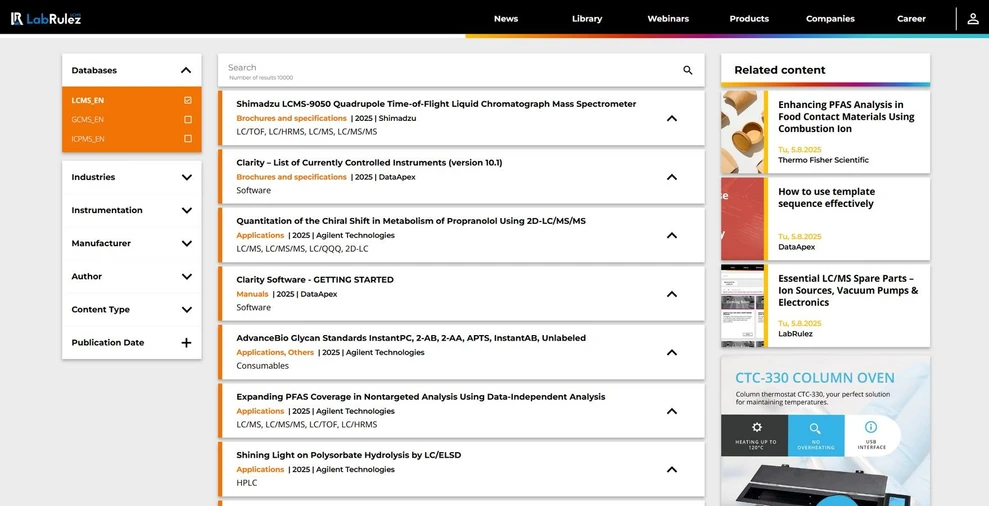
Our Library never stops expanding. What are the most recent contributions to LabRulezLCMS Library in the week of 4th August 2025? Check out new documents from the field of liquid phase, especially HPLC and LC/MS techniques!
👉 SEARCH THE LARGEST REPOSITORY OF DOCUMENTS ABOUT LCMS AND RELATED TECHNIQUES
👉 Need info about different analytical techniques? Peek into LabRulezGCMS or LabRulezICPMS libraries.
This week we bring you posters by Agilent Technologies / ASMS, Shimadzu / ASMS and Thermo Fisher Scientific / ASMS and application notes by Metrohm and Waters Corporation!
1. Agilent Technologies / ASMS: Evaluating System Robustness of a High-Sensitivity Triple Quadrupole LC/MS for PFAS Analysis in Food Matrix Over an Extended Period
- Poster
- Full PDF for download
Due to the rapidly evolving regulatory environment of per- and polyfluoroalkyl substances (PFAS), many analytical laboratories are opting to use highsensitivity triple quadrupole mass spectrometers for the targeted analysis of such compounds to ensure meeting present and potential future requirements for sensitivity and PFAS coverage. These assays are regularly conducted in a high-throughput manner involving complex matrices such as food, soil, wastewater or biological samples. Therefore, system robustness and instrument uptime are crucial for such applications to maintain productivity and profitability. In this work, we present results from an expedited robustness testing of a high-sensitivity triple quadrupole LC/MS system using select PFASs in one of the most challenging food matrices
Experimental
Instrumentation Data was collected using an Agilent 1290 Infinity II LC system coupled to an Agilent 6495D LC/TQ mass spectrometer.
Conclusions
The robustness of a 6495D LC/TQ was tested using undiluted salmon extract, a complex and challenging food matrix. During the experiment, the system was exposed to more than 130 mL of the matrix over a period of ~3 weeks of continuous operation, without any maintenance. System performance was monitored by injections of a mixture of native and isotopically labelled PFAS samples. The monitored signals exhibited low variations (RSD<6%) throughout the entire experiment. No obvious performance degradation or significant contamination of the inner ion optics elements were observed after the conclusion of the test. Although no loss of instrument performance was observed during this expedited robustness test, a routine maintenance of ion source and optics is recommended to ensure prolonged instrument operation.
2. Metrohm: Quantification of paracetamol with square wave voltammetry
The electrochemical sensing application with INTELLO
- Application note
- Full PDF for download
Square wave voltammetry (SWV) is an electrochemical technique that offers high sensitivity and rapid analysis times, making it particularly wellsuited for the detection of low-concentration analytes. As a member of the family of pulsed voltammetric techniques, SWV is a staircase scan superimposed by a symmetric double pulse—one in the forward direction and one in the reverse direction (Figure 1).
The current is sampled at the end of each pulse and the differential is taken, resulting in three plots from a single square wave voltammetry experiment: one showing the forward current (i1 ), a second showing the reverse current (i2 ), and a third plot showing the difference current (i1 -i2 ) vs. the potential. In INTELLO, the difference current is always sampled by default and the forward and reverse currents are optional signals that can be selected in the signals tab of the SWV command. Each parameter has diagnostic value, but typically the difference current vs. potential plot is most used. This approach enables the separation of faradaic and non-faradaic currents, significantly improving signal resolution and detection limits compared to conventional sweep/staircase techniques (e.g., cyclic voltammetry or linear sweep voltammetry). This feature is particularly valuable when working with analytes at trace levels or in complex matrices where background currents may otherwise obscure analytical signals.
The waveform is characterized by the following parameters: square wave frequency (f), the pulse amplitude (ΔE), and the step height (ΔEs ). The step height is the voltage increment between pulses in the underlying staircase scan (Figure 1). The frequency determines the number of pulses applied per second and the amplitude determines the height of the pulses. The scan rate (ν) is given by ν = f ΔEs . SWV stands out as being more versatile than other pulse techniques, such as differential pulse voltammetry (DPV), because a larger range of scan rates are accessible. The faster scan rates make SWV less susceptible to oxygen interference and mean that a wider range of kinetic timescales can be investigated. However, in certain circumstances DPV can give sharper peaks and improved resolution in the case of responses with overlapping potential windows.
RESULTS AND DISCUSSION
In order to use the electrochemical response to quantify the amount of 4-acetamidophenol (paracetamol) in the sample, the response must first be understood. To that end, cyclic voltammetry (CV) was conducted in the region of interest at two different pH values. The result is shown in Figure 2. At pH 6–7 (in blue), on the forward scan, acetamidophenol (APAP) undergoes an irreversible, proton-coupled, 2eoxidation. There is no faradaic current observed on the backward scan. This is consistent with literature sources which show that in acidic and weakly acidic solutions the intermediate produced during the oxidation of APAP, termed NAPQI, undergoes rapid reaction with free H+ to ultimately produce a NAPQI-hydrate [1]. At higher pH values, the absence of free protons should make NAPQI sufficiently stable to be detected on the reverse scan, and faradic current is indeed observed on the orange trace (Figure 2). The process is considered quasi-reversible under these conditions. For the determination of the paracetamol content, the higher pH was used because of the increased stability of the NAPQI intermediate. Nevertheless, in principle, there is nothing which prevents an electrochemically irreversible system from being used in a quantitative determination of this type.
As discussed, SWV is more sensitive than CV and it is often the preferred method for direct evaluation of analyte concentrations. The parameters of the SWV were optimized to the following: an amplitude of 80 mV, a frequency of 15 Hz, a potential range of -0.2 to 1.3 V vs. AgCl, and a step height of 5 mV. SWV with the optimized parameters was conducted on a series of standard solutions to produce the calibration curve shown in Figure 3.
3. Shimadzu / ASMS: Determination of PFAS in Pharmaceutical Water Used for Development of Injectable Drugs Using a High-Speed Triple Quadrupole
- Poster
- Full PDF for download
Per- and polyfluoroalkyl substances (PFAS) are associated with risks to human health, including the development of tumors and other serious diseases that affect quality and life expectancy. [1] In this context, due to the dangerous nature of injectable drugs, a detailed extraction and leaching studies are necessary for the safe regulation of this type of product. [2] The objective of this study was to develop an analytical methodology for the detection of PFAS in the pharmaceutical water matrix, used for the preparation of injectable medicines, and to evaluate the possible effect of leaching and extraction in “serum bag” type packaging (Figure 1).
Methods
Analyses were performed using an integrated LC-2060C liquid chromatograph coupled to an LCMS-8045 mass spectrometer, equipped with an electrospray ionization (ESI) source. The LabSolutions software was used for sample injections, MRM event optimization, and data processing. The Connect and Insight software platforms were employed for interface condition optimization and data analysis, respectively. Calibration curves were prepared by spiking pharmaceutical-grade water with the target standards and internal at 100 ng/L. After spiking, samples were injected directly into the system.
Results
Linearity tests were conducted over the range of 20 to 200 ng/L (vial concentration), and satisfactory results were obtained for all analyzed PFAS compounds (R² > 0.99). Table 2 lists all monitored analytes (target compounds) and internal standards, along with the corresponding MRM transitions used. Figure 2 shows the calibration curves obtained for the analytes PFOA, 4:2 FTS, and PFBA. Figure 3 shows the results of leaching experiments.
Conclusion
Using the LC-2060C system coupled to the LCMS-8045 mass spectrometer, a highly sensitive method was developed for the quantification of PFAS in pharmaceutical-grade water, with detection limits in the ppt range. This method was applied to leaching tests involving IV bag-type packaging, where PFBA was detected at levels below the calibration curve's lower limit. When EtOH was used as an alternative solvent, no PFAS were detected, suggesting that solvent polarity may influence the leaching behavior of PFBA from the tested packaging.
4. Thermo Fisher Scientific / ASMS: Enhanced sensitivity of the Orbitrap Astral Zoom mass spectrometer for deeper proteome coverage in single-cell proteomics applications
- Poster
- Full PDF for download
Contrary to traditional proteomics application using LC-MS/MS, where millions of cells are simultaneously analyzed and the observed changes are presented as a cumulative response of all cells analyzed, single-cell proteomics (SCP) analysis allows for a more detailed investigation of the changes in protein compositions and functions at the single cell level. However, to confidently characterize these changes in proteins, their functions and the diversities, many individual single cells need to be analysed. Working with individual cells raises challenges not only due to the limited sample amount, but also related to sample preparation, throughput and depth of coverage. Therefore, workflows that provide the highest sensitivity, highest proteome coverage and highest throughput would be of great interest to single cell proteomics applications. Here we evaluated the depth of proteome coverage and throughput that can be achieved for low-input and single cell samples using the Orbitrap Astral Zoom mass spectrometer.
Materials and methods
LC-MS Method
The samples (HeLa digest, K562 digest, and HEK single cell digests) were loaded onto either an Aurora Ultimate 25 cm XT C18 column or Aurora Rapid 8 cm column (IonOpticks) and separated using a Vanquish Neo UHPLC system configured in direct injection mode. Samples were separated using different gradients (see Figure 1). The eluting peptides were analyzed on the Orbitrap Astral Zoom mass spectrometer (detailed acquisition parameters are shown in figure 2) in the ‘Low Input’ application mode with a Thermo Scientific FAIMS Pro Duo interface using a data-independent acquisition method. The FAIMS CV was set to -48 and the FAIMS carrier gas was set to 3.5 L/min.
Data Analysis
Proteome Discoverer software
Each raw file obtained from the different sample amounts was processed using Proteome Discoverer software with CHIMERYS intelligent search algorithm. The data was searched against a human protein database containing 20,563 sequences. Oxidation of methionine was selected as variable modification and carbamidomethylation of cysteine as static modification. False-discovery rate (FDR) of 1% was applied at the precursor, peptide, and protein level.
Spectronaut 19 software
Data analysis was performed in Spectronaut 19.6 software using the directDIA workflow, the search was performed with default settings against the Human UniProt protein database (20,607 FASTA entries), except that Quantitation > Quantity MS level was set to "MS1", and Post analysis > Differential Abundance Grouping > Use All MSLevel Quantities checkbox was set to unchecked. False-discovery rate (FDR) of 1% was applied at the precursor, peptide, and protein level.
Results
In contrast to Orbitrap Astral MS, due to improved ion optics settling times and faster ion transfer, the Orbitrap Astral Zoom MS can achieve acquisition speeds of up to 270 Hz (35 % faster). It also comes with enhanced spectral processing capabilities, higher sensitivity by ion pre-accumulation in the bent trap and a ‘Low Input’ application mode with which the single ion detection probability is increased by 10%. Comparison Orbitrap Astral MS vs Orbitrap Astral Zoom MS To assess the performance difference between the new Orbitrap Astral Zoom MS and Orbitrap Astral MS, 50 pg and 250 pg bulk HeLa digest were analyzed. The Orbitrap Astral Zoom MS was operated in the ‘Low Input’ application mode using DIA. Spectronaut results in Figure 3 A and B show that the Orbitrap Astral Zoom MS identified approximately 5 % more protein groups for 250 pg HeLa and 10 % more protein groups for 50 pg HeLa at a throughput of 50SPD. The results from Proteome Discoverer software show similar gain in protein groups, 10.8 % for 50 pg and 4.4 % for 250 pg.
Conclusions
- We demonstrated that for 50 and 250pg HeLa digest the Orbitrap Astral Zoom MS showed about 10% and 5% gain in protein groups IDs compared to the Thermo Scientific Orbitrap Astral MS.
- From 50 pg HeLa digest, we identified about 3,700 protein groups at a throughput of 120 SPD and more than 5,600 protein groups at 50 SPD
- More than 5,200 protein groups were identified from 50 pg K562 and more than 6,100 protein groups from 250 pg K562 with a median protein group CV of <5% for three technical replicates at 50 SPD.
- We demonstrated the repeatability of our method by injecting 250 pg HeLa and K562 digest for more than half a day.
- On average we identified more than 5,800 protein groups from HEK single cells using 50 SPD method and a library-free approach.
5. Waters Corporation: Automating the Sample Preparation Workflow for Per- and Polyfluoroalkyl Substances (PFAS) in Aqueous Samples Following EPA Method 1633
- Application note
- Full PDF for download
US EPA Method 1633 is a multi-lab validated method for the analysis of non-potable water matrices, soils, biosolids, and tissues.1 The method covers 40 PFAS, and for aqueous samples utilizes a sample preparation incorporating solid phase extraction (SPE) on a weak anion exchange (WAX) cartridge followed by graphitized carbon black (GCB) clean up. Large volume sample sizes are extracted using this protocol, which is a lengthy process that requires trained laboratory personnel to complete. Manual SPE preparation for a 250 mL sample size can take in the range of 3 to 4 hours per batch for a skilled user. With the need for PFAS analysis increasing, a lengthy sample preparation process like this can significantly impact sample throughput and turnaround time. Sample preparation automation can ease the burden of challenging methods on laboratory staff and reduce the processing time for samples. In previous work, the manual workflow for EPA 1633 was established and thoroughly tested for complex environmental water samples.2 This work adapts the use of an automated SPE extraction system for these same sample types reducing the 3–4 hour sample preparation time to 2 hours per batch. This automation enhances an already reliable solution of the ACQUITY™ Premier BSM FTN UPLC™ System coupled with a Xevo™ TQ Absolute Mass Spectrometer for PFAS analysis following the EPA Method 1633.
Experimental
The Oasis WAX/GCB bilayer dual-phase SPE cartridge containing both WAX and GCB sorbents, was used for the preparation of all samples. The addition of GCB into the SPE cartridge allows for the full sample extraction and sample clean-up required by EPA 1633 to be automated rather than having to perform the GCB clean-up step using a dispersive technique.
LC Conditions
- LC system: ACQUITY Premier BSM with FTN
MS Conditions
- MS system: Xevo TQ Absolute
Data Management
- Software: waters_connect™ for Quantitation
Results and Discussion
Recovery in Water Samples
One of the important QC criteria to be demonstrated for method performance according to EPA 1633, is recovery of the extracted internal standards (EIS). The percent recovery of the EIS for each type of water sample tested (ground, surface, influent and effluent) is shown in Figure 2, with the minimum recovery limit identified by the black lines.1 As expected, the more complex wastewater samples did have lower recoveries, but they were all well above the required minimum recovery values. The isotope labeled standards for 6:2 and 8:2 FTS did experience quite a large enhancement effect in the influent wastewater samples. The acceptable maximum recovery for 13C2-6:2 FTS and 13C2-8:2 FTS are 200% and 300%, respectively. The 6:2 FTS internal standard had a slightly higher recovery than that range and may have been influenced by the high concentration of native 6:2 FTS present in the wastewater samples. Due to the internal standard only containing 2 13C isotope labels, there is a potential that natural isotope abundance in a highly contaminated sample may be detected as the isotope labeled standard. Overall, the mean recovery of all EIS among 19 environmental water samples extracted was 78.2% with a mean RSD of 8.1%. This demonstrates that the automated SPE extraction system is reproducible across a range of water sample types and is fit-for-purpose for EPA 1633.
Conclusion
Sample preparation for aqueous samples following the EPA 1633 workflow was successfully automated using the Promochrom SPE-03 system. Full automation of the sample preparation and additional carbon cleanup was made possible due to the use of the Oasis WAX/GCB bilayer dual-phase for PFAS Analysis SPE cartridge. It was shown that the SPE system does not contribute to PFAS contamination of the samples and is therefore suitable for accurate and confident PFAS analysis. Extracted internal standard recoveries in four different water sample types were well above the required minimum recovery values. Additionally, calculated concentrations values for a wastewater reference material were determined to be very accurate when compared to the provided certified range, reinforcing confidence in method accuracy. 4 types of water samples, varying in complexity, were analyzed for the 40 PFAS included in EPA 1633 where PFAS were detected in all samples in a range similar to those detected when the same samples were prepared manually. The data presented demonstrates that the use of an automated SPE extraction system is equivalent to processing the samples manually, allowing laboratories more flexibility in sample handling and potentially increasing sample capacity for EPA 1633.