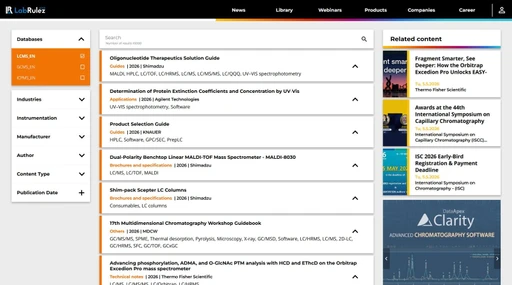
News from LabRulezLCMS Library - Week 24, 2026

LabRulez / AI: News from LabRulezLCMS Library - Week 24, 2026
Our Library never stops expanding. What are the most recent contributions to LabRulezLCMS Library in the week of 8th June 2026? Check out new documents from the field of liquid phase, especially HPLC and LC/MS techniques!
👉 SEARCH THE LARGEST REPOSITORY OF DOCUMENTS ABOUT LCMS AND RELATED TECHNIQUES
👉 Need info about different analytical techniques? Peek into LabRulezGCMS or LabRulezICPMS libraries.
This week we bring you application notes by Agilent Technologies, KNAUER and Shimadzu, other document by Thermo Fisher Scientific and poster by Waters Corporation / ASMS!
1. Agilent Technologies: Analytical Characterization of GLP-1 Agonists: Sequence Confirmation by Q-TOF MS/MS
- Application note
- Full PDF for download
Peptides represent a rapidly growing class of therapeutics used across a wide range of therapeutic applications. Compared with traditional small-molecule therapeutics, peptide therapeutics typically deliver superior target specificity. Ensuring the structural integrity of synthetic peptide therapeutics is essential for verifying amino acid sequence order, chain length, molecular weight, and overall purity. Even subtle sequence deviations such as a single residue substitution or deletion can profoundly affect biological activity and therapeutic performance.1 Robust sequence confirmation is therefore critical when assessing batch-to-batch consistency and identifying any structural modifications that may arise during development, manufacturing, or storage. Achieving this level of confidence requires advanced analytical platforms capable of delivering high-resolution, comprehensive characterization of synthetic peptides.
Glucagon-like peptide-1 (GLP-1) agonists are an emerging class of therapeutic agents. These synthetic peptides essentially copy the GLP-1 hormone, activating its effects through GLP receptors. These agonists are effective in lowering blood sugar and can also contribute to weight loss. GLP-1 peptides are typically 30 to 40 amino acids in length, with modifications involving a few amino acid substitutions at certain positions and the addition of a fatty acid chain to prolong their half-life. With a robust pipeline of GLP-1 receptor agonists and multi-target receptor agonists currently in development2, comprehensive sequence confirmation ensures accurate identification and reliable quality characterization of these therapeutic peptides.
Recent advancements in high-resolution mass spectrometry (HRMS) have improved the characterization of synthetic peptides, providing high sensitivity and mass accuracy. Modern Q-TOF MS platforms provide the resolving power needed to distinguish subtle chemical variants and postsynthetic modifications, enabling comprehensive impurity profiling and confident quality assessment of complex peptide therapeutics. Tandem mass spectrometry (MS/MS) enhances structural elucidation by precise verification of peptide primary sequence. Together, HRMS and MS/MS provide a powerful, reliable analytical framework for confirming molecular weight and sequence information.
In this study, we analyzed three GLP-1 agonists—liraglutide, tirzepatide, and retatrutide—to confirm their sequences using tandem MS/MS. The analysis delivered complete sequence coverage for these peptides by comprehensively identifying all b and y ions. The intuitive BioConfirm software interface simplified the sequence data analysis.
Experimental
Analytical equipment
- Agilent 1290 Infinity II high-speed pump (p/n G7120A)
- Agilent 1290 Infinity II multisampler (p/n G7167B)
- Agilent 1290 Infinity II multicolumn thermostat (p/n G7116B)
- Agilent Revident LC/Q-TOF (p/n G6575A)
Software and data processing
- Agilent MassHunter Data Acquisition for LC/TOF and LC/Q-TOF, version 12.0
- Agilent MassHunter BioConfirm software, version 12.1
Conclusion
These results demonstrate the suitability of this LC/Q-TOF MS/MS workflow for high-resolution sequence confirmation of GLP-1 agonists. For all three peptides examined, the MS/MS method provided complete sequence coverage together with well distributed fragment ion series This is important for synthetic therapeutic peptides, where sequence identity is a critical parameter in product quality and regulatory confidence.
2. KNAUER: Hey, ho, oliGO – Comparison of ion-pairing systems for oligonucleotide analysis with HPLC-UV
- Application note
- Full PDF for download
Ion-pairing reversed phase (IP-RP) chromatography is one of the most used methods for the analysis of oligonucleotides (ON). Oligonucleotides are highly customizable compounds. The backbone can be modified to improve identification of each nucleotide to more easily track ON synthesis [2] or to improve protection against degradation by enzymes [3]. The sugar ring can also be modified. Often, modifying the 2’ position on the sugar ring will result in greatly increased binding capabilities while also reducing non-specific protein binding to the oligonucleotide [4]. 2’-O-methyl and 2’-O-methoxyethyl are the most common modifications on the sugar ring. Those short nucleotide sequences are becoming increasingly essential for molecular biology and therapeutic ends. But with their naturally negative charge, it is not that easy to gain retention on a column.
That’s where the ion-pairing mechanism comes into play. By adding a positively charged ion pair reagent, the oligonucleotide acquires a hydrophobic shell and can thus interact with a RP stationary phase [5]. The used amines and acidic counterions can significantly affect the retention and resolution of the ON. Here, two different ion-pairing systems were investigated. Both used triethyl amine (TEA) but different counterions: acetic acid (HAc) and hexafluoro isopropanol (HFIP). To evaluate how the systems compare, three synthetic oligonucleotides with different sequences and lengths (15, 25 and 64 bases) were measured using columns of different lengths to furthermore investigate the On/Off mechanism [6].
CONCLUSION
The experimental results demonstrate that HAc, in combination with TEA, constitutes a very suitable alternative to HFIP for IP-RP-HPLC with UV detection. While with the HFIP methods slightly shorter retention times were achieved HAc provided better peak symmetry, comparable resolution and overall chromatographic performance. The investigation into reduced column lengths confirmed the presence of a functional “On/Off” retention mechanism within the IP-RP-HPLC system. Both HFIP and HAc-based methods preserved sufficient retention and analyte resolution upon transfer to shorter columns. Furthermore, the used Sepapure oliGO column showed good overall symmetry even for higher molecular weight analytes (64mer). The ability to separate oligonucleotides in under two minutes is a good basis and shows the potential for high-throughput analysis.
3. Shimadzu: Achieving Sharp Peaks and High Sensitivity with Nexera X4
- Application note
- Full PDF for download
User Benefits
- The low-dispersion design of Nexera X4 suppresses extra-column band broadening within the system, enabling the column to deliver its maximum separation performance. This also results in sharper peak shapes and improved detection limits for impurity analysis
In high-performance liquid chromatography, minimizing sample band broadening both inside and outside the column is essential to achieving high separation performance. For example, impurity analysis often requires the separation of structurally similar components, demanding high separation performance and high sensitivity. Nexera X4 (Fig. 1) is a next-generation UHPLC system that inherits the advanced technologies of Shimadzu’s Nexera series and delivers top-class analytical performance. Its industryleading*1 low-dispersion design provides exceptionally sharp peaks and outstanding separation capability. In addition, Nexflow technology achieves low dispersion without changing the inner diameter of the flow lines, thereby minimizing system-derived band broadening while reducing the risk of tube blockage. This allows UHPLC columns to perform at their full potential and enables highly efficient separations. All high-pressure flow lines that samples pass through employ end-surface-sealed connections, minimizing dead volume–induced peak broadening. Tool-free fittings (Fig. 2) are also used to enhance usability. This article introduces an example in which impurities were separated with high resolution and high sensitivity using Nexera X4.
Conclusion
High-resolution and high-sensitivity impurity analysis was demonstrated using Nexera X4. The system’s low-dispersion design minimizes extra-column band broadening, enabling excellent separation performance even for structurally related impurities. Suppression of sample band spreading results in sharper peak shapes, contributing to improved detection limits.
4. Thermo Fisher Scientific: The role of guard columns in ion chromatography— best practices for Thermo Scientific Dionex columns
- Other document (white paper)
- Full PDF for download
Ion chromatography (IC) is a powerful technique for separating inorganic anions, cations, and many polar organic compounds. In a typical IC system, an ion-exchange analytical column resolves ions in the sample while a suppressor and detector translate their elution into an electrical signal. Real-world samples, however, contain particulates, strongly retained species, and other matrix components that can foul the separator column and shorten its life. To prevent this, Thermo Scientific™ Dionex™ ion chromatography systems use guard columns, which can intercept contaminants, protecting the separator column from damage.
In this white paper, we describe the purpose of guard columns, differentiate them from other in-line fluidic devices, such as Thermo Scientific™ Dionex™ InGuard™ cartridges, trap columns, and concentrator columns, and provide guidance on when and how to replace them. We focus on Thermo Scientific™ Dionex™ products; however, the concepts apply broadly across liquid chromatography. It is important to always check the performance of a new column before running a method using a Quality Assurance Report (QAR). Refer to the product manual for detailed information regarding column use and maintenance.
Purpose and benefits of guard columns
Protecting the analytical column
The primary role of a guard column is to shield the analytical column from sample contaminants. Thermo Scientific™ IC column product manuals emphasize that a guard is essential to protect the analytical column. The guard retains strongly adsorbed substances and particulates before they reach the main separation column, thus providing valuable protection. It is much easier and more economical to replace the short guard column than the long analytical column.
Effect on retention times and capacity
Because the guard column adds extra resin volume, using a guard will slightly increase analyte retention times. There are three categories of guards related to their capacity relative to their respective separators: high (15–25%), medium (6–14%), and low (1–5%), as shown in Tables 1A, 1B, and 1C. The total retention time typically increases approximately in proportion to the relative capacity. For low relative guard-to-separator capacity column sets—such as the Thermo Scientific™ Dionex™ IonPac™ AG11-HC and AS11-HC—the analyte retention time increases approximately 5% under isocratic conditions, as shown in Figure 1 (Thermo Fisher Scientific, 2013). For high relative guard-toseparator capacity column sets—such as the Thermo Scientific™ Dionex™ IonPac™ CG21 and CS21—the analyte retention time increase is roughly 21% (Thermo Fisher Scientific, 2018). While this extra retention must be accounted for, in addition to protection, the guard column effectively increases overall capacity, allowing larger sample loads without overloading the analytical column. While the overall analysis time will increase, guard columns do not affect resolution or quantitation; in fact, they maintain quantitative accuracy by preventing separator fouling and peak tailing that may result from it.
Conclusion
Guard columns are the unsung heroes of ion chromatography. By sacrificing themselves to protect analytical columns from contaminants and pressure fluctuations, they extend column life and ensure consistent separations. Manuals for Thermo Scientific™ products emphasize that guards should be used at all times and replaced whenever peak efficiency or retention time declines. Their modest effect on retention times is a small price to pay for the protection they provide.
As discussed, there are guard columns, and there are sample prep tools. Dionex InGuard cartridges remove matrix interferences before the sample reaches the injection valve. Trap columns purify the eluent to reduce baseline drift during gradient IC. Concentrator columns preconcentrate analytes for trace analysis. Each plays a distinct role, and all may be used together. Regardless of configuration, guard columns remain essential for protecting the analytical column.
5. Waters Corporation / ASMS: Precursor and Product Ion Mobility and Collision Cross Section Determination by Travelling Wave Cyclic Ion Mobility – Mass Spectrometry
- Poster
- Full PDF for download
The identification and elucidation of (bio)chemical compound structures are critically important across numerous applications, such as pharmaceutical sciences, toxicology, biotechnology, and food safety research. The potential of Travelling-Wave Cyclic Ion Mobility – Mass Spectrometry was evaluated for the identification of compounds where the position of a functional group could not be resolved using conventional tandem mass spectrometry. In addition to ion mobility measurements of intact precursor ions, ion mobility measurements of product ions were obtained and the development of workflows for the processing of multi-dimensional data sets, including precursor/product ion m/z, retention time, CCS, and intensity investigated.
Experimental
Chromatography
- ACQUITY UPLC BEH C18 Column (100 mm x 2.1 mm, 1.8 µm) operated @ 35 ºC and 0.3 mL/min
- Mobile phase(s) A 95 H2O (2 mM ammonium acetate): 5 MeOH, and B MeOH (2 mM ammonium acetate)
- 22 min (PFOS isomers) and 5 min (pharmaceutical/natural product standards) reversed phase separation gradients
- Injection volume: 10 µL
Mass Spectrometry
- Waters SELECT SERIES Cyclic IMS
- Polarity: positive (ESI+)/negative (ESI-)
- Capillary voltage: 0.5/0.3 kV
- Source temp: 100 ºC
- Desolvation temp/gas flow: 550 ºC and 1000 L/Hr
- Acquisition methods: HDMSE (IM enabled DIA), HDMS (IM-MS) with/without quadrupole isolation
Data processing
- MassLynx /DriftScope (data acquisition and review)
- ApexRT 1.17 (peak detection),
- CompareCSV 1.22 (multicolumn matching with tolerances)
- CFM-ID v2.4 (in-silico fragmentation)
- Streamlit, plotly, pandas, numpy, matplotlib Python libraries (user interface(s), visualization and CCS calculation)
Conclusions
- Ion mobility–derived CCS values of diagnostic precursor and product ions enabled discrimination between linear and branched PFOS isomers
- Drift time and CCS measurements allowed differentiation of isomeric flavonoid precursor and product ions.
- Highly specific CCS fingerprints of small-molecule product ions were generated for pharmaceutical-relevant compounds in combination with in-silico product-ion prediction.
- Fast data processing and review were facilitated through lightweight application development