News from LabRulezLCMS Library - Week 26, 2026
LabRulez / AI: News from LabRulezLCMS Library - Week 26, 2026
Our Library never stops expanding. What are the most recent contributions to LabRulezLCMS Library in the week of 22nd June 2026? Check out new documents from the field of liquid phase, especially HPLC and LC/MS techniques!
👉 SEARCH THE LARGEST REPOSITORY OF DOCUMENTS ABOUT LCMS AND RELATED TECHNIQUES
👉 Need info about different analytical techniques? Peek into LabRulezGCMS or LabRulezICPMS libraries.
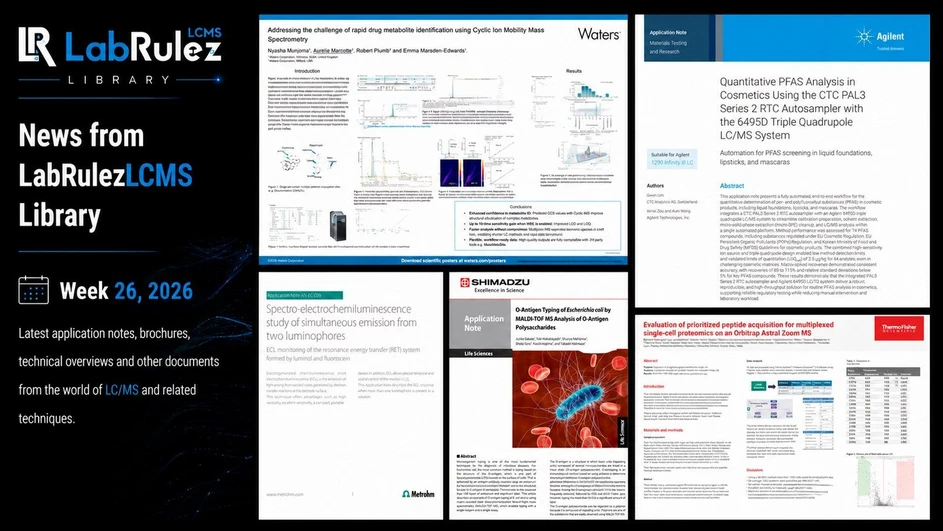
This week we bring you application notes by Agilent Technologies, Metrohm, Shimadzu and posters by Thermo Fisher Scientific / ASMS and Waters Corporation / ASMS!
1. Agilent Technologies: Quantitative PFAS Analysis in Cosmetics Using the CTC PAL3 Series 2 RTC Autosampler with the 6495D Triple Quadrupole LC/MS System
Automation for PFAS screening in liquid foundations, lipsticks, and mascaras
- Application note
- Full PDF for download
PFAS are a diverse group of synthetic compounds characterized by highly stable carbon–fluorine bonds, which confer exceptional chemical resistance and persistence.1 In cosmetics, PFAS may be added intentionally to provide a desired functionality or effect, such as emulsifying, film‑forming, and water-resistant capabilities.2,3 Unintentional PFAS contamination can also occur through raw material impurities, manufacturing equipment, processing aids, and environmental cross-contamination. As a result, consumers may be exposed to PFAS in cosmetics via dermal, ocular, and incidental oral routes, and these substances ultimately enter the environment and food chain over their lifecycle.
Regulatory agencies worldwide have begun tightening oversight of PFAS in cosmetics. Within the European Union, Regulation (EC) No 1223/2009 has restricted a wide range of PFAS in cosmetic products, aligning cosmetic safety requirements with broader chemical risk management strategies.4 In parallel, various PFAS are regulated under the EU POPs Regulation, which establishes strict limits for perfluorooctanoic acid (PFOA) and perfluorooctane sulfonate (PFOS) for unintentional trace contaminants in substances, mixtures, and articles.5 South Korea added five PFAS and their salts to restricted substances list for cosmetics in 20246 ; France has implemented a full ban7 ; Canada has proposed a broad prohibition8 ; and the U.S. FDA, under the Modernization of Cosmetics Regulation Act (MoCRA), evaluated PFAS safety in cosmetics, with report released in December 2025.9 These combined regulatory and industry initiatives are driving an increased need for robust analytical tools capable of detecting PFAS at trace levels in complex cosmetic matrices.
This application note demonstrates a fully automated workflow for the quantitative analysis of 74 PFAS compounds in cosmetic samples using a PAL3 Series 2 RTC autosampler coupled with an Agilent 6495D triple quadrupole LC/MS system. Seven commercially available cosmetic products across multiple brands—including liquid foundations, lipsticks, and mascaras—were evaluated. The workflow integrates automated calibration, solvent extraction, and micro-SPE cleanup, delivering high-throughput performance with excellent sensitivity, precision, and recovery to enable reliable PFAS screening in complex cosmetic matrices.
Experimental
Instrumentation
An integrated PAL3 Series 2 RTC autosampler coupled with a 6495D LC/TQ (Figure 1) was employed for the fully automated workflow of PFAS quantitation from cosmetic matrix in this study.
The PAL3 platform was equipped with various tools and modules, providing the necessary capabilities to achieve its designated functions. The following tools and modules were used in this study:
- Two PAL park stations with three liquid syringe tools, dilutor tool, micro-SPE tool, and LC/MS tool
- Vortex Mixer
- Centrifuge
- Dilutor Multi
- Tray Cooler (for 2/10/20 mL vials)
- Tray Holders with rack R60 (for 10/20 mL vials)
- Micro-SPE Tray (for 2 mL vials and micro-SPE cartridges)
- Solvent Module and Fast Wash Module
- LC Injection Valve
The LC Injection Valve was configured on the PAL3 platform, and all liquid syringes were cleaned using a Fast Wash Module. All solvent tubing used in the PAL3 platform were PFAS free. Extra modules and tools can be added to meet specific sample preparation needs.
An Agilent 1290 Infinity II UHPLC system equipped with high-speed pump (part number G7120A) and multicolumn thermostat (part number G7116B) was used for chromatographic separation. A 6495D LC/TQ equipped with an Agilent Jet Stream technology ion source (AJS) was used for compound acquisition in negative/positive ionization mode.
The integrated PAL3 Series 2 RTC autosampler and 6495D LC/TQ, controlled by Agilent MassHunter acquisition software for LC/MS systems (version 12.2), was operated following the condition and parameters displayed in Table 1. Data analysis was conducted using Quantitative Analysis software, version 12.1
Conclusions
A fully automated, end‑to‑end workflow for PFAS analysis in cosmetic products was developed using the integrated CTC PAL3 Series 2 RTC autosampler coupled with the Agilent 6495D triple quadrupole LC/MS system. The workflow transfers traditionally labor‑intensive steps—including calibration preparation, sample extraction, micro‑SPE cleanup, and LC/MS analysis—to an integrated robotic platform, significantly reducing manual handling during sample preparation. The successful implementation of automated micro‑SPE cleanup further streamlines the workflow and eliminates time‑consuming manual operations.
Excellent analytical performance was achieved across key metrics, including method detection limits, validated limits of quantitation, matrix‑spiked recoveries, and method reproducibility, demonstrating the system's capability to generate high‑quality and reliable analytical data. By minimizing manual intervention, the automated workflow reduces the potential for human error while improving analytical precision and consistency.
The integrated platform enables parallel sample preparation and data acquisition, resulting in improved throughput and operational efficiency for routine laboratory testing. Combined with the high sensitivity and robustness of the Agilent 6495D LC/TQ system, the automated workflow provides a practical and reproducible solution for trace‑level PFAS determination in complex cosmetic matrices, supporting routine monitoring, regulatory compliance, and consumer product safety.
2. Metrohm: Spectro-electrochemiluminescence study of simultaneous emission from two luminophores
ECL monitoring of the resonance energy transfer (RET) system formed by luminol and fluorescein
- Application note
- Full PDF for download
Electrogenerated chemiluminescence, short electrochemiluminescence (ECL), is the emission of light arising from excited states generated by electron transfer reactions at the electrode surface. This technique offers advantages such as high versatility, excellent sensitivity, a compact, portable device. In addition, ECL allows precise temporal and spatial control of the reaction [1,2]. This Application Note describes the ECL response when more than one luminophore is present in a solution.
INSTRUMENTATION AND SOFTWARE
ECL experiments are performed using the SpectroECL instrument equipped either with a microspectrometer cell (Figure 1) or with a photodiode cell (ECLPHOTODIODCELL) as detector. Carbon screen-printed electrodes (SPEs, 110) are used for performing the ECL experiments. The SpectroECL is controlled with the DropView SPELEC software, that allows the simultaneous collection of the electrochemical and the emitted light signal. Furthermore, the software includes tools for data treatment and analysis. Table 1 lists all hardware and software used for this study.
ECL OF LUMINOL AND FLUORESCEIN LUMINOPHORES
The potential-dependent evolution of the emissions is analyzed using the «Spectra vs EC» tool in DropView SPELEC. As can be observed in Figure 5b, the emissions of both luminol and fluorescein increase during the oxidation of luminol and reach their maxima at 0.30 V. The spectroelectrochemiluminescence response also allows the evaluation of each luminophore’s contribution, showing that the luminol emission is higher than the fluorescein signal.
The ECL system formed by luminol as luminophore and hydrogen peroxide as co-reactant as well as the RET ECL system based on two luminophores, luminol and fluorescein, and hydrogen peroxide as coreactant have been studied using the SpectroECL with two different detectors. The photodiode detector does not discriminate between wavelengths and records the total luminescence intensity for each electrochemical point. The photodiode cell is very useful for detection of very low concentrations of the lumiphore under study and for research with only one marker species. On the other hand, the microspectrometer detector provides wavelength resolution and allows the performance of spectro-electrochemiluminescence experiments since visible spectra are simultaneously recorded to the electrochemical signal. This cell is useful for multianalyte systems, development of new luminophores, and characterization of material properties.
3. Shimadzu: O-Antigen Typing of Escherichia coli by MALDI-TOF MS Analysis of O-Antigen Polysaccharides
- Application note
- Full PDF for download
Serotyping is routinely employed in testing for foodborne illnesses and infectious diseases caused by microorganisms. It targets molecular determinants expressed on the bacterial surface,such as glycans and proteins. For E. coli and Salmonella, O-serotyping targets the O-antigen, one structural constituent of cell-surface lipopolysaccharides (LPS). LPSs comprise three domains: lipid A, core oligosaccharide, and O-antigen (Fig. 1).
The O-antigen is a structure in which basic units (repeating units) composed of several monosaccharides are linked in a linear chain (O-antigen polysaccharide). O-serotyping is an immunological method based on using antisera to determine structural differencesin O-antigen polysaccharides.
Enterohemorrhagic E. coli (EHEC) are pathogenic E. coli strains characterized by production of Shiga-toxin. EHEC cause severe abdominal pain and bloody diarrhea with a small number of bacteria. Among the O-serogroups of EHEC, O157 is the most frequently detected, followed by O26 and O103 (Table 1). However, typing the more than 180 O-serogroups of E. coli requires costly antiserum reagents and a significant amount of labor.
The O-antigen polysaccharide can be regarded as a polymer because it is composed of repeating units. Polymers are one of the substances that are easily observed using MALDI-TOF MS. When the LPSs extracted from E. coli were analyzed, a mass spectrum was obtained in which the peak intervals corresponded to the size of the repeating units. Based on those findings, it was considered that the O-antigen type could be identified by observing the structural differences in the Oantigen polysaccharides based on mass spectral patterns (PAT. JP7365007). This study attempted, we try to identify the Oantigen types from mass spectra of O-antigen polysaccharide using bacterial isolates, including human-derived EHEC bacteria.
Experiments
MALDI-TOF MS
O-antigen polysaccharides were analyzed using a benchtop MALDI-TOF MS (MALDI-8020, Fig. 2) system under the parameters listed in Table 3.
Conclusion
This Application Note article demonstrated that the structural differences of O-antigen polysaccharides could be observed as mass spectral patterns from E. coli strains in a single assay using a single reagent. This O-antigen typing method using MALDITOF MS was applicable not only for type strains but also for EHEC strains (O157, O26, and O103) isolated from humans. This method is an effective tool for determining O-antigen types. In the future, the possibility of typing other O-serogroups will also be investigated.
4. Thermo Fisher Scientific / ASMS: Evaluation of prioritized peptide acquisition for multiplexed single-cell proteomics on an Orbitrap Astral Zoom MS
- Poster
- Full PDF for download
In recent years single cell analysis has profited from advances in LC-MS based proteomics approaches. Nevertheless, there are still challenges in this field of application. Besides sample preparation, the key challenges in looking at individual single cell proteomes are sensitivity, coverage, dynamic range, and throughput.
Sample multiplexing using isobaric labeling strategies such as SCoPE-MS (Budnik et al., 2018) has substantially increased throughput in single-cell proteomics. Many acquisition challenges have been addressed through prioritized targeting of predefined precursors (pSCoPE; Huffman et al., 2023), enabling high data completeness while maintaining robust proteome coverage.
Here we described a high-throughput workflow of Thermo Scientific TMTPro 35plex labeled single cells using an Thermo Scientific Orbitrap Astral Zoom Mass Spectrometer.
Method
The workflow using a prioritized targeted SCoPE-MS method is depicted in figure 1. All the samples were analyzed using a 30 SPD method on a Thermo Scientific Vanquish Neo UHPLC System. A 50 cm Thermo Scientific μPAC Neo Plus HPLC Column was used in a trap and elute mode.
Data analysis
All data was processed using Thermo Scientific Proteome Discoverer 3.4 Software using CHIMERYS algorithm, with default settings. FASTA used for the HeLa samples was a Homo Sapiens Swiss Prot with canonical sequences (20528 entries).
Conclusions
- Using a 30 SPD method more than 1000 cells could be analyzed per day.
- On average, 1452 proteins were quantified per AML8227cell.
- No carrier channel is needed.
- Excellent sensitivity for relatively small AML8227cells.
5. Waters Corporation / ASMS: Addressing the challenge of rapid drug metabolite identification using Cyclic Ion Mobility Mass Spectrometry
- Poster
- Full PDF for download
This poster demonstrates how cyclic ion mobility mass spectrometry (cyclic IMS-MS) can address one of the key challenges in drug metabolism studies: the rapid identification and characterization of metabolites generated during early ADME investigations. Traditional LC-MS workflows often require a compromise between chromatographic resolution and throughput. Shorter LC methods increase sample throughput but can lead to coelution of metabolites, particularly isomeric compounds such as glucuronides. To overcome this limitation, the authors combined rapid UHPLC separation with cyclic IMS-QToF mass spectrometry, enabling additional gas-phase separation based on ion mobility and improving metabolite identification confidence.
The study focused on diclofenac and raloxifene, which were incubated in human hepatocytes and analyzed using a 10-minute reversed-phase UHPLC method coupled to a Waters cyclic IMS-QToF mass spectrometer operated in HDMSE mode with positive electrospray ionization. Data processing was performed using MassLynx, waters_connect, and MassMetaSite software platforms. The workflow incorporated predicted collision cross section (CCS) values as an orthogonal identification parameter, providing additional structural confirmation alongside accurate mass and fragmentation data. The waters_connect software automatically searched for multiple potential biotransformation pathways, facilitating rapid metabolite discovery.
Results showed that rapid UHPLC-cyclic IMS-MS successfully detected and characterized glucuronide metabolites of both diclofenac and raloxifene with mass errors below 2 ppm while providing supporting fragment ion and CCS information. Time-course analysis enabled tracking of metabolite formation during hepatocyte incubations. Importantly, cyclic ion mobility allowed the separation of structurally similar glucuronide isomers that would otherwise be difficult to distinguish using chromatography alone. By extending the ion mobility path length through multipass experiments, raloxifene glucuronides conjugated at different positions (4′ and 6′) were separated in drift time, reducing the need for longer LC gradients.
The poster also highlights the benefits of Waters Wideband Enhancement (WBE) technology. Using glucuronide standards, WBE improved sensitivity by up to tenfold, resulting in lower limits of detection and quantification while maintaining excellent linearity across the calibration range. The combination of rapid UHPLC, cyclic IMS separation, CCS prediction, and enhanced sensitivity provides a powerful workflow for metabolite identification, offering faster analysis without sacrificing confidence in structural assignment. Furthermore, the generated data remain fully compatible with third-party metabolite identification software such as MassMetaSite, making the approach readily applicable within existing drug discovery workflows.