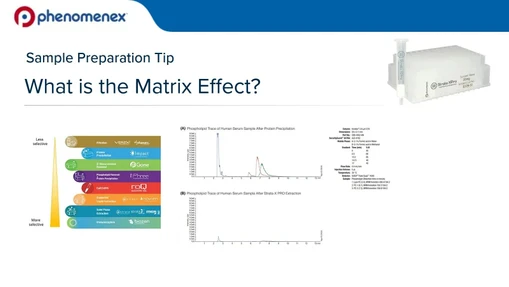
Sample Preparation Tip - What is the Matrix Effect?
Article | Academy

Sample Preparation Tip - What is the Matrix Effect?

Matrix effects can suppress or enhance analyte signals and compromise accuracy. Learn how sample prep techniques—especially SPE with Strata-X PRO—reduce phospholipid interference and improve LC-MS results.
We, 10.12.2025
Phenomenex
tag
share
more
Sample Preparation Tip - What is the Matrix Effect?
How is Normal Phase (NP) SPE Different from Reversed-Phase (RP) SPE?
Article | Academy

How is Normal Phase (NP) SPE Different from Reversed-Phase (RP) SPE?

A clear guide to Normal Phase SPE: when to use it, how polar interactions drive retention, and which solvents to choose in increasing polarity—plus a quick reference list for optimized sample preparation.
We, 3.12.2025
Phenomenex
tag
share
more
How is Normal Phase (NP) SPE Different from Reversed-Phase (RP) SPE?
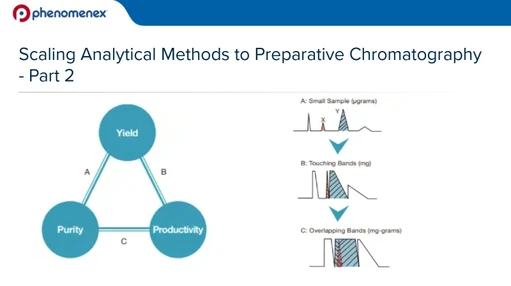
Scaling Analytical Methods to Preparative Chromatography - Part 2
Article | Academy

Scaling Analytical Methods to Preparative Chromatography - Part 2

Learn how to evaluate column loadability when scaling from analytical to preparative HPLC, and how to balance purity, yield, and productivity for optimal purification.
We, 26.11.2025
Phenomenex
tag
share
more
Scaling Analytical Methods to Preparative Chromatography - Part 2
What is the most appropriate way to approach scaling up your analytical method when transferring it to preparative chromatography scale? Part 1
Article | Academy

What is the most appropriate way to approach scaling up your analytical method when transferring it to preparative chromatography scale? Part 1

Learn how to balance purity, yield, and throughput when scaling analytical HPLC methods to preparative chromatography.
We, 19.11.2025
Phenomenex
tag
share
more
What is the most appropriate way to approach scaling up your analytical method when transferring it to preparative chromatography scale? Part 1
Basic Analytes and the Use of High pH Stable Stationary Phases
Article | Academy

Basic Analytes and the Use of High pH Stable Stationary Phases

Discover how hybrid HPLC materials extend pH stability up to 12, improving retention and peak shape for basic compounds. Learn how Gemini™ and Kinetex™ EVO columns enhance LC-MS/MS performance.
We, 12.11.2025
Phenomenex
tag
share
more
Basic Analytes and the Use of High pH Stable Stationary Phases
Overcoming Peak Tailing of Basic Analytes: Silica Type A Stationary Phases RP
Article | Academy

Overcoming Peak Tailing of Basic Analytes: Silica Type A Stationary Phases RP

Learn how to minimize peak tailing when analyzing basic compounds on type A silicas. Explore pH adjustment, mobile phase modifiers, and modern type B silica columns for sharper, more symmetrical peaks.
We, 5.11.2025
Phenomenex
tag
share
more
Overcoming Peak Tailing of Basic Analytes: Silica Type A Stationary Phases RP
Episode 4: Introducing a More Confident Era in HPLC-CAD Analysis
Article | Academy

Episode 4: Introducing a More Confident Era in HPLC-CAD Analysis

Discover the new Thermo Scientific Vanquish CAD P Series – the next evolution in HPLC detection. Improved sensitivity, method transfer tools, and real-time optimization.
Tu, 4.11.2025
Thermo Fisher Scientific
tag
share
more
Episode 4: Introducing a More Confident Era in HPLC-CAD Analysis
The Role of End-Capping in Reversed-Phase
Article | Academy

The Role of End-Capping in Reversed-Phase

Learn how silica end-capping improves HPLC column performance. Discover how C18, PS-C18, Polar C18, and XB-C18 chemistries enhance retention, peak shape, and selectivity for various analytes.
We, 29.10.2025
Phenomenex
tag
share
more
The Role of End-Capping in Reversed-Phase
The Use of Bio-Inert Hardware in the Analysis of Oligonucleotides
Article | Academy

The Use of Bio-Inert Hardware in the Analysis of Oligonucleotides

Discover how bio-inert HPLC hardware enhances oligonucleotide analysis. Learn how BioTi™ columns improve resolution, sensitivity, and reduce adduct formation compared to stainless steel.
We, 22.10.2025
Phenomenex
tag
share
more
The Use of Bio-Inert Hardware in the Analysis of Oligonucleotides
Episode 3: Understanding How Charged Aerosol Detection (CAD) Works
Article | Academy

Episode 3: Understanding How Charged Aerosol Detection (CAD) Works

Dive deeper into Charged Aerosol Detection (CAD) technology in HPLC. Learn how nebulization, evaporation, charging, and detection steps deliver consistent, mass-based quantification across analytes.
Tu, 21.10.2025
Thermo Fisher Scientific
tag
share
more
Episode 3: Understanding How Charged Aerosol Detection (CAD) Works
Other projects
GCMS
ICPMS
Follow us
FacebookX (Twitter)LinkedInYouTube
More information
WebinarsAbout usContact usTerms of use
LabRulez s.r.o. All rights reserved. Content available under a CC BY-SA 4.0 Attribution-ShareAlike