News from LabRulezLCMS Library - Week 28, 2025
LabRulez: News from LabRulezLCMS Library - Week 28, 2025
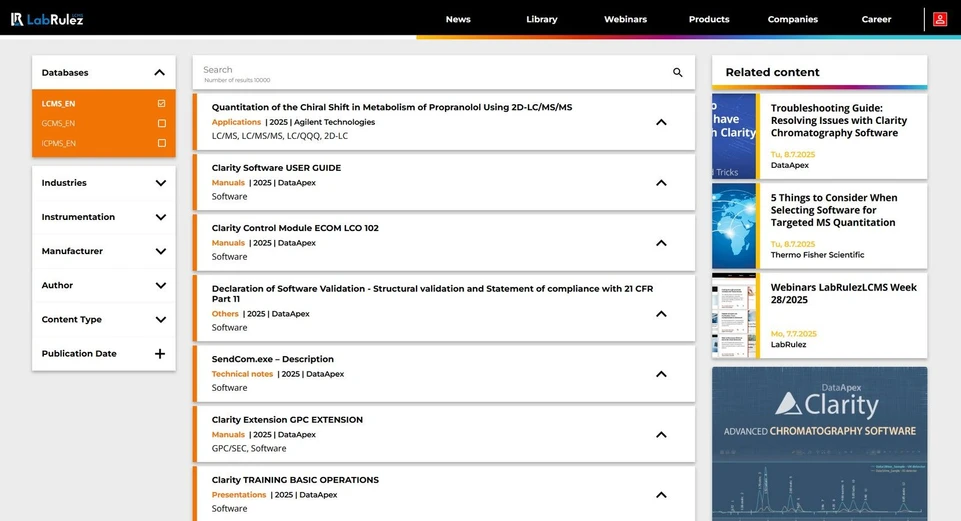
Our Library never stops expanding. What are the most recent contributions to LabRulezLCMS Library in the week of 7th July 2025? Check out new documents from the field of liquid phase, especially HPLC and LC/MS techniques!
👉 SEARCH THE LARGEST REPOSITORY OF DOCUMENTS ABOUT LCMS AND RELATED TECHNIQUES
👉 Need info about different analytical techniques? Peek into LabRulezGCMS or LabRulezICPMS libraries.
This week we bring you application note by Agilent Technologies and posters by Shimadzu / ASMS, Thermo Fisher Scientific / ASMS and Waters Corporation / ASMS!
1. Agilent Technologies: Rapid and Sensitive Analysis of Antifungal Agents in Human Serum Using the Agilent 6475 LC/TQ
- Application note
- Full PDF for download
In addition to minimizing drug-related toxicity, TDM has been hailed as a key step to prevent the emergence of drug resistance. The growing number of invasive fungal infections creates a ripple effect on the rapid advancement of TDM for antifungal agents. Increasing evidence confirms the critical role of TDM in preventing and treating antifungal infections.1 The RECIPE ClinMass TDM kit system for antimycotics in serum (Munich, Germany) was used on a 6475 LC/TQ for the analysis of eight antifungal agents. This application note demonstrates the evaluation and validation of the RECIPE TDM kit, covering sensitivity, linearity, and robustness across five consecutive days (n = 5). Quick and simple sample preparation was implemented, providing high-throughput monitoring of antifungal agents in biological samples.
Experimental
Instrumentation
- Liquid Chromatography System
- Agilent 1290 Infinity II High-Speed Pump
- Agilent 1290 Infinity II Multisampler
- Agilent 1290 Infinity II Multicolumn Thermostat
- Mass Spectrometry System
- Agilent 6475 LC/TQ
- Agilent Jet Stream Technology Ion Source (AJS)
Method
The optimization of multiple reaction monitoring (MRM) transitions for analytes and ISTDs was carried out using Auto MRM Optimizer in the Agilent MassHunter acquisition software to provide optimal sensitivity and selectivity. Data were processed using the Agilent MassHunter Qualitative Analysis software, version B.12, and Agilent MassHunter Quantitative Analysis software, version B.12.
Results and discussion
Figure 2 shows the chromatograms of quantifier MRM transitions for the eight antifungal agents at the lowest calibration level. Six out of eight antifungal agents had good chromatographic separation across the run time. The retention times of two antifungals, posaconazole and hydroxy-itraconazole, were slightly overlapped. Despite this overlap, measurement integrity can still be maintained due to MRM selectivity.
Conclusion
A fast and sensitive analysis of eight antifungal agents in serum was validated on an Agilent 6475 triple quadrupole LC/MS. By employing a ready-to-use RECIPE ClinMass TDM kit, this method demonstrates accurate and precise quantitation of antifungal agents in biological samples. Additionally, the streamlined sample preparation method allows high throughput analysis of up to 350 samples per day.
2. Shimadzu / ASMS: Robustness Evaluation of PFAS Analysis in Soil Using LC-MS/MS
- Poster
- Full PDF for download
Per- and polyfluoroalkyl substances (PFAS) are widely used in various fields and industries. However, due to their structural stability and resistance to degradation, they accumulate in the environment and are suspected of being harmful to humans. PFAS in soil can accumulate in the human body via agricultural products, thus it is essential to develop sensitive and robust analytical methods for the detection of PFAS in soil with complex matrices.1 This study shows a robustness evaluation by adding 30 PFAS to a soil matrix and using the LCMS-8060RX to measure these PFAS in the soil matrix 500 consecutive times.
Methods
For this analysis, LC-MS/MS equipped with a newly designed ESI source was used, and a delay column was installed between the mixer and the autosampler to inhibit the effects of PFAS contamination from the LC system. Six points calibration curves were built, and each calibration point was measured 3 times. A soil sample was prepared referring to part of the soil preparation procedures published by the National Agricultural and Food Research Organization. 2 Thirty PFAS compounds were spiked to the soil sample at 0.1 μg/L after pretreatment and 500 soil sample analyses were performed for the robustness evaluation. This sample contains more than 90% soil matrix. QC samples were also analyzed after every 20 injections of the soil samples.
Conclusion
The LCMS-8060RX performed 500 consecutive measurements of 30 PFAS spiked to a soil matrix sample. The results showed good peak area repeatability, good peak shapes, and good recovery. The newly designed ESI source showed excellent robustness, and stable analysis was achieved over a long period, even for samples with complex matrices.
3. Thermo Fisher Scientific / ASMS: Evaluation of a modified Orbitrap Astral Mass Spectrometer for label-free quantitation of proteomic samples
- Poster
- Full PDF for download
The demand for high-throughput proteomics analysis of complex samples is continually increasing, focusing on greater analysis depth and improved precision and accuracy in quantitation. Label-free quantitation of very complex proteomic samples poses significant challenges for mass spectrometers, requiring faster and more efficient processing of eluting peptide ions and their fragments. The new Orbitrap Astral Zoom mass spectrometer addresses these challenges, offering a higher acquisition rate by improved ion optics switching times and faster ion transfer, higher sensitivity due to ion pre-accumulation, and enhanced spectral processing, leading to deeper coverage with higher confidence.
Materials and methods
Vanquish Neo: Direct injection mode using 25cm x 75 μm ID Aurora Ultimate TS column (IonOpticks)
- High loads: 37min gradient; 4-45%B and injection-to-injection time 48min (30SPD)
- Low loads: 20min gradient; 1-40%B and injection-to-injection time 28min (50SPD)
Mass Spectrometer: Orbitrap Astral and Orbitrap Astral Zoom
- Orbitrap (MS1) and Astral (MS2) detectors
- Orbitrap: 240K; m/z range 380-980; AGC 500%; max IT 5ms
- NCE 25; Thermo Scientific FAIMS Pro Duo (low loads): -48V; gas 3.5 L/min
- Astral: DIA; window size depending on loads (in the tables below); m/z 150-2000; AGC 800% (low loads) or 100% (high loads); max IT depending on load; cycle time: 0.6s
Data Processing
- Spectronaut® v19.5 Direct DIA, 6 files (2 x 3 replicates) processed together for each load; all other settings were default
- Thermo Scientific Proteome Discoverer software 3.3.0.54, CHIMERYS 4.0.21
- Human, E.coli, and Yeast FASTA (all w/o isoforms) from UniProt; normalization by Human FASTA
Results (High Loads)
The new Orbitrap Astral Zoom mass spectrometer takes advantage of ion preaccumulation in the bent trap, increasing the effective MS2 injection time. Its reduced ion transfer overheads result in a higher MS2 acquisition rate of up to 270 scans per second. Additionally, an enhanced spectral processing algorithm was implemented to deconvolute overlapping spectral features in MS2, for better handling spectra with increased spectrum density.
Using Orbitrap Astral Zoom MS and Spectronaut® 19.5 software, there was a 12-17% increase in IDs at the precursor level, 10-15% at the peptide level (stripped sequence), and 4-9% at the protein groups level. With Proteome Discoverer software, the gain was 12-19% at the DIA precursor level, 12-17% at the peptide level, and 4-7% at the protein group level. The increase in identifications was primarily observed for low-abundant species. Orbitrap Astral Zoom mass spectrometer also yielded, on average, a 15% higher median number of MS2 data points per peak, while maintaining consistently high quantitation precision and accuracy at the MS2 level.
Conclusions
The novel Orbitrap Astral Zoom mass spectrometer demonstrates improved performance for qualitative and quantitative analysis of complex proteomics samples over a wide range of sample loads spanning four orders of magnitude, from 100 pg to 1µg.
4. Waters Corporation / ASMS: Investigating Fire Fighter and E-waste Handlers Exposure to PFAS Using Liquid Chromatography and Cyclic Ion Mobility Mass Spectrometry
- Poster
- Full PDF for download
PFAS are persistent environmental pollutants linked to health risks, including cancer. Monitoring their levels in human biofluids provides insight into exposure pathways. However, the analysis of PFAS isomers is technically challenging due to their structural similarity. To overcome this, the study employs LC coupled with cyclic ion mobility mass spectrometry (LC-cIM-MS) using the Waters SELECT SERIES Cyclic IMS, which adds a new separation dimension for better specificity.
Methods
Serum samples from Ghanaian firefighters and E-waste workers were prepared using solid-phase extraction (SPE) on 96-well µElution plates. A 22-minute reversed-phase LC gradient was used for separation. The Cyclic IMS system, with ion mobility resolution R~65 and 145, enabled non-targeted PFAS analysis, including the generation of collision cross section (CCS) values to support compound identification.
Results
- PFAS compounds such as PFOS, PFHxS, PFHpS, PFNA, and 6:2 FTS were identified in real serum samples.
- The cyclic IMS allowed for the separation of coeluting isobaric compounds, such as PFOS isomers and cholic acid biomarkers, minimizing false identifications (Figure 3).
- Figure 4 lists CCS values and other parameters for PFAS standards and identified analytes from a firefighter serum sample.
- Figure 5 shows ion mobility conformeric profiles for PFNA, enabling reliable identification even at low signal intensities.
Conclusion
The LC-cIM-MS method:
- Significantly improves specificity in PFAS identification.
- Enables both targeted and untargeted detection of known and unknown PFAS in complex human samples.
- Can be a key part of future occupational and environmental exposure assessments.