News from LabRulezLCMS Library - Week 25, 2026
LabRulez / AI: News from LabRulezLCMS Library - Week 25, 2026
Our Library never stops expanding. What are the most recent contributions to LabRulezLCMS Library in the week of 15th June 2026? Check out new documents from the field of liquid phase, especially HPLC and LC/MS techniques!
👉 SEARCH THE LARGEST REPOSITORY OF DOCUMENTS ABOUT LCMS AND RELATED TECHNIQUES
👉 Need info about different analytical techniques? Peek into LabRulezGCMS or LabRulezICPMS libraries.
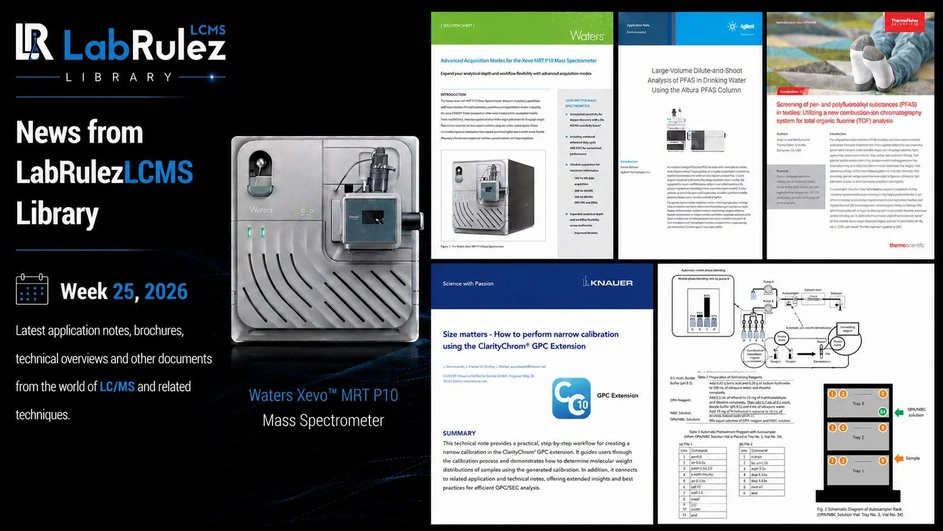
This week we bring you application notes by Agilent Technologies, Shimadzu and Thermo Fisher Scientific, technical note by KNAUER and brochure by Waters Corporation!
1. Agilent Technologies: Large-Volume Dilute-and-Shoot Analysis of PFAS in Drinking Water Using the Altura PFAS Column
- Application note
- Full PDF for download
Per‑ and polyfluoroalkyl substances (PFAS) are synthetic fluorinated compounds valued for their oil‑ and water‑repellent properties, but their environmental persistence and mobility have driven the development of increasingly stringent regulations for drinking water monitoring. Existing dilute-and-shoot methods, such as EPA 8327 and ASTM D7979, were originally designed for screening PFAS in nonpotable water. These methods typically rely on 10 to 30 µL injection volumes, setting practical quantitation limits appropriately 10 ng/L.1,2
We present a large‑volume injection workflow that extends the capabilities of these methods toward trace PFAS quantitation in drinking water. Using the Agilent 6495D triple quadrupole LC/MS (LC/TQ) coupled with a 1290 Infinity II LC, we achieved injections of 200 µL of methanol‑diluted water on the Altura PFAS column without requiring SPE concentration. The Altura PFAS column maintained peak symmetry and retention stability under these injection conditions. This configuration enabled a working calibration range of 0.25 to 25 ng/L, extending the low-end sensitivity substantially relative to published dilute-and shoot methods.1,2
This performance enhancement simplifies operations by removing labor‑intensive extraction steps, while maintaining sensitivity required for regulatory guidelines thereby supporting high‑throughput PFAS workflows suitable for routine drinking water analysis. The PFAS compounds analyzed were PFBS, HFPO-DA, PFHpA, PFHxA, PFHxS, PFOA, PFOS, PFNA, and PFDA. These compounds were selected due to their relevance to ongoing regulatory actions and proposed maximum contaminant level (MCL) considerations for drinking water.
Specific highlights of this experiment include:
- Minimized peak tailing and solvent effects with 200 µL injections water/methanol (1:1) injections.
- Increased throughput by elimination of solid phase extraction (SPE).
- Enhanced sensitivity of 6495D LC/TQ at low end (0.25 ng/L) for the dilute-and-shoot method in drinking water.
Experimental
Instrumentation
Agilent 1290 Infinity II LC coupled to Agilent 6495D LC/TQ system was utilized for the LC/MS/MS analysis. An Infinity II multisampler with an extended multidraw capillary tube (G7137-68307) was connected to the needle seat and injection valve with a union for large volume injection (200 µL). The data were acquired with MassHunter acquisition software version 12.2. All LC/MS parameters are shown in Table 1 and 2. PFAS multiple reaction monitoring (MRM) transition methods were imported from the PFAS MRM database (G1736AA) while labelled homologues were optimized to obtain correct MRM transitions (Table 3).
Conclusion
This study demonstrates a practical large‑volume dilute-and-shoot workflow for the determination of PFAS in drinking water using the Agilent 1290 Infinity II LC coupled to the 6495D triple quadrupole LC/MS, and Agilent Altura Poroshell PFAS column. With 200 µL water samples diluted in methanol can be injected directly, eliminating the need for SPE concentration and significantly reducing sample preparation time. This method exhibits good sensitivity, accuracy, and reproducibility. The Altura PFAS column maintained consistent peak performance and retention stability even at low sub‑ppt concentrations, supporting long‑term reliability for trace‑level PFAS monitoring. Overall, the findings highlight the method potential to support routine, high‑sensitivity PFAS monitoring in drinking water laboratories.
2. KNAUER: Size matters - How to perform narrow calibration using the ClarityChrom® GPC Extension
- Technical note
- Full PDF for download
Gel Permeation Chromatography (GPC), also known as Size Exclusion Chromatography (SEC), is a separation technique that separates molecules based on their hydrodynamic size rather than chemical interactions. In a GPC column, separation is based on the ability of molecules to access the pores of the stationary phase. Smaller molecules can penetrate these pores and therefore spend more time inside the column, resulting in a delayed elution. Larger molecules, on the other hand, cannot enter the pores and pass through the column more quickly, leading to earlier elution.
As a result, molecules are separated by size in solution, providing the basis for the determination of molecular weight and molecular weight distributions. Calibration is therefore a fundamental requirement for ensuring the accuracy and reliability of the results. The ClarityChrom® GPC Extension enables users to efficiently create and apply different calibration models for precise analysis. The workflow presented here focuses on narrow calibration using standards with defined molecular weights and low polydispersity (PD ≈ 1).
Material and Methods
- Software
- ClarityChrom® 10.1 - station single instrument license one time base
- ClarityChrom® 10.1 - GPC license for GPC data processing
- Pump: AZURA P 6.1L isocratic HPLC pump with 10 ml pump head for normal phase applications, stainless steel
- Degasser: Analytical 2 channel GPC degasser
- Autosampler: AZURA® AS 6.1L, analytical HPLC autosampler, 862 bar
- Detector: AZURA® RID 2.1L, analytical refractive index detector
- Thermostat: AZURA® CT 2.1 ATC00 Capillaries Start-Up Kit with flexible, precut capillaries for analytical HPLC systems with 1/16" connections
Conclusion
This technical note demonstrates how to successfully create and apply a narrow calibration using the ClarityChrom® GPC Extension. By following the outlined workflow, users can ensure reliable calibration and determination of molecular weight and molecular weight distributions. The described approach supports consistent and reproducible results, making it a valuable tool for routine GPC/SEC analysis. For further optimization and advanced applications, additional related technical and application notes can be consulted.
3. Shimadzu: UHPLC Method for Sensitive Automatic Analysis of Thirty-Seven D/L-Amino Acids and for Liquor Profiling
- Application note
- Full PDF for download
User Benefits
- Enables high-sensitivity simultaneous fast analysis of thirty-seven D/L-amino acids using simple operations.
- Good reproducibility of analytical results can be achieved by keeping the derivatization reaction time constant.
- Statistical analysis software enables easy multivariate analysis of multiple samples.
Recent advances in analytical techniques have revealed the presence of D-amino acids in fermented foods and biological samples and clarified their role in the taste, preservation, and aroma of foods , and as potential disease biomarkers. Therefore, the demand for D/L separation of amino acids is increasing. Because D-amino acids are only present in trace amounts in fermented foods and biological systems, unlike L-amino acids, it is necessary to determine the concentration of each D-amino acid by separating them from the high concentrations of Lamino acids.
A comprehensive method for quantitating the thirty-seven D/Lamino acids was previously reported1), in which two chiral derivatizing reagents were employed to provide different diastereomers for each amino acid, with the instrument automatically switching between two separation methods to analyze each sample twice.
This article introduces an improved method that employs a single chiral derivatizing reagent to enable simultaneous analysis of D/L-amino acidsin a shorter time.
D/L-Amino Acid Analysis by UHPLC
In general, LC/MS or multi-dimensional LC is used to analyze D/L-amino acids by HPLC, because it is difficult to separate proteinogenic D/L-amino acids with a single separation mode. However, it is known that LC/MS is susceptible to matrix effects and less quantitative than HPLC. It is also known that the multidimensional LC method requires a long analysis time and very complicated HPLC setup. Therefore, a simple operational method that provides good separation for D/L-amino acids in a short time is needed.
For food analysis, a small particle column is used to achieve appropriate separation of the small amounts of D-amino acids from the large amounts of L-amino acids and co-existing contaminants. A UHPLC system (Nexera X3) was employed in this study due to the increased system pressure caused by the use of a small particle column.
Conclusion
A method was developed for simultaneous separation of OPA/NIBC diastereomers for thirty-seven D/L-amino acids using a simple UHPLC system in approximately half the time of the conventional methods. By optimizing the derivatization reaction, all compounds were determined sensitively, accurately, and precisely. Separation of the target compounds from the contaminants was good in the liquor samples when evaluated using real liquor samples. It is expected to be easily applicable to D/L-amino acid profiling in food and beverage samples without using expensive MS detection or complicated multidimensional HPLC configurations as long as samples are prepared properly. Moreover, D/L-amino acid profiling could be used to research and develop foods containing D-amino acids intended to help to maintain and improve the intestinal environment, and could help in the early detection of diseases and determining optimal treatment strategies through biomarker discovery
4. Thermo Fisher Scientific: Screening of per- and polyfluoroalkyl substances (PFAS) in cosmetics: Utilizing a new combustion-ion chromatography system for total organic fluorine (TOF) analysis
- Application note
- Full PDF for download
This application note describes a method for screening per- and polyfluoroalkyl substances (PFAS) in textiles using total organic fluorine (TOF) analysis by combustion-ion chromatography (C-IC). PFAS are widely used in textiles to provide water, oil, and stain resistance, but increasing concerns about their environmental persistence and potential health effects have led to stricter regulations worldwide. California’s AB 1817 legislation, for example, limits TOF concentrations in textiles to 100 ppm beginning in 2025 and 50 ppm by 2027, creating a need for reliable analytical methods capable of assessing PFAS content in textile products.
The study evaluates a new Thermo Scientific Cindion Combustion Ion Chromatography System, which combines a Dionex Inuvion IC system with a Cindion combustion/absorption module. The system features an optimized Z-fold combustion tube design that improves combustion efficiency, shortens analysis time, reduces instrument footprint, and allows complete control through Chromeleon software. Unlike surface-sensitive techniques such as PIGE, the combustion-IC approach analyzes the entire sample, providing results that are independent of sample thickness. The method measures total fluorine (TF) after combustion and total inorganic fluorine (TIF) by direct IC analysis, with TOF calculated as the difference between TF and TIF.
To validate the approach, six textile samples representing waterproof and stain-resistant consumer products were analyzed and compared with results previously obtained using a Nittoseiko combustion-IC system. TOF concentrations ranged from approximately 1 ppm in one nylon fabric to nearly 375 ppm in a polyester baby bib. The values generated by the new Cindion system showed excellent agreement with the reference system, achieving between 100% and 105% of the previously reported results. Reproducibility was also strong, with relative standard deviations below 8% for all samples.
The authors conclude that the new Cindion C-IC platform provides an accurate, reliable, and efficient solution for PFAS screening in textiles. In addition to matching the performance of the established combustion-IC method, the enhanced system offers a flexible “2-in-1” configuration that allows seamless switching between combustion-IC and standalone IC operation. This improves workflow efficiency, reduces manual intervention, and provides manufacturers and testing laboratories with a practical tool for monitoring compliance with evolving PFAS regulations in textile products.
5. Waters Corporation: Advanced Acquisition Modes for the Xevo MRT P10 Mass Spectrometer
- Brochure
- Full PDF for download
The Waters solution sheet introduces the Xevo MRT P10 Mass Spectrometer, a next-generation high-resolution mass spectrometer designed to provide significantly greater analytical depth, sensitivity, and flexibility for modern omics workflows. Compared with the previous Xevo MRT platform, the instrument delivers a reported 20-fold increase in MS/MS sensitivity, incorporates Wideband Enhanced Duty Cycle (WB EDC) technology, and supports ultrafast acquisition rates of up to 100 Hz for MS data and 200 Hz for MS/MS data. These performance improvements are intended to enhance the detection of low-abundance compounds while maintaining high-quality spectral information across complex biological samples.
A major focus of the document is the introduction of the new SONAR Pulse Acquisition Mode, an advanced data-independent acquisition (DIA) approach. SONAR Pulse improves selectivity by rapidly stepping a quadrupole isolation window across a defined precursor mass range, allowing fragment ions to be associated with narrower precursor windows than in conventional DIA experiments. This strategy reduces spectral complexity, improves confidence in compound identification, and increases the likelihood of detecting low-level analytes that might be missed by traditional data-dependent acquisition (DDA) methods. The method supports precursor and product ion scans up to m/z 2000, multiple quadrupole isolation window sizes, acquisition speeds up to 200 Hz, and full compatibility with WB EDC technology.
The second major innovation described is Mixed Mode Acquisition, a hybrid workflow that combines targeted and untargeted analysis within a single injection. In this approach, high-sensitivity Tof MRM quantification is performed simultaneously with untargeted DIA (MSE) acquisition. This enables users to obtain quantitative data for predefined targets while also collecting comprehensive full-scan information for discovery and screening purposes. The workflow integrates seamlessly with Waters software tools, allowing targeted quantification through the MS Quan application and untargeted analysis through UNIFI or export to open data formats such as mzML for processing in third-party software packages including MZmine, MS-DIAL, DIA-NN, PEAKS, and Progenesis QI.
According to Waters, both acquisition strategies are designed to maximize information obtained from each sample injection. SONAR Pulse emphasizes deeper molecular coverage, improved selectivity, and simplified interpretation of complex DIA datasets, while Mixed Mode provides a unified quantitative–qualitative workflow that combines targeted measurement and discovery screening without compromising sensitivity or acquisition speed. Together, these capabilities position the Xevo MRT P10 as a versatile platform for metabolomics, lipidomics, proteomics, and other multiomics applications where both comprehensive characterization and accurate quantification are required.